How it works
Documentation · Getting started · Core concepts
One command prints 98,000 tokens. The agent needs one traceback.
This sounds like a compression problem. It is not. Compression asks how to make the 98,000 tokens smaller. The agent problem is different:
Which facts deserve to stay in the prompt, and how can everything else remain addressable while retained?
That distinction determines the architecture.
Handles address immutable stored bytes. Model-visible retrieval is still bounded and subject to the current redaction policy.
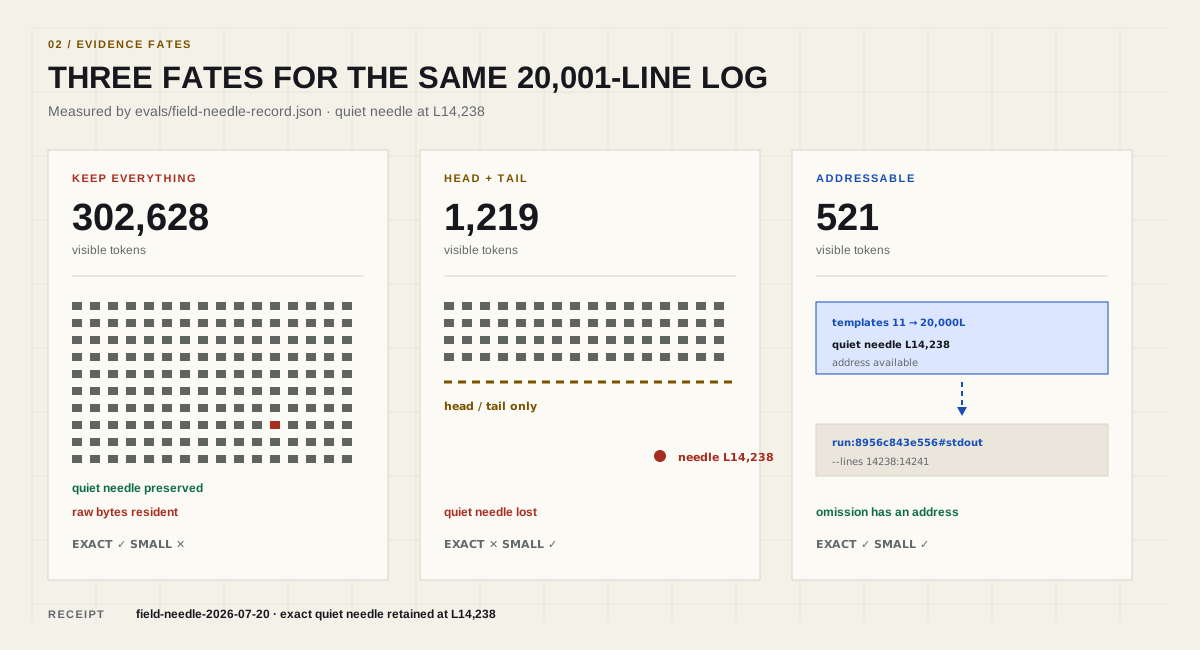
The ordinary path
Section titled “The ordinary path”Consider a failing test run near the start of a debugging session:
turn 1 read teststurn 2 run pytest ──→ 98,000 tokens enter the transcriptturn 3 inspect implementation ──→ the log is sent againturn 4 inspect caller ──────────→ the log is sent againturn 5 edit ────────────────────→ the log is sent againturn 6 rerun ──────────────────→ the old log is still thereturn 7 debug ──────────────────→ both logs are now thereThe test process produced the bytes once. The conversation rents them on every later turn.
Eventually the host compacts the transcript. Now the system has paid to carry the log repeatedly and may still lose the only line that matters. It combines the cost of preservation with the semantics of deletion.
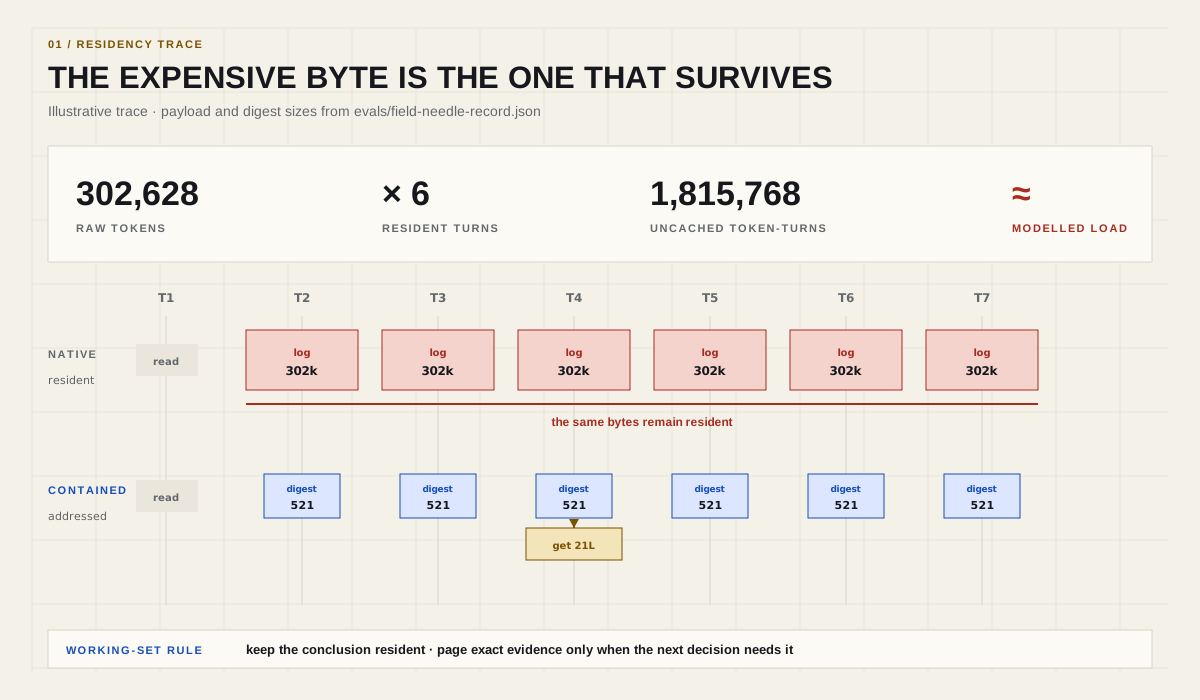
The contained path
Section titled “The contained path”ctx run -- pytest -qThe command still runs. stdout and stderr stream into a local content-addressed artifact. They do not first pass through the model.
A pytest profile extracts typed facts:
- command outcome;
- failed test identities;
- source locations;
- traceback spans;
- coverage of the failure census.
The delivery layer renders those facts within a fixed budget:
[ctx run:8d8335db6848 profile=pytest/v2]exit: 1stdout: 4,102 lines · 402.1 KiB · est 98,000 tokensfailures: tests/test_auth.py::test_token_expiry tests/test_auth.py:42coverage: identities: 1/1 omitted: 4,098 linesnext: ctx get run:8d8335db6848#stdout --lines 1280:1300The model receives the failure, its location, an honest omission count, and the next useful read. The artifact store keeps the rest.
The fields vary by profile. A separate, receipt-derived log specimen makes the contract visible:
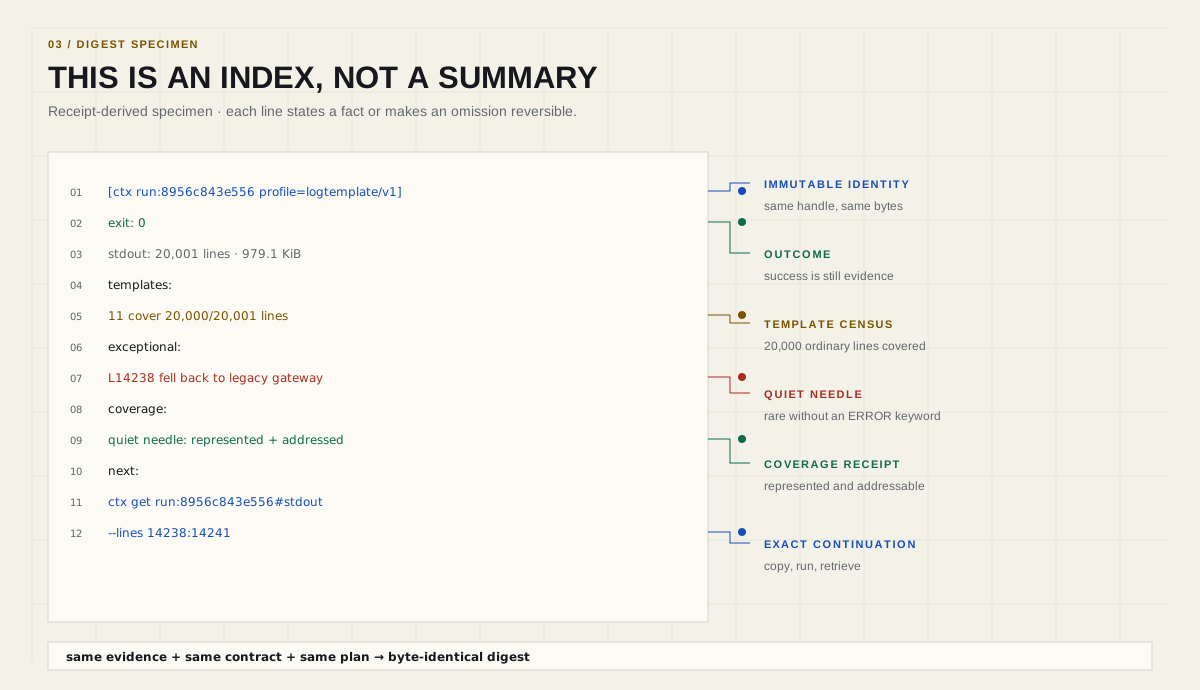
The digest is not a lossy replacement. It is the first page of a lossless protocol.
Why not summarize it?
Section titled “Why not summarize it?”A language-model summary has three bad properties for this job:
- it is probabilistic;
- it cannot prove which identities it omitted;
- it cannot recover exact omitted bytes by itself.
straitjacket uses profiles and evidence contracts instead.
A profile understands the output family. A contract defines three classes:
- Required facts must remain represented.
- Elastic detail may expand or contract with the budget.
- Retrievable evidence may stay outside context only when a valid address exists.
The renderer produces a coverage receipt before it declares success.
identities: 37/37inline detail: 5/37retrievable detail: 32/37unrepresented required facts: 0A 200-token digest with 36 missing failures is not a win. It is a small bug.
Retrieval is a page fault
Section titled “Retrieval is a page fault”If the model needs the traceback:
ctx get run:8d8335db6848#stdout --lines 1280:1300If it needs a named error:
ctx search run:8d8335db6848 "MissingTenantError"The prompt acts like a small working set. The artifact store acts like durable backing storage. A handle connects them.
The comparison is operational, not metaphorical: retrieval happens only on demand, returns a bounded page, and may return a narrower continuation rather than materialize an oversized region.
Determinism is a billing feature
Section titled “Determinism is a billing feature”Two identical failures should render identically.
straitjacket normalizes volatile details such as terminal decoration, temporary paths, and irrelevant timing fields where the profile permits it. The same evidence, contract, and delivery plan produce the same digest bytes.
That buys:
- stable prompt prefixes;
- meaningful run-to-run diffs;
- reproducible evaluation;
- no model call on the digest hot path.
ctx diff run:8d8335db6848 run:5a67c9de0123 can then report the behavioural delta instead of asking the model to compare two logs in attention.
Capture has to happen before the flood
Section titled “Capture has to happen before the flood”Once 98,000 tokens enter the transcript, any repair mechanism is late.
ctx setup installs a birth-time classifier. It separates operations into four practical classes:
known bounded read ─────→ pass throughknown noisy read ───────→ rewrite through ctx captureknown mutation ─────────→ preserve approval boundaryunknown operation ──────→ apply configured guard policySupported hosts also provide an entry-time safety net for oversized results that were not predictable from the call itself.
Host contracts are not equal:
| Host | Pre-execution | Post-execution |
|---|---|---|
| Claude Code | can rewrite arguments | can replace output |
| Codex | implemented and contract-tested | implemented and contract-tested; live CLI receipt pending |
| Antigravity | can allow or deny, not rewrite | cannot replace output |
On Antigravity, straitjacket denies a known flood and returns the bounded replacement command. That costs a turn, but prevents the bytes. A large connector result can only be observed after return because the host exposes no replacement field. See Host capabilities.
There are four places to act
Section titled “There are four places to act”Every byte has a short career:
- Birth — an operation is about to produce it.
- Entry — it crosses a tool or host boundary.
- Residence — it occupies active context over later turns.
- Emission — the model may paste it into a deliverable.
One store serves all four gates, but the policy differs:
- prevent predictable floods at birth;
- catch unpredicted floods at entry;
- preserve only decision-relevant views in residence;
- cite evidence instead of reciting it at emission.
The earlier the gate, the cheaper the intervention.
Live files need stronger addresses
Section titled “Live files need stronger addresses”An immutable run handle always means the same bytes. A repository line address does not.
Suppose the model records src/auth.py:40:52. Another edit inserts six lines above it. The same coordinates now return different code with exit status zero.
That is worse than a missing address. It is plausible false evidence.
straitjacket adds a short content anchor:
ctx get repo:src/auth.py --lines 40:52@07407f1cResolution follows three steps:
content still at 40:52? ── yes ─→ return it │ no ▼same content moved? ───── yes ─→ return new location and report the move │ no ▼refuseThe address names content first and position second.
Bounded investigation, not bounded intelligence
Section titled “Bounded investigation, not bounded intelligence”Containment does not mean starving the model. It means moving deterministic work out of the conversation.
If five searches are already known, ctx seq can run them beside the repository. If the question has a typed shape, ctx ask can compile it. If the investigation is a bounded DAG, ctx plan run can execute it locally and return one causally organized digest.
This removes scheduling, parsing, and joining from the expensive conversational loop. It does not precompute through uncertainty.
Batch within one hypothesis. Return when evidence can change the hypothesis.
That boundary matters. A perfectly optimized investigation of the wrong theory is still wrong.
The honest boundary
Section titled “The honest boundary”straitjacket contains evidence. It does not sandbox execution.
Commands run with the invoking user’s authority. A captured deletion is still a deletion. A deterministic digest is not a security boundary. The guard preserves mutation approvals; it does not launder mutations into reads.
It also does not promise that every task improves. Small outputs should pass through. Cheap, already-bounded operations may be faster natively. The evaluation suite includes these losing regimes because the correct policy is conditional.
The whole design in one sentence
Section titled “The whole design in one sentence”Keep complete evidence outside the prompt, keep decision-relevant facts inside it, and keep exact addresses between them.