Skip to content

Anvil

Anvil compiles an API spec into four artifacts that stay in sync: a CLI, an MCP server, an agent skill, and enforcement hooks. It reads the specs you already have — OpenAPI, SOAP, gRPC, GraphQL, and Postman — plus explicitly tiered gateway-assessment inputs. WSO2 estates and one Kong declarative state are native inputs; Apigee, MuleSoft, and IBM API Connect currently require documented normalized interchange. Every operation carries the same risk, idempotency, and approval rules on every surface, and none reaches an agent until a person approves it.

Most enterprise APIs don’t live in a git repo. They live behind a gateway, and the gateway holds details the spec leaves out: which auth plugin fronts an operation, which scopes a product grants, where quotas apply, and which requests get rewritten in flight.

Anvil inventories the catalog of APIs behind your gateway — its estate — then lets you adopt selected APIs through the same approval-gated compiler path as a hand-written OpenAPI file. Five offline adapters read explicitly documented interchange shapes. Kong declarative config is direct; WSO2 accepts its native apictl export apis directory, per-API ZIP/project, or standalone api.yaml. Apigee, MuleSoft, and API Connect currently require the normalized documents described in the import guide.

Terminal window
# 0. Verify the accepted bytes and proof tier before preparing an export
anvil estate support apigee
# 1. Inventory, audit, and create a triage plan — without compiling an API
anvil estate inventory payments.apigee.normalized.yaml --vendor apigee
anvil estate audit payments.apigee.normalized.yaml --vendor apigee
anvil estate plan payments.apigee.normalized.yaml --vendor apigee \
--gateway-id apigee-org-prod --init-selection estate-selection.yaml \
--out estate-adoption-plan.json
# 2. Pair one selected API with its real contract and gateway URL
anvil estate import payments.apigee.normalized.yaml --vendor apigee --api payments \
--gateway-id apigee-org-prod --strict-identity \
--revision 12 --environment prod \
--spec payments.openapi.yaml --gateway-url https://api.example.com/payments

Anvil safely opens supported ZIP/JAR containers: it refuses path traversal, symlinks, and decompression bombs. The archive reader is not a semantic translator—native Apigee proxy XML, Mule application JAR internals, and IBM x-ibm-configuration OpenAPI are not decoded by those adapters today.

If the adapter can’t fully read a gateway policy, it flags that policy for a human and holds the affected API back from shipping. Findings are owned by an API, route, or content-addressed artifact when the export proves that boundary, so one bad WSO2 project does not poison an unrelated selected API; genuinely estate-global parse or archive failures still fail closed. Nothing is ignored. What lands is an ordinary bundle, and the approval gate still stands between the API and the agent. New to this? Export your gateway, vendor by vendor →

An estate has 800 APIs. An agent should see five.

Section titled “An estate has 800 APIs. An agent should see five.”
  1. 01 The estate

    Roughly 800 APIs remain behind the gateway.

  2. 02 Inventory

    List the whole catalog cheaply before compiling anything.

  3. 03 Import

    Bring in only the handful of APIs that matter.

  4. 04 Capabilities

    Group related operations into review-sized units.

  5. 05 The agent

    Expose only the few approved operations it needs.

from the gateway's whole catalog to what the agent sees the estate inventory import capabilities the agent ≈800 800 handful a few 5 APIs behind the gateway list them all · cheap the handful that matter grouped · refunds, payments operations it can call the estate stays 800 wide; only a few operations ever reach an agent.
fig 10 · 800 APIs in the estate, five in the agent's hands

A production gateway holds hundreds of APIs, and almost none of them belong in an agent’s hands. Anvil is built for that ratio. inventory gives a bounded, filterable operator view; audit evaluates the complete estate; and plan creates a resumable, coordinate-aware triage queue. You then import the handful that matter, group their operations into review-sized capabilities (a capability is a set of related operations, like Refunds or Payments), and leave the other 795 where they are, behind the gate. How Anvil operates at scale →

Enterprises don’t lack APIs — they lack agent-safe ones. A payments spec says a refund moves money; a WSDL says a transfer can’t be undone. That information is in the spec, but hand-written wrappers usually drop it. Anvil compiles it in.

  1. Input Any supported spec

    OpenAPI, Swagger, GraphQL, gRPC, SOAP, Postman, Discovery, or a gateway export.

  2. 01 Compile

    Parse, classify, and validate every operation.

  3. 02 AIR

    Hold effect, risk, idempotency, auth, and approval in one shared model.

  4. Gate Approve deliberately

    Unapproved operations never reach a generated surface.

  5. Out Project together

    Generate the CLI, MCP server, skill, and harness hooks from that same contract.

any spec or gateway estate OpenAPI 3.x Swagger 2.0 GraphQL SDL gRPC · proto3 SOAP · WSDL Postman Collection Google Discovery Gateway estates apigee · kong · wso2 · mulesoft · ibm api connect anvil compile parse · classify · validate AIR one shared model effect · action · risk reversibility idempotency · retries confirmation · approval tier auth · structured errors approval gate · unapproved ops never ship generated tools CLI typed commands · --dry-run · --confirm for engineers, pipelines, and agents alike MCP server one tool per approved operation risk visible in every tool's annotations Skill the operating manual agents actually read capabilities → operations → workflows Harness hooks Antigravity · Claude Code · Codex deny pre-flight · escalate to a human
fig 01 · one spec in, four aligned tools out — regenerated together, so they cannot disagree

Everything on the right is generated from the one model in the middle. Nobody hand-writes the CLI, the MCP tool descriptions, or the skill — so nobody can forget that a refund needs an idempotency key (a token that makes a repeated call safe: run it twice, it still counts once) in one place but not another.

The problem isn’t writing wrappers. It’s keeping them in sync.

Section titled “The problem isn’t writing wrappers. It’s keeping them in sync.”

Any team can wrap an API for one demo. The failure mode arrives six months later, when the CLI wrapper retries a payment the MCP wrapper wouldn’t, and the runbook says a third thing.

  1. Drift Separate wrappers guess

    The CLI, MCP tool, and runbook can assign different retry and confirmation rules to one refund.

  2. AIR One contract decides

    Anvil records the refund as financial, irreversible, and idempotency-key protected once.

  3. Align Every surface agrees

    The CLI, MCP tool, and skill regenerate with the same confirmation, key, and retry behavior.

without anvil — the wrapper factory payments.yaml CLI wrapper retry: 3×, why not confirm: — MCP wrapper retry: none confirm: optional runbook / docs "should be safe to re-run…" three teams, three guesses about one refund — and they drift apart silently. with anvil — one model, generated payments.yaml AIR · refund financial · irreversible · key required CLI confirm ✓ key ✓ no auto-retry MCP tool confirm ✓ key ✓ no auto-retry Skill confirm ✓ key ✓ no auto-retry the same rules on every tool, enforced — regenerate, and they still can't disagree.
fig 02 · the drift problem — alignment is the product, not the code generation

A refund is a financial, irreversible mutation — money moves and you can’t take it back. Anvil reads that from the spec, and every generated tool enforces it: the call refuses to run without confirm: true and an idempotency key, and it’s never retried automatically.

Terminal window
anvil compile stripe-payments.yaml --manifest payments.anvil.yaml \
--human-approval unsafe --out generated/payments
anvil inspect generated/payments
# payments.refunds.create mutation · financial · irreversible
# confirmation: required (human approval) idempotency: required

With --human-approval unsafe, the generated hooks — scripts the agent harness runs before each tool call, in Antigravity, Claude Code, and Codex alike — escalate the refund to a person; a model-supplied confirm: true can’t clear the gate.

Hooks make enforcement cheap and early; the runtime makes it inescapable. Every check lives in the innermost ring that can enforce it — the outer rings buy speed and human escalation, never correctness.

  1. Core Runtime executor

    Authoritative and fail-closed: confirmation, idempotency, retries, egress, and redaction.

  2. 02 Generated CLI and MCP

    Only approved operations exist on either callable surface.

  3. 03 Harness hooks

    Fail-open preflight catches problems early and can escalate to a person.

  4. Human Approval tier

    A model cannot clear an operation that is configured to require human approval.

ring 3 · harness hooks — antigravity · claude code · codex fail-open · denies before the model burns a turn · escalates to a human ring 2 · generated tools — cli · mcp server only approved operations exist here at all ring 1 · runtime executor — authoritative, fail-closed confirmation gate · idempotency ledger · retry policy egress pinning · secret redaction Human approval tier anvil compile --human-approval unsafe manifest · human_approval true per operation or by risk class hooks answer ask / force_ask — the model cannot approve itself. remove every outer ring and the contract still holds — the runtime refuses.
fig 04 · defense in depth — hooks are the outer ring, never the only ring

One contract, enforced in Antigravity, Claude Code, and Codex — and visible to every MCP client.

The quality of the generated MCP server and skill is not asserted — each bundle demonstrates it about itself, with every record bound to the bundle’s content hash so stale evidence can never masquerade as current:

  • anvil selftest boots the generated mock and MCP server, then invokes every approved tool over the real MCP transport — arguments reach the wire faithfully, confirmation gates refuse before any side effect, and non-idempotent mutations are never auto-retried.
  • anvil conformance proves the skill, CLI, and MCP tool list agree — same operations, same handles, and a skill that documents the exact posture the runtime enforces. A skill that under-states a gate fails here.
  • anvil simulate drives the full safety matrix through a deterministic simulator, then deliberately weakens each safety control and proves the surface catches the mutant.
  • anvil certify is the static gate: byte-level surface agreement plus semantic checks (sibling operations may not share one description).
  • anvil benchmark scores agent-task completion — tool discovery, parameter satisfiability, call success — and gates CI with --check.

On the public-corpus gauntlet (5,500+ operations across Stripe, GitHub, Jira, Twilio, Slack, Coda, Zendesk, TM Forum, Coupa, Workday, Zoho, Oracle OPERA, and a 2004-era SOAP service), fully-driven bundles pass every lane — Coda: 72/72 selftest, 136/136 conformance, 504/504 simulation cells with 4/4 safety mutants killed, 134/134 benchmark tasks.

You never edit generated code and never fork the vendor spec. One declarative manifest layer reshapes the whole surface — rename operations, remodel a blocked end-user OAuth estate to per-caller token exchange with a single auth: { type: oauth2_on_behalf_of } line, enforce idempotency keys, replace a raw SQL passthrough with a constrained read-only query template — and anvil refine proposes evidence-gated improvements (descriptions, examples, intent phrases) that apply back to the model, never to one surface. Recompile, and the CLI, MCP server, and skill move together.

  1. 01 Compile

    Turn the source specification into one complete bundle.

  2. 02 Inspect

    Read risk, approval state, and the next safe action.

  3. 03 Enrich

    Supply evidence for gaps the source could not prove.

  4. 04 Approve

    Open only the operations whose contract you inspected.

  5. 05 Release

    Run static assurance and executable evidence, then prepare an operator deployment plan.

the working loop 01 Compile spec in, bundle out 02 Inspect read the risk 03 Enrich fill the gaps 04 Approve a human opens the gate 05 Release assure · exercise · plan and back · recompile when the spec drifts
fig 09 · the loop: compile, inspect, enrich, approve, release
Terminal window
# 1. Compile a spec into a full bundle (CLI + MCP + skill + hooks)
anvil compile <spec> --manifest <manifest> --out <dir>
# 2. Orient, then read every operation's effect, risk, and idempotency
anvil status <dir>
anvil inspect <dir>
anvil lint <dir>
# 3. Target the residue, then expose only what you have inspected
anvil distill <dir> --as-enrich-plan --write /tmp/anvil-enrich-plan.json
anvil approve <dir> <operation-id>
# 4. Package and statically assure the complete bundle, then exercise it
anvil package skill <dir>
anvil certify <dir>
anvil selftest <dir>
anvil conformance <dir>
anvil simulate <dir>
# 5. Verify the generated durable-write contract offline
anvil deploy ledger <dir> --project <project-id> --database <firestore-database>
# 6. Prepare the gated deployment plan; this makes no cloud call
anvil publish <dir> --env prod
anvil status <dir> # planned · operator-action-required

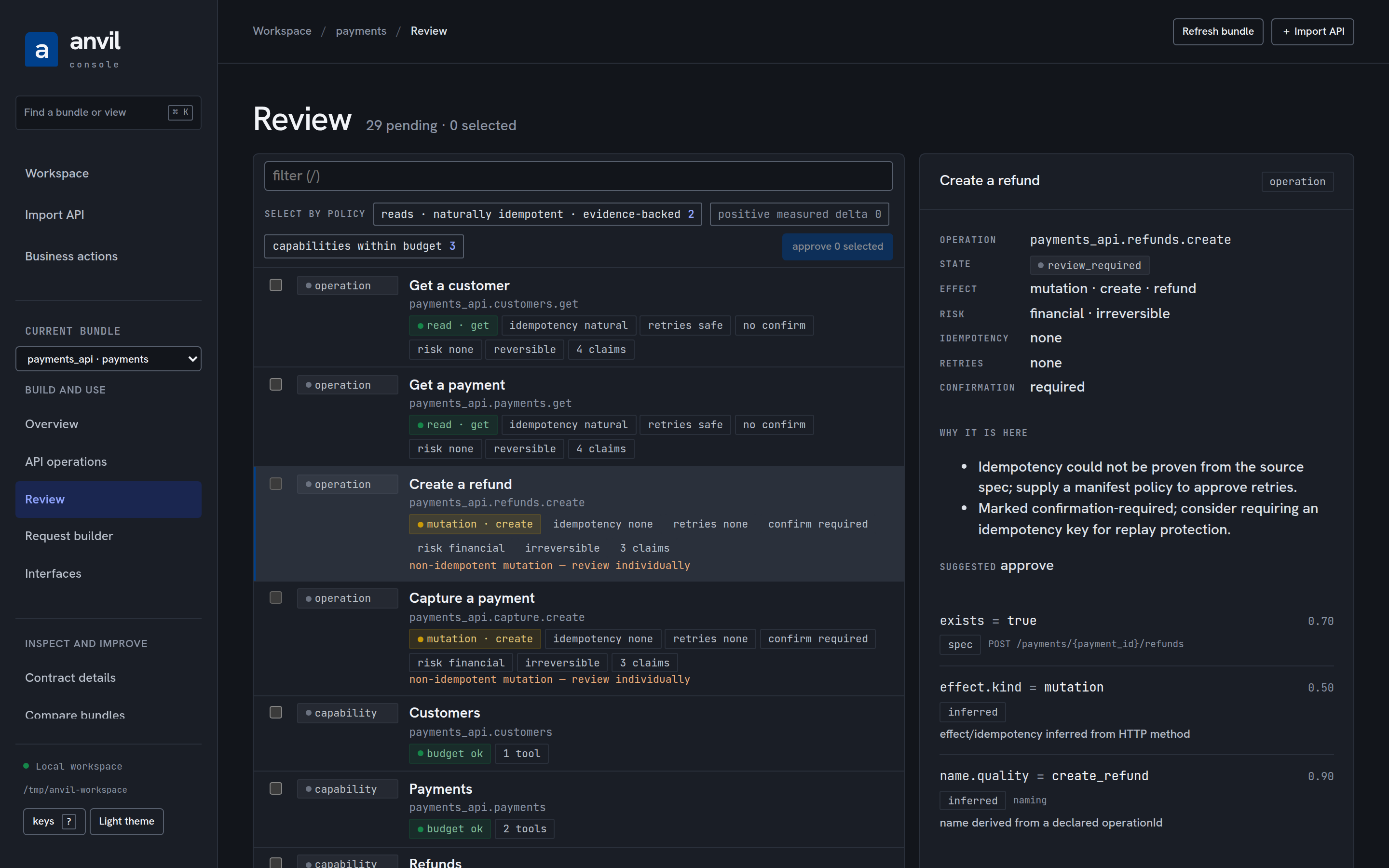
Mutations that can’t be safely repeated land as review_required — held for review, not exposed until a human approves them. That refusal is the point. certify proves static byte and contract coherence; the three following commands add executable evidence without changing the bundle digest. The compatibility verb publish requires all four fresh records for that digest and records their evidence snapshot in a plan. A non-production plan can explicitly waive incomplete executable evidence with --allow-incomplete-evidence; production fails closed. A plan never means deployed or live.

Set up in one sitting

Install Anvil is the copy-paste path from a fresh clone to a working anvil command — three commands, a version check, and a first compile to prove it runs.

Compile your own spec

The playground runs the real compiler in your browser — paste an OpenAPI document and watch every operation get classified. Nothing is uploaded.

For enterprises

The conversion playbook: pilot one API, template the pipeline, and map Anvil onto the governance you already run.

Operate it safely

Operating Anvil is the progressive-disclosure manual: the compile → enrich → approve → release loop and the safety rules.

Connect Gemini Enterprise

Choose Custom MCP or Agent Gateway, keep sign-in, MCP OAuth, gateway IAM, and upstream credentials separate, and use the supported project/location matrix.

Design notes

Hooks and plugins shows how the safety contract ships into Antigravity, Claude Code, and Codex.