Live Session Callbacks
Callbacks are how your application reacts to events from the Gemini Live API. The SDK routes events through two lanes with distinct performance contracts, and a third telemetry lane for usage metadata. Understanding the lanes prevents the most common audio-quality and deadlock bugs.
The Two-Lane Model
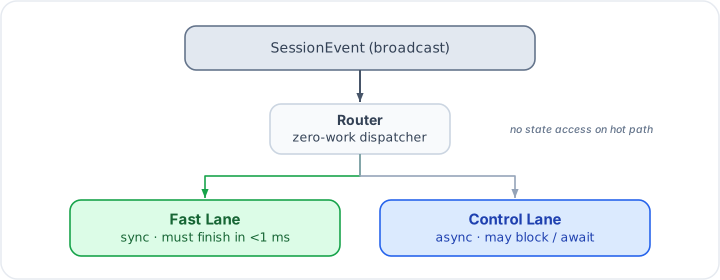
The router receives every incoming WebSocket event and dispatches it to the appropriate lane. It does zero work itself — no state reads, no allocations.
Fast lane callbacks are invoked synchronously on the dispatch thread. They
must complete in under 1 ms. No allocations, no mutex locks, no async work. A
channel try_send is acceptable; a channel send that can block is not.
Control lane callbacks run in a dedicated async task. They may perform I/O,
read shared state, call async functions, or do any other async work. Most
control-lane callbacks have a _concurrent variant that spawns the body as a
detached tokio task instead of blocking the control loop.
Fast-Lane Callbacks (sync, <1 ms)
Register these with the synchronous closure variants on Live::builder().
| Setter | Signature | Description |
|---|---|---|
.on_audio(f) | f: Fn(&Bytes) | Raw PCM audio chunk from the model (PCM16, 24 kHz, mono). Forward to a speaker buffer or channel. |
.on_text(f) | f: Fn(&str) | Incremental text delta as the model generates. Suitable for streaming display. |
.on_text_complete(f) | f: Fn(&str) | Full accumulated text for the current generation, delivered once per turn boundary. |
.on_input_transcript(f) | f: Fn(&str, bool) | ASR transcript of the user's speech. Second argument is is_final. |
.on_output_transcript(f) | f: Fn(&str, bool) | Transcript of the model's audio output. Second argument is is_final. |
.on_thought(f) | f: Fn(&str) | Thought summary chunk. Requires .include_thoughts(). Google AI only. |
.on_vad_start(f) | f: Fn() | Server-side VAD detected voice activity start. |
.on_vad_end(f) | f: Fn() | Server-side VAD detected voice activity end. |
.on_phase(f) | f: Fn(SessionPhase) | Session lifecycle phase changed (connecting, active, disconnecting, etc.). Use for lightweight UI state updates. |
.on_usage(f) | f: Fn(&UsageMetadata) | Token usage delivered after each generation. Fires on the telemetry lane (not the audio hot path), but shares the sync-only constraint. |
Partial and Final Transcript Semantics
Both on_input_transcript and on_output_transcript implement a streaming
ASR pattern:
- While speech is in progress, callbacks fire repeatedly with
is_final = false. Each delivery is the server's current best guess; earlier partial results may be revised. - At the turn boundary, a single callback fires with
is_final = truecarrying the complete, finalized transcript for the turn.
Only the is_final = true delivery is suitable for storage, downstream
processing, or display in a permanent transcript. Use is_final = false
deliveries for a live "typing" indicator or real-time captions.
.on_input_transcript(|text, is_final| {
    if is_final {
        println!("User said: {text}");  // commit to transcript
    } else {
        // update live caption display
    }
})
.on_output_transcript(|text, is_final| {
    if is_final {
        println!("Model said: {text}");
    }
})
The <1 ms Rule in Practice
// OK: try_send never blocks
.on_audio(|data| {
    playback_tx.try_send(data.clone()).ok();
})

// OK: atomic store
.on_vad_start(|| {
    is_speaking.store(true, Ordering::Relaxed);
})

// BAD: blocking send can stall the audio pipeline
.on_audio(|data| {
    blocking_channel.send(data.clone()).unwrap(); // DO NOT DO THIS
})

// BAD: async work requires spawning, not direct await
.on_text(|text| {
    // Cannot .await here — the closure is sync
    database.insert(text).await;  // compile error anyway
})
Fast-lane delivery policy (backpressure)
Internally the router forwards fast-lane events over a bounded channel. By default delivery is lossless — if a downstream consumer falls behind, the router awaits, which is the safe default but can stall routing under sustained back-pressure. For voice apps where a dropped frame is better than a stalled pipeline, opt into a lossy policy per event class:
use gemini_adk_rs::live::{Delivery, DeliveryConfig};

Live::builder()
    // Convenience setters for the common cases:
    .lossy_audio()          // drop newest audio frame instead of stalling
    .lossy_transcript()
    // …or configure every class explicitly:
    .delivery(
        DeliveryConfig::default()
            .audio(Delivery::LossyDropNewest)
            .transcript(Delivery::LossyDropNewest),
    )
Delivery::Lossless (the default for every class) is byte-for-byte the historical
behavior. Delivery::LossyDropNewest uses a non-blocking try_send and drops the
newest frame when the channel is full, bumping an internal dropped-frame counter
rather than blocking the router. Control-lane events (tool calls, turn/generation
completion, etc.) are always lossless. Per-class classes are audio, text,
transcript, thought, vad, and phase.
Control-Lane Callbacks (async, may block)
These are registered with async-closure variants. The control lane awaits each blocking callback in sequence; concurrent variants are spawned as detached tasks.
Lifecycle Callbacks
| Setter | Signature | Description |
|---|---|---|
.on_connected(f) | f: Fn(Arc<dyn SessionWriter>) -> impl Future | Fires when the WebSocket setup completes. The SessionWriter can be cloned and stored for sending messages from outside callbacks. |
.on_disconnected(f) | f: Fn(Option<String>) -> impl Future | Fires on disconnect. Some(msg) indicates an error close; None is a clean close. |
.on_go_away(f) | f: Fn(Duration) -> impl Future | Server sent a GoAway signal with a time-to-disconnect hint. Save state and prepare for reconnect. |
.on_resumed(f) | f: Fn() -> impl Future | Fires after a session resumes from a persisted snapshot. Use to re-subscribe to external streams or reset UI state. Requires .persistence(...) on the builder. |
.on_error(f) | f: Fn(String) -> impl Future | Non-fatal error from the server or processor. The session continues. |
.on_interrupted(f) | f: Fn() -> impl Future | Model output was interrupted by barge-in. Flush your playback buffer here. Forced blocking — no _concurrent variant. |
Tool Callbacks
| Setter | Signature | Description |
|---|---|---|
.on_tool_call(f) | f: Fn(Vec<FunctionCall>, State) -> impl Future<Output = Option<Vec<FunctionResponse>>> | Model requested tool execution. Return None to use auto-dispatch (ToolDispatcher); return Some(responses) to override. Receives the shared session State. Forced blocking — no _concurrent variant (return value is the tool response). |
.on_tool_cancelled(f) | f: Fn(Vec<String>) -> impl Future | Server cancelled pending tool calls. Argument is the list of cancelled call IDs. Use to clean up in-flight async work. |
Turn and Generation Callbacks
| Setter | Signature | Description |
|---|---|---|
.on_turn_complete(f) | f: Fn() -> impl Future | Turn boundary reached — the model has finished its (possibly truncated) response for this turn. |
.on_generation_complete(f) | f: Fn() -> impl Future | Model finished its full intended response before any interruption truncation. |
on_generation_complete vs on_turn_complete
These two callbacks mark different points in the generation lifecycle:
-
on_generation_completefires on the wireGenerationCompleteevent, which arrives before interruption truncation is applied. If the user interrupts mid-response,on_generation_completestill delivers a notification about the complete intended output. Pair this with.extract_on_generation::<T>(llm, "...")to run a structured extractor against the model's full text before truncation. -
on_turn_completefires at the turn boundary after any truncation. Use this for turn-level bookkeeping: transcript commits, phase evaluation, extractor runs triggered by.extract_turns(), and downstream signals.
Live::builder()
    // Capture full intent even when user interrupts
    .extract_on_generation::<FullIntent>(llm, "Extract model's intended action")
    .on_generation_complete(|| async {
        println!("Generation complete (pre-truncation)");
    })
    // Normal turn-level work
    .on_turn_complete(|| async {
        println!("Turn complete (post-truncation)");
    })
Extraction Callbacks
| Setter | Signature | Description |
|---|---|---|
.on_extracted(f) | f: Fn(String, serde_json::Value) -> impl Future | An out-of-band extractor produced a result. First argument is the schema type name; second is the extracted JSON value. |
.on_extraction_error(f) | f: Fn(String, String) -> impl Future | An extractor failed. First argument is the schema type name; second is the error message. By default, extraction failures are logged via tracing::warn!; register this callback for custom handling. |
Outbound Interceptors
These are not event callbacks but pipeline hooks that transform data on its way
out to Gemini. They are always blocking (no _concurrent variant).
before_tool_response
Intercept tool responses before they are sent back to the model. Use this to augment responses with conversation context, filter sensitive fields, or normalize formats.
.before_tool_response(|responses, state| async move {
    let customer: Option<String> = state.get("customer_name");
    responses.into_iter().map(|mut r| {
        if let Some(name) = &customer {
            r.response["customer"] = serde_json::json!(name);
        }
        r
    }).collect()
})
on_turn_boundary
Called at turn boundaries after extractors run but before on_turn_complete.
Receives the shared State and a SessionWriter for injecting content into
the conversation. Use for context stuffing, K/V injection, or condensed state
summaries.
.on_turn_boundary(|state, writer| async move {
    let summary = state.get::<String>("session_summary").unwrap_or_default();
    if !summary.is_empty() {
        writer.send_client_content(
            Content::user().text(format!("[Background context: {summary}]")),
            false,
        ).await.ok();
    }
})
Instruction Interceptors
These sync callbacks allow state-reactive instruction updates without requiring an async round-trip:
instruction_template(onLive::builder()via the phases module): called after extractors on eachTurnComplete; returnsSome(instruction)to fully replace the current system instruction, orNoneto leave it unchanged.instruction_amendment: additive alternative — returnsSome(text)to append to the phase instruction. Unlikeinstruction_template, you never need to repeat the base instruction text.
Both are sync closures (Fn(&State) -> Option<String>).
Callback Execution Modes
Control-lane callbacks default to Blocking — the event loop awaits each
callback before processing the next event. Use _concurrent variants for
fire-and-forget work.
// Blocking (default) — ordering guarantee: turn_complete fires after
// all in-turn processing completes
.on_turn_complete(|| async {
    metrics_tx.send(TurnComplete).await.ok();
})

// Concurrent — detached task, event loop continues immediately
.on_extracted_concurrent(|name, value| async move {
    db.upsert_extraction(&name, value).await.ok();
})

.on_error_concurrent(|msg| async move {
    alerting::send_slack(&msg).await;
})

.on_disconnected_concurrent(|reason| async move {
    tracing::info!(?reason, "session disconnected");
})
Forced-Blocking Callbacks
Some callbacks cannot be made concurrent because the event loop depends on their return value or side effects:
| Callback | Reason |
|---|---|
on_interrupted | Must clear the interrupted state before audio resumes |
on_tool_call | Returns the tool responses to the model |
before_tool_response | Transforms the response pipeline |
on_turn_boundary | Content injection must complete before on_turn_complete |
Middleware Tool Hooks
For tool-level audit logging or retry logic, register middleware via
Live::middleware(layer). The Middleware trait provides
before_tool / after_tool / on_tool_error hooks in addition to
agent-level before_agent / after_agent. See the
Middleware chapter for details.
Worked Example
A representative session wiring a cross-section of callbacks:
use gemini_adk_fluent_rs::prelude::*;
use std::sync::atomic::{AtomicBool, Ordering};
use std::sync::Arc;

let is_speaking = Arc::new(AtomicBool::new(false));
let is_speaking2 = is_speaking.clone();

let handle = Live::builder()
    .model(GeminiModel::Gemini2_0FlashLive)
    .voice(Voice::Kore)
    .instruction("You are a customer service agent.")
    .transcription(true, true)
    .greeting("Welcome! How can I help you today?")

    // Fast lane: audio forwarded via lock-free channel
    .on_audio(move |data| {
        playback_tx.try_send(data.clone()).ok();
    })

    // Fast lane: partial/final transcripts
    .on_input_transcript(|text, is_final| {
        if is_final {
            println!("User: {text}");
        }
    })
    .on_output_transcript(|text, is_final| {
        if is_final {
            println!("Agent: {text}");
        }
    })

    // Fast lane: VAD signals for UI
    .on_vad_start(move || { is_speaking2.store(true, Ordering::Relaxed); })
    .on_vad_end(move || { is_speaking.store(false, Ordering::Relaxed); })

    // Fast lane: token usage
    .on_usage(|usage| {
        if let Some(total) = usage.total_token_count {
            println!("Total tokens used: {total}");
        }
    })

    // Control lane: flush playback on barge-in (forced blocking)
    .on_interrupted(|| async move {
        playback.flush().await;
    })

    // Control lane: tool dispatch — None means auto-dispatch via ToolDispatcher
    .on_tool_call(|calls, _state| async move { None })

    // Control lane: clean up cancelled async tool work
    .on_tool_cancelled(|ids| async move {
        for id in ids {
            tracing::warn!("Tool call {id} was cancelled");
        }
    })

    // Control lane: turn-level bookkeeping (blocking)
    .on_turn_complete(|| async {
        tracing::debug!("turn complete");
    })

    // Control lane: capture full intent before truncation
    .on_generation_complete(|| async {
        tracing::debug!("generation complete (pre-truncation)");
    })

    // Control lane: log extractions concurrently (fire-and-forget)
    .on_extracted_concurrent(|name, value| async move {
        tracing::info!(%name, %value, "extraction result");
    })

    // Control lane: log disconnects concurrently
    .on_disconnected_concurrent(|reason| async move {
        tracing::info!(?reason, "session disconnected");
    })

    .connect_from_env()
    .await?;
Related Chapters
- Authentication and Connecting — credential resolution and connection methods
- Live Sessions — full session configuration and the
runtime
LiveHandleAPI - Extraction Pipeline — structured turn-by-turn extraction
with
on_extracted - Middleware — tool-level hooks via
Live::middleware()