When the Orchestrator Isn't Code⌗
A treatise on agents that act⌗
Prelude⌗
1/ A wrong sentence is forgiven. A wrong charge is disputed. A wrong message — sent under your name, to your customer, on your authority — is apologised for, sometimes for years. The cost of being wrong about words and the cost of being wrong about acts are not on the same scale. The systems that produce them must not be either.
2/ A chatbot produces words. An agent produces acts. The chatbot's failures stay inside the conversation. The agent's failures leak into the world.
3/ This is not a degree of difference. It is a difference of kind. A model that places trades, sends messages, books trips, files tickets, signs documents — that model is not a chatbot with extra steps. It is a different category of system, and the category has its own engineering.
4/ Most current agent frameworks have not yet admitted this. They treat the agent as a chatbot with hands. Tools are added. Retries are wrapped. State is checkpointed. The pattern of the chatbot is preserved while the consequences underneath it have changed. The retry decorator is the tell.
5/ Every retry decorator is a place where the framework asked the developer to solve, by hand, what ledgers and merchants and clearing houses solved at the boundary a long time ago. Multiplied across every tool call, the developer rebuilds — badly — the workflow runtime they did not realise they needed.
6/ The reasonable objection. Merchants already keep books. Stripe deduplicates. Shopify holds carts. Brokers accept idempotency keys. Why does the agent need to keep books above the merchant?
7/ Because each merchant keeps the half of the ledger that protects the merchant. None keeps the half that protects the agent. After a restart, an agent without its own books cannot tell whether the call was made and the response was lost, or never made at all. Two systems, both correct, neither wrong, and reality somewhere between them until someone reconciles.
8/ This is the floor. It is well-trodden. Lamport in 1978: there is no global clock. Garcia-Molina and Salem in 1987: maintain consistency through compensation. Helland later: distributed systems live on grants, agreements, and apologies. Forty years of literature has been telling agent builders what they are about to discover.
9/ The ceiling is new. The forward path of an LLM-orchestrated agent is not a graph an engineer can enumerate at design time. The compensation depends on what the model decided. The action space is open. The audit, when it comes — and it will come — must include reasoning, not effects alone. The journal stops being a record of what happened. It becomes the record of why.
10/ Frameworks have noticed. Temporal, Restate, DBOS, Step Functions, Cloudflare Workflows. The runtime layer is being built. The agent framework layer is, increasingly, an application of it.
11/ The deflationary argument — we already have sagas — is correct about the floor and silent about the ceiling. The expansive argument — agents need everything new — is wrong about the floor and right about the ceiling. The conversation goes in circles because the language has not separated the two.
12/ The chatbot was forgiven for forgetting. The agent will not be. An agent is a contract with the world. The runtime is what keeps the contract honest.
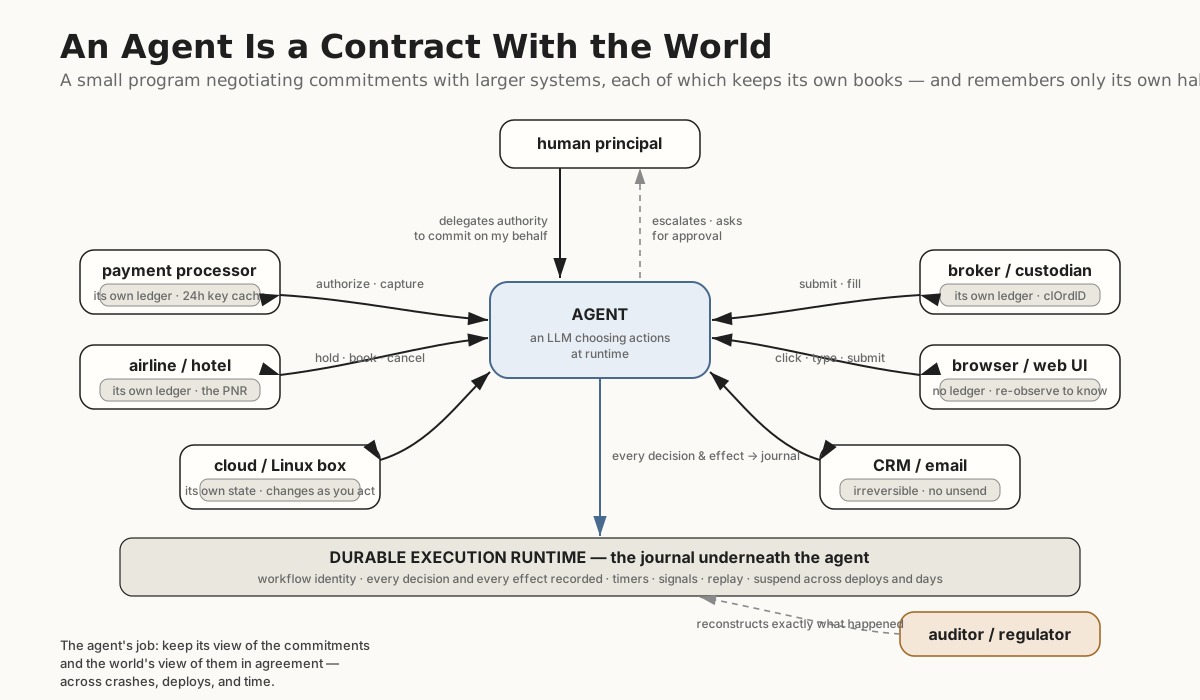
                          human principal
                       (delegates · approves · escalates)
                                   │
                                   ▼
   payment ─┐                  ┌───────┐                  ┌─ broker / custodian
   airline ─┼─ commitments ───►│ AGENT │◄─── commitments ─┼─ browser (no ledger)
   cloud ───┘                  └───┬───┘                  └─ CRM / email (no unsend)
   each keeps its own                  │ every decision & effect
   half of the ledger                  ▼
   ════════════════════════════════════════════════════════════════════════
    DURABLE EXECUTION RUNTIME — the journal underneath
   ════════════════════════════════════════════════════════════════════════
                                       │  reconstructs what happened
                                       ▼
                              auditor / regulator
The agent is a small program negotiating commitments with larger systems, each of which keeps its own books — and remembers only its own half. Its job: keep its view of the commitments and the world's view of them in agreement, across crashes, deploys, and time.
I. The Asymmetry⌗
1/ An agent is a chatbot that can spend your money. That is the whole story and the whole problem.
2/ The chatbot's worst day is a wrong answer. The agent's worst day is the wrong charge. The first is fixed by clicking regenerate. The second is not.
3/ Look at it from the system's side, not the user's. A chatbot returns text. The text is consumed by the user, who decides whether to act on it. The user is the integration point. The user catches errors. The user reconciles. The user is, in the language of distributed systems, the end-to-end check.
4/ An agent removes the user from that role. The agent is the integration point. The agent catches errors. The agent reconciles. The agent is the end-to-end check. The user has delegated the role and gone to bed.
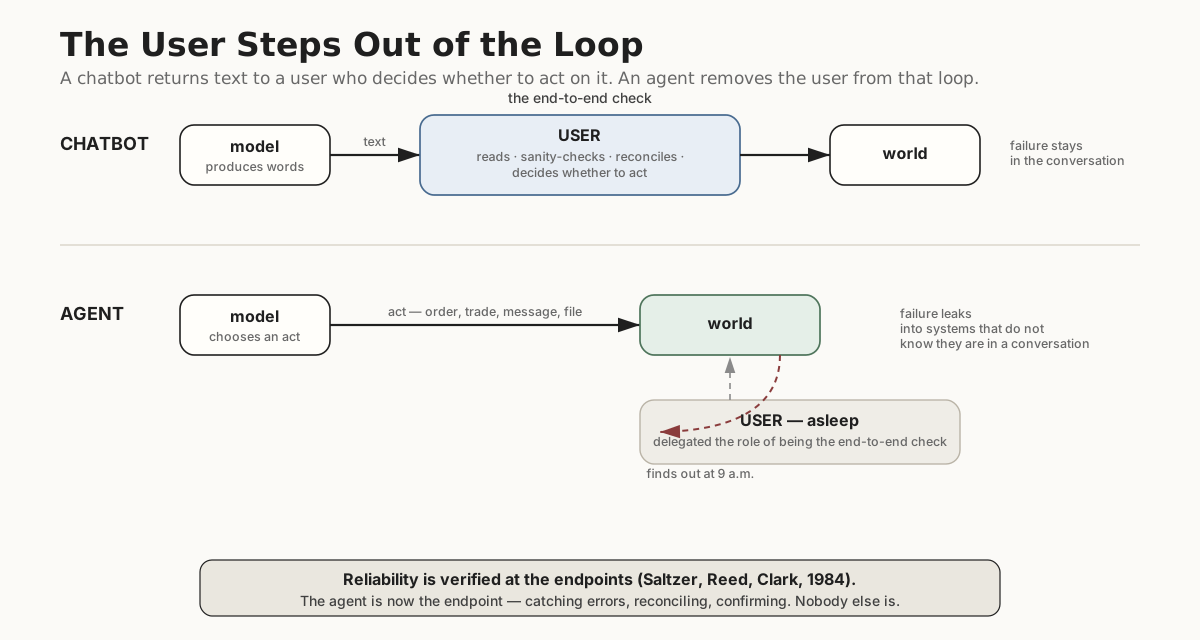
CHATBOT     model ──► [text] ──►  USER  ──► world
                                  (reads · reconciles · decides whether to act)
                                  = the end-to-end check       failure stays in the conversation

AGENT       model ──► [act] ──────────────────► world
                                                              failure leaks into systems
            USER (asleep — delegated the role) ┄┄┄┄┄┄┄┄┄┄┄┄┄┄ that don't know they're in a
                                                              conversation — "finds out at 9 a.m."
A chatbot returns text to a user who decides whether to act on it — the user is the end-to-end check. An agent removes the user from that loop and inherits the role: catching errors, reconciling, confirming. Nobody else is doing it.
5/ This is the move. The user has handed the agent authority to commit on their behalf. Commit is not a metaphor. It is the database word. It is the point at which a change becomes durable, becomes other people's truth, becomes something that can no longer be unsaid by deciding not to mean it.
6/ The chatbot does not commit. The chatbot proposes. The agent commits.
7/ A system that proposes is graded on the proposal. A system that commits is graded on whether the commitment was correct, whether it was authorised, whether it was honoured by the counterparty, whether the counterparty's record agrees with the agent's record, and whether anyone, asked, can reconstruct what happened. It is graded, in the end, on whether reality — after the run — looks the way the user wanted. The transcript can be regenerated. Reality cannot.
8/ Five graders, not one. None of them are reading the prose.
9/ This is why the discipline becomes less a 2020s machine-learning problem than a 1990s distributed-systems problem with a stochastic step in the middle. The hard part is not the model. The hard part is the part of the system that must keep promises across crashes, deploys, network partitions, and the model's own caprice.
10/ The model has been improving for ten years. The system around it has not. Every benchmark gain in reasoning, every new tool-use capability, every longer context window is a benchmark gain at the front of the contract. The back of the contract has not moved.
11/ The chatbot was forgiven for forgetting. The agent will not be.
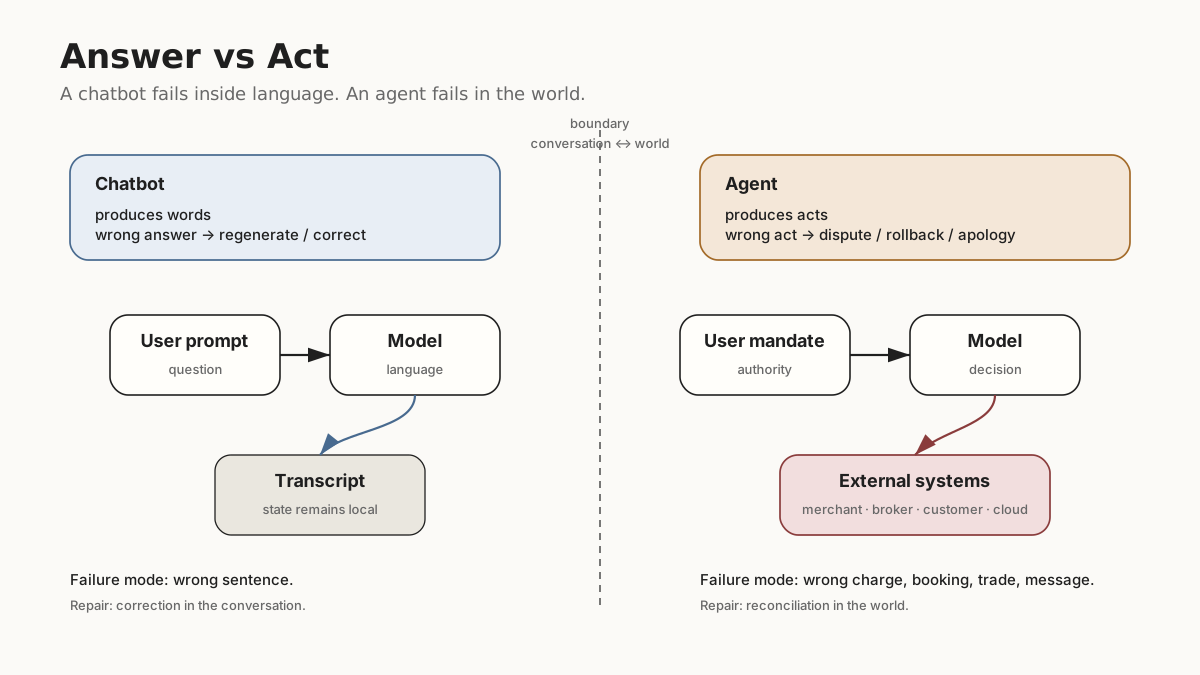
CHATBOT                                      AGENT
-------                                      -----
user asks                                    user delegates
   │                                            │
   ▼                                            ▼
model produces words                         model chooses act
   │                                            │
   ▼                                            ▼
transcript changes                           world changes
   │                                            │
wrong sentence                                wrong charge / trade / message
   │                                            │
fix: correct / regenerate                     fix: reconcile / compensate / apologize
The chatbot's failure remains in language. The agent's failure crosses into systems that do not know they are inside a conversation.
II. Three Commitments⌗
Three concrete cases. The first two as prose, briefly, to establish the shape. The third in detail — diagrams, code, and the ceremony the developer ends up writing — because the third is where the argument stops being an argument and becomes a bill of work.
Read each as a sequence of mutations against the world, not as a happy-path API call.
The shopping agent⌗
1/ A user says: find me these running shoes in size 11, ship to my home.
2/ The request resolves into four commitments across three systems. The cart held at the retailer. The payment authorised on the card. The order committed at the retailer. Inventory decremented in a real warehouse three states away.
3/ Four promises. Three vendors. None of them know about each other.
4/ The agent's process dies between the second commitment and the third. The card has a hold. The order does not exist. The user does not know.
5/ Without durable execution, the agent on retry runs from the top. Searches again. Picks again. Attempts checkout again. Whether duplicates fire at the retailer or at the card depends on whose idempotency layer is paying attention. The optimistic outcome is one charge, one order. The pessimistic outcome is two charges, one order, and an angry email at nine in the morning.
6/ What durable execution offers here is a discipline, not a miracle. Each external call is journaled. Each carries an idempotency key derived deterministically from the workflow itself — same workflow, same step, same key. The retailer dedupes. If the agent crashes after authorisation but before the order, replay reconstructs state from the journal: the authorisation recorded with its response, the order step the unfinished one, the engine retrying only what is unfinished. One charge, one order, regardless of how many times the host bounced.
7/ The merchant's idempotency layer was already there. Stripe's twenty-four-hour key cache. Shopify's cart tokens. The airline's PNR. None of them were built for agents. They were built for humans submitting forms twice when the page did not load, who press the back button at the wrong moment, who reload checkout pages out of impatience.
8/ Agents do not need new plumbing. They need to plug into old plumbing correctly. The patterns that survived a decade of microservice failure are the patterns agents need; nothing has to be reinvented.
9/ A shopping agent is four promises in a row, each to a different system. Two charges and one shipment is worse than no shipment at all.
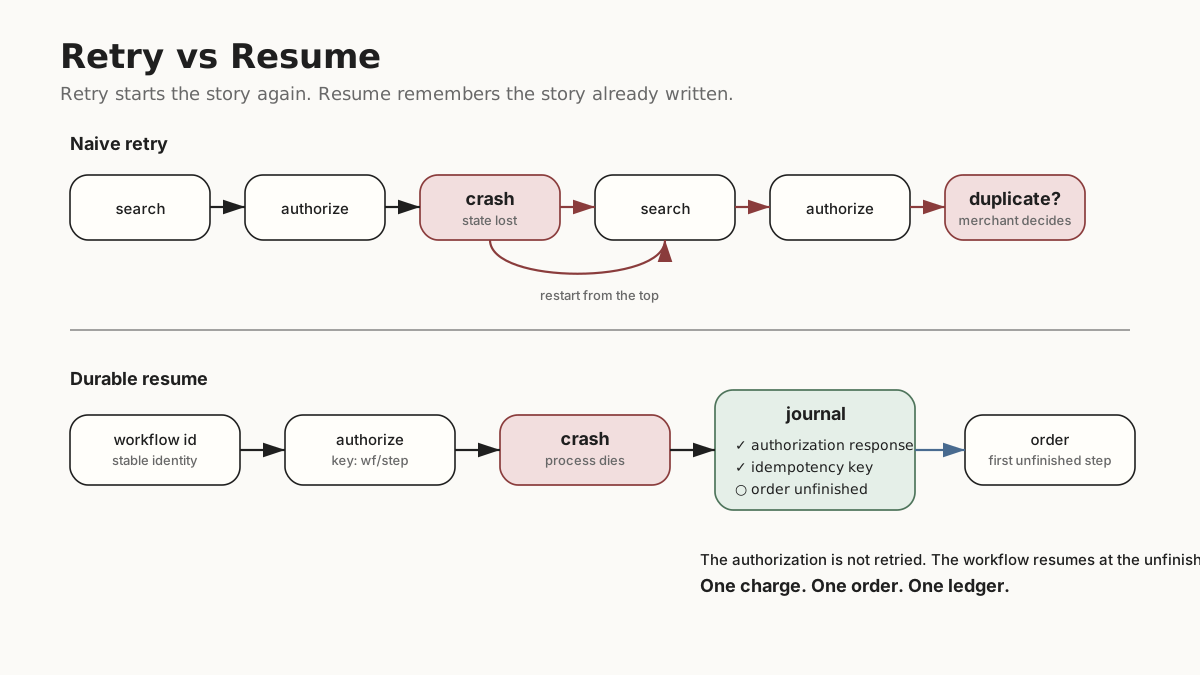
NAIVE RETRY

search ──► authorize ──► CRASH
                         state lost
search ──► authorize ──► checkout
             ▲
             └── duplicate risk now belongs to the merchant


DURABLE RESUME

workflow W
   │
   ├─ search        ✓ journaled
   ├─ authorize     ✓ response recorded, key = W/authorize
   ├─ checkout      ○ unfinished
   │
   └─ resume here ──► checkout
Retry repeats the story. Resume remembers the story.
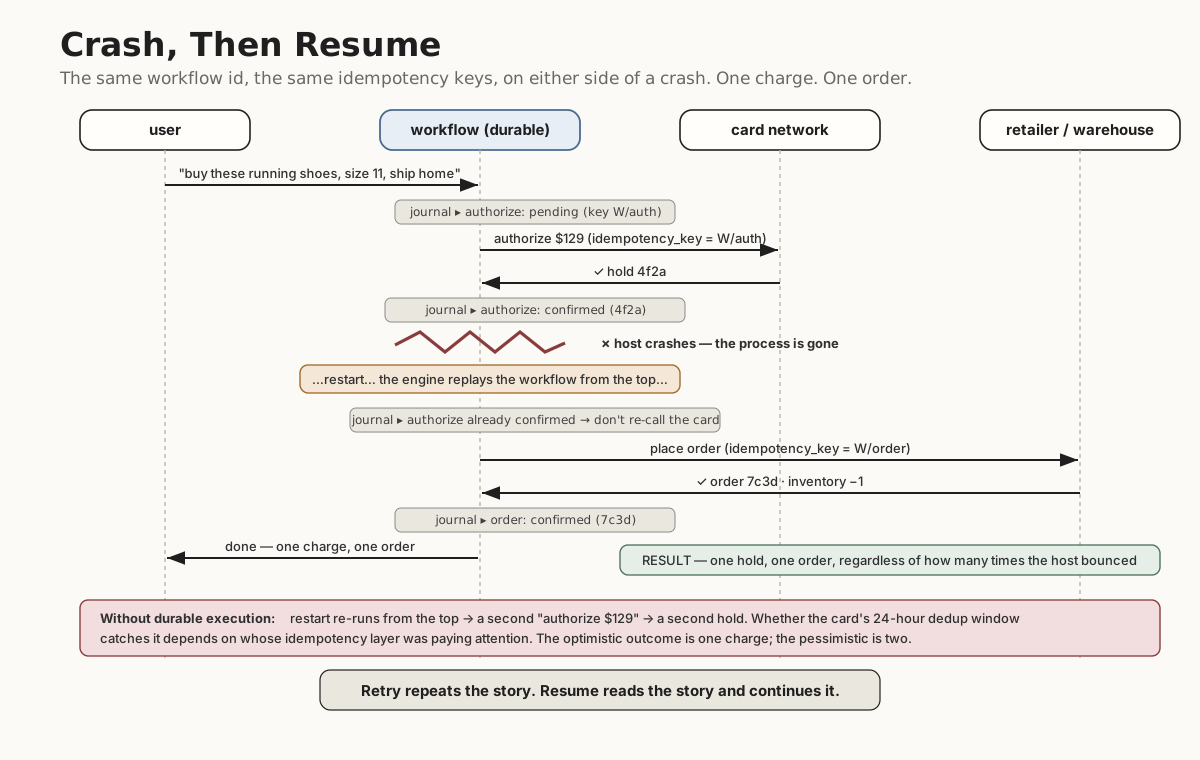
user            workflow (durable)              card network        retailer
 │  buy shoes ──►│
 │               │ journal ▸ authorize: pending (key W/auth)
 │               │ authorize $129 (key=W/auth) ──────►│
 │               │◄────────────────── ✓ hold 4f2a ────┤
 │               │ journal ▸ authorize: confirmed (4f2a)
 │            ✗ CRASH — the process is gone
 │            …restart… the engine replays the workflow from the top…
 │               │ journal ▸ authorize already confirmed → don't re-call the card
 │               │ place order (key=W/order) ─────────────────────────────►│
 │               │◄─────────────────────────── ✓ order 7c3d, inv −1 ───────┤
 │               │ journal ▸ order: confirmed (7c3d)
 │  ◄── done ────┤   one hold, one order — however many times the host bounced

Without durable execution: restart re-runs from the top → a second "authorize $129"
→ a second hold; the card's 24-hour dedup window may or may not catch it.
The same workflow id, the same idempotency keys, on either side of a crash. Retry repeats the story; resume reads the story and continues it.
The travel agent⌗
1/ Travel is shopping with a longer time horizon and more vendors. It gets harder along both axes.
2/ A round trip to Singapore. Outbound flight, return flight, hotel, sometimes a car, a payment processor. Five external systems. None know about each other. None agree on what time it is. None will tell the agent anything it did not ask for.
3/ The interesting failure is the partial commit. Outbound booked. Return rejected because the fare class disappeared in the fifteen seconds since the search.
4/ Now the user has half a trip and a charge. Three responses are available. Cancel the outbound and refund — compensation. Retry the return at the next available fare — forward recovery. Surface the failure and wait — escalation.
5/ Each is a real saga path. None of them are reachable without a runtime that remembers what was committed and what was not.
6/ Time adds a second axis. Travel approvals come from partners, expense systems, managers. The agent presents an itinerary and waits. The wait may be ten minutes or two days.
7/ During that wait, the process holding agent state cannot stay pinned in memory. The operator deploys. The host autoscales. The cluster reschedules. Without durable suspend, the agent loses its place; the human approval becomes orphaned; the user clicks approve, and nothing happens, because nothing on the other side is listening anymore.
8/ Travel also exposes the freshness problem in its sharpest form. The price seen at search time is not the price at booking time. Durable execution does not solve this. What it does is force the choice to be explicit. You design a re-fetch step immediately before commit. You journal its result. The workflow consumes the fresh price, not the stale search result. The runtime does not smuggle freshness in; it makes every step declare whether its data is snapshot or live.
9/ The hard part of travel is not booking. It is unbooking. Any travel agent that can commit but cannot roll back is a travel agent that should not be authorised to commit.
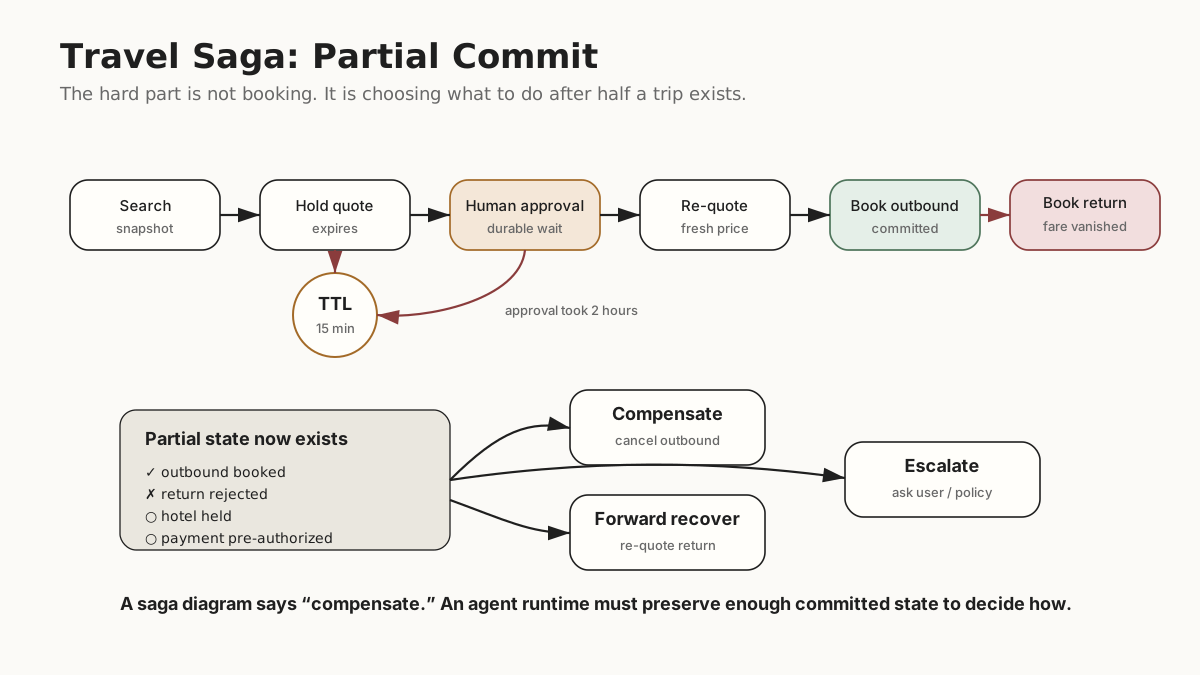
search ─► hold quote ─► wait for approval ─► re-quote ─► book outbound ✓ ─► book return ✗
             │                    │
             │                    └── approval arrives after quote expiry
             ▼
          TTL expires

PARTIAL STATE
  outbound: booked
  return:   rejected
  hotel:    held
  payment:  pre-authorized

NEXT STEP IS NOT “RETRY”
  ├─ compensate: cancel outbound
  ├─ recover:    re-quote return
  └─ escalate:   ask user / policy
A travel agent is not finished when it can book. It is finished when it knows what to do after half a trip exists.
The treasury agent — a walk through one day⌗
The third case is the one with the highest cost of getting wrong, and it is worth walking through in full because the walk reveals what the developer ends up writing when the framework declines to.
The scenario⌗
1/ The CFO writes the standing policy each morning. How much cash sits in each operating account. Where the excess sweeps to. Which counterparties are allowed. What FX exposures are tolerable, and at what notional. What amounts cross the line into ask me first. The policy is short. The policy is binding. The policy is what the regulator will compare against, line by line, when something goes wrong.
2/ The market closes. The agent runs. Across four banks in three currencies, it reads balances and the day's flows. It pulls rates from the data vendor. It applies the policy to the day's facts. The excess in USD operating goes to the whitelisted money-market fund. The AUD short above threshold is hedged on the agreed forward. Intercompany funding is instructed. GL entries are posted. The liquidity ratio is filed with the regulator. A summary lands on the CFO's phone before dinner.
3/ This is one run. It will run every business day. It must not over-sweep, double-hedge, miss a cutoff, or post the same entry twice. It must not pay the wrong counterparty by a digit. It must not file a ratio computed on stale balances. When it does any of these — and it will, once — the treasurer will be asked, by someone who is not in a forgiving mood, what the agent did and why.
4/ The chatbot was forgiven for forgetting. The treasury agent will not be. The agent's day is a contract with the firm, the bank, the counterparty, and the regulator, all of whom keep books, none of whom keep the agent's books for it.
The ceremony, in seven points⌗
The work each tool call has to do, every time, regardless of which framework it lives in:
① The instruction is sent twice; the money moves once. The idempotency key is the agent's promise to the bank. The developer derives it by hand from (run_date, account_id, amount_minor, target) and prays the inputs are stable across retries.
② Check the journal before acting. If the prior attempt confirmed, return its result. The check exists because the act is not free, not undoable, and not always knowable from the bank alone.
③ The intent is written before the wire leaves. A crash between the write and the wire leaves a trace. A crash between the wire and the ack leaves a question. Without the pre-write, both are silence — and silence at the close is the worst state a treasury can be in.
④ The act. The framework treats it as a function call. The world treats it as money moved. The two treatments must be reconciled, and reconciliation is the developer's job until the runtime takes it.
⑤ The outcome is written when it returns. Confirmed, failed, or unknown. The unknown is not a developer error. It is a category of state the journal must hold, because the network can lose acks, the bank can be slow, and the cutoff is at four o'clock regardless.
⑥ Compensation registered with the act. The reversing entry for a misposted GL line. The cancelling instruction for a wire still in the queue. The offsetting hedge for an over-hedge. The agent that does not journal compensation handles cannot apologise to the world in time.
⑦ The reasoning is journaled with the action, not after it. Why this counterparty. Why this amount. Why this minute. The CFO will ask. The auditor will ask. The regulator, when it comes, will ask in writing and expect the answer in writing. The journal that records what without why is the journal of a chatbot, not an agent.
5/ Seven points. Six of them rebuild what ledgers and clearing houses solved at the boundary forty years ago. The seventh is the new ceiling — and none of the frameworks below give the developer a place to put it that survives the run.
6/ Multi-leg trades are where the discipline becomes philosophically interesting. An FX hedge is two trades that must both execute or neither execute. Without compensation primitives, a partial fill is an unhedged position the user did not ask for. With sagas, leg one is reversed if leg two fails. The agent's job is no longer submit orders. It is submit orders, observe fills, compensate on partial failure, maintain the invariant the user actually wanted. That is a saga, and a saga needs a runtime.
7/ Audit is where the journal stops being an implementation detail and becomes the deliverable. Every decision the agent made, every input it considered, every effect it submitted, every response it received — recorded, ordered, replayable. A non-durable agent has logging. It does not have audit. The difference is whether a regulator can reconstruct exactly what happened, or whether the firm has to defend a partial story.
LangGraph⌗
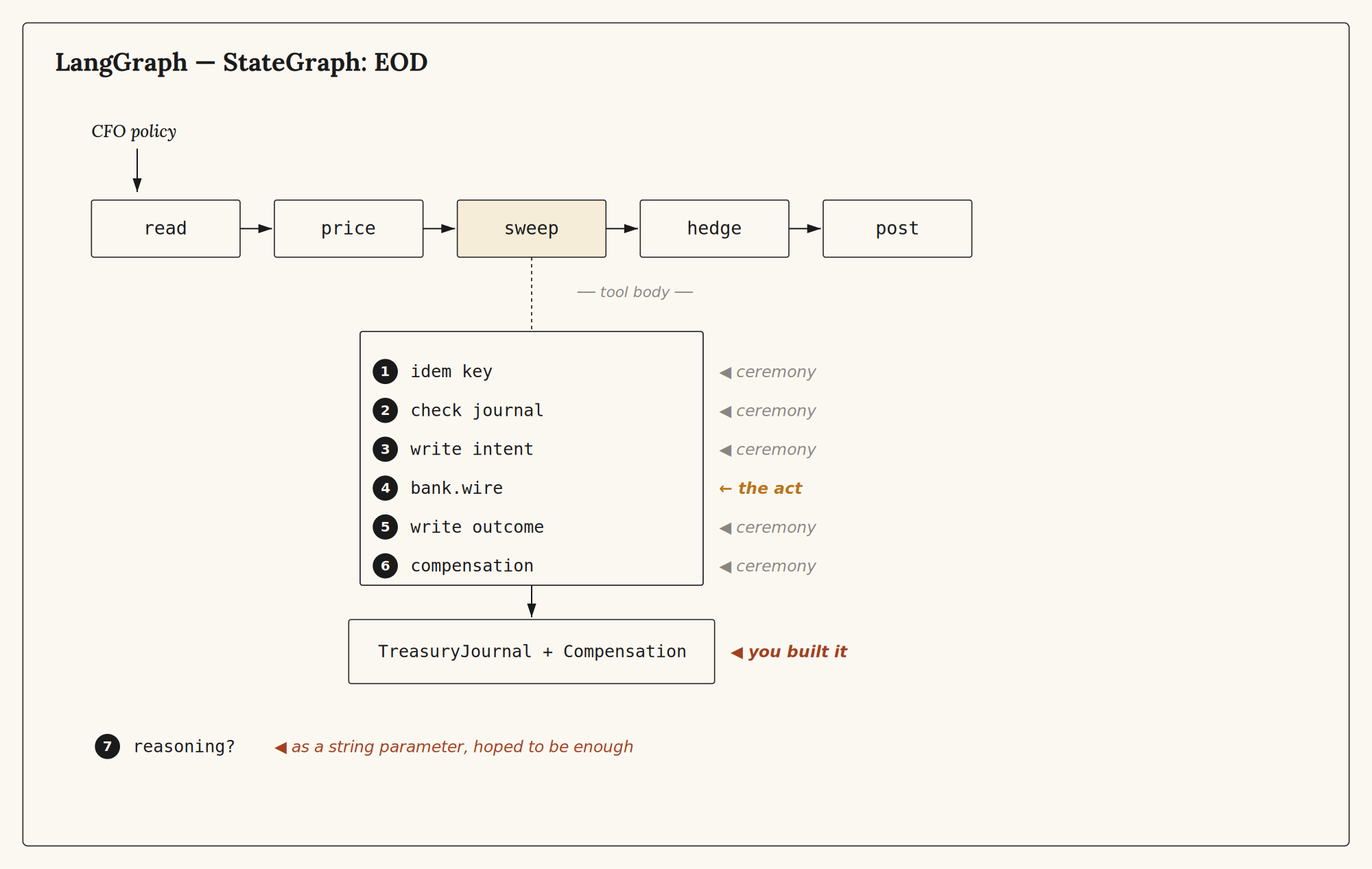
from langgraph.graph import StateGraph, END
from tenacity import retry, stop_after_attempt, wait_exponential
import hashlib

@retry(stop=stop_after_attempt(3), wait=wait_exponential())
def execute_sweep(state: TreasuryState) -> TreasuryState:
    # ① idempotency — derived from inputs we hope are stable across retries
    key = hashlib.sha256(
        f"{state['run_date']}:{state['account_id']}:"
        f"{state['amount_minor']}:{state['target_mmf']}".encode()
    ).hexdigest()

    with Session(engine) as s:
        # ② check the journal we built
        prior = s.query(TreasuryJournal).filter_by(key=key).first()
        if prior and prior.status == "confirmed":
            return {**state, "wire_id": prior.wire_id}

        # ③ write intent before the wire leaves
        s.add(TreasuryJournal(
            key=key, status="pending",
            account_id=state["account_id"],
            amount_minor=state["amount_minor"],
            target=state["target_mmf"],
            rationale=state["rationale"],          # ⑦ the model's why, as a string
        ))
        s.commit()

    # ④ the act
    try:
        wire_id = bank.wire(
            account=state["account_id"],
            amount_minor=state["amount_minor"],
            target=state["target_mmf"],
            idempotency_key=key,
        )
    except UnknownAck:
        # ⑤ the third status — neither confirmed nor failed
        with Session(engine) as s:
            s.query(TreasuryJournal).filter_by(key=key).update({"status": "unknown"})
            s.commit()
        raise   # reconciliation will resolve this later
    except Exception:
        with Session(engine) as s:
            s.query(TreasuryJournal).filter_by(key=key).update({"status": "failed"})
            s.commit()
        raise

    with Session(engine) as s:
        # ⑤ write outcome
        s.query(TreasuryJournal).filter_by(key=key).update(
            {"status": "confirmed", "wire_id": wire_id}
        )
        # ⑥ register the compensation handle — what unwinds this if hedge fails
        s.add(Compensation(
            key=key, kind="reverse_wire",
            payload={"wire_id": wire_id, "account": state["account_id"]},
        ))
        s.commit()

    return {**state, "wire_id": wire_id}

graph = StateGraph(TreasuryState)
graph.add_node("read",  read_balances)
graph.add_node("price", price_market)
graph.add_node("sweep", execute_sweep)
graph.add_node("hedge", execute_hedge)        # same ceremony, repeated
graph.add_node("post",  post_gl)              # same ceremony, repeated
graph.add_edge("read", "price"); graph.add_edge("price", "sweep")
graph.add_edge("sweep", "hedge"); graph.add_edge("hedge", "post")
graph.add_edge("post", END)
8/ The graph is the agent. The journal is the runtime the graph declined to be.
ADK⌗
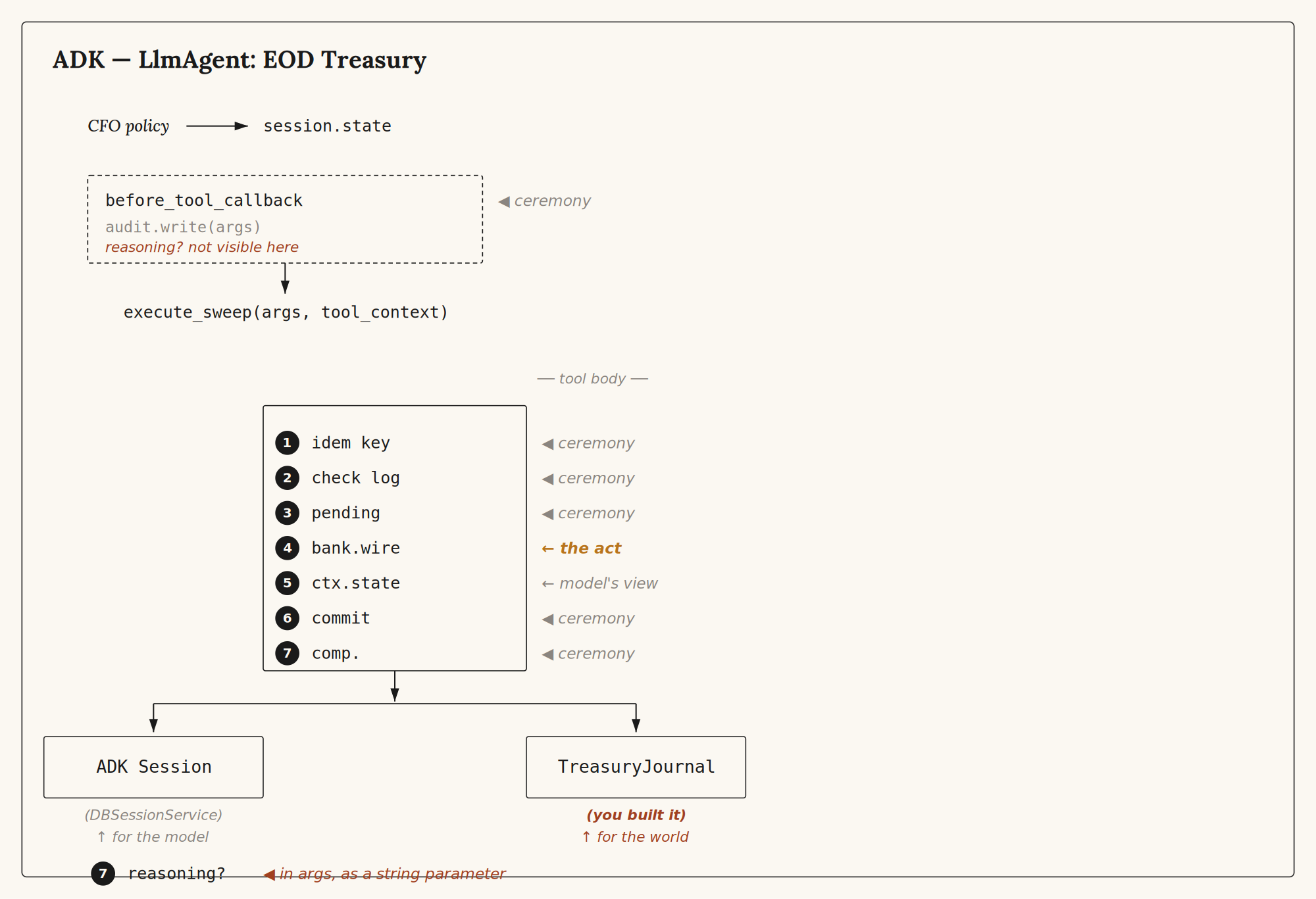
from google.adk.agents import LlmAgent
from google.adk.tools import FunctionTool
from google.adk.sessions import DatabaseSessionService

session_service = DatabaseSessionService(db_url="postgresql://...")

def execute_sweep(
    account_id: str,
    currency: str,
    amount_minor: int,
    target_mmf: str,
    run_date: str,
    rationale: str,             # ⑦ the model's why, as best we can capture
    tool_context,
) -> dict:
    # ① idempotency key — invocation_id helps when inputs would otherwise repeat
    key = hashlib.sha256(
        f"{run_date}:{account_id}:{amount_minor}:{target_mmf}".encode()
    ).hexdigest()

    with side_journal() as j:
        # ② check the journal we built alongside the session
        if j.exists(key, status="confirmed"):
            return {"wire_id": j.wire_id(key)}
        # ③ write intent
        j.write(key, status="pending",
                account_id=account_id, amount_minor=amount_minor,
                target=target_mmf, rationale=rationale)

    # ④ the act
    try:
        wire_id = bank.wire(account_id, amount_minor, target_mmf, idempotency_key=key)
    except UnknownAck:
        with side_journal() as j: j.write(key, status="unknown")
        raise
    except Exception:
        with side_journal() as j: j.write(key, status="failed")
        raise

    # ⑤ session.state — what the model will read next turn
    tool_context.state[f"sweep:{account_id}:{run_date}"] = wire_id
    # ⑥ our journal — what survives the model
    with side_journal() as j: j.write(key, status="confirmed", wire_id=wire_id)
    # ⑦ compensation handle
    with comp_journal() as c:
        c.register(key, kind="reverse_wire",
                   payload={"wire_id": wire_id, "account": account_id})

    return {"wire_id": wire_id}

def before_tool_callback(tool, args, tool_context):
    # audit fires on the call. the deliberation that produced `args` and
    # `rationale` is upstream of this hook; we get the result, not the reasoning.
    audit.write({
        "invocation": tool_context.invocation_id,
        "tool": tool.name,
        "args": redact(args),
        "policy_version": tool_context.state.get("cfo_policy_version"),
    })

agent = LlmAgent(
    model="gemini-2.5-pro",
    instruction="Apply the CFO policy in session.state to today's positions.",
    tools=[FunctionTool(execute_sweep), FunctionTool(execute_hedge), FunctionTool(post_gl)],
    before_tool_callback=before_tool_callback,
)
9/ ADK splits the ceremony across three places — callback, tool body, session state — and the developer keeps all three in step. The session is durable. The session is the wrong shape for a ledger. Two ledgers, one process, one team paying for the gap.
CrewAI⌗
from crewai import Agent, Task, Crew
from crewai.tools import BaseTool

class ExecuteSweepTool(BaseTool):
    name = "execute_sweep"
    description = "Sweep excess cash to a whitelisted MMF per CFO policy."

    def _run(
        self, account_id: str, currency: str, amount_minor: int,
        target_mmf: str, run_date: str, rationale: str,
    ) -> dict:
        # ① idem — crew gives inputs, not invocation identity
        key = hashlib.sha256(
            f"{run_date}:{account_id}:{amount_minor}:{target_mmf}".encode()
        ).hexdigest()

        # ② check
        if treasury_journal.exists(key, status="confirmed"):
            return {"wire_id": treasury_journal.wire_id(key)}

        # ③ pending
        treasury_journal.write(key, status="pending",
            account_id=account_id, amount_minor=amount_minor,
            target=target_mmf, rationale=rationale)

        # ④ the act
        try:
            wire_id = bank.wire(account_id, amount_minor, target_mmf, idempotency_key=key)
        except UnknownAck:
            treasury_journal.write(key, status="unknown");  raise
        except Exception:
            treasury_journal.write(key, status="failed");   raise

        # ⑤ commit
        treasury_journal.write(key, status="confirmed", wire_id=wire_id)
        # ⑥ compensation
        compensation_journal.register(
            key, kind="reverse_wire",
            payload={"wire_id": wire_id, "account": account_id},
        )
        return {"wire_id": wire_id}

agent = Agent(role="Treasurer", goal="Close the day per CFO policy.",
              tools=[ExecuteSweepTool(), ExecuteHedgeTool(), PostGLTool()])
crew  = Crew(agents=[agent],
             tasks=[read_task, sweep_task, hedge_task, post_task])

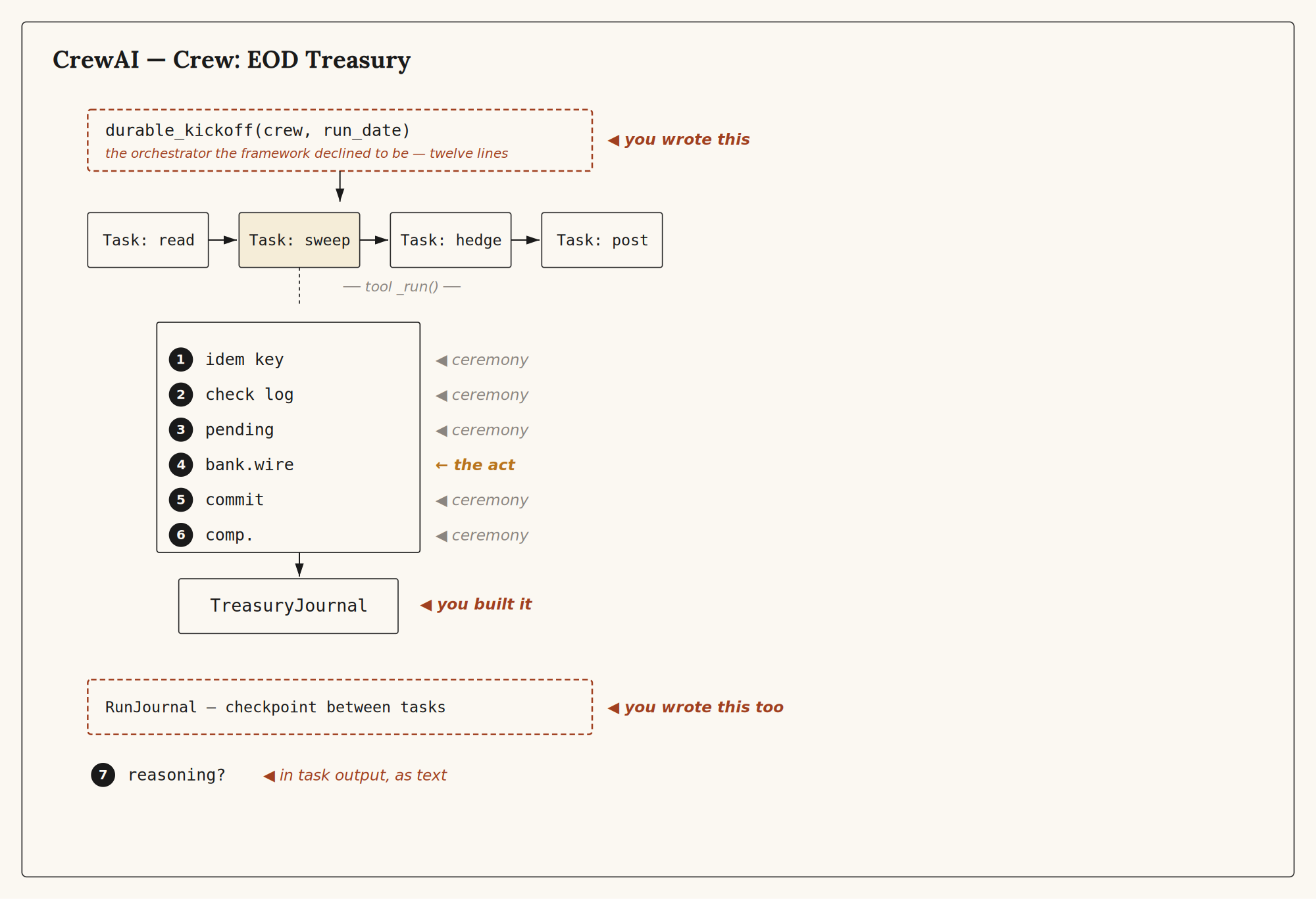
# Crew does not checkpoint between tasks. If `sweep` succeeds and the process
# dies before `hedge`, restart re-runs `sweep`. We write the resumption.
def durable_kickoff(crew, run_date: str):
    state = run_journal.load(run_date) or {}
    for i, t in enumerate(crew.tasks):
        slot = f"task_{i}"
        if slot in state:
            continue
        state[slot] = t.execute()
        run_journal.save(run_date, state)
    return state
10/ The kickoff wrapper is the orchestrator the framework declined to be. Twelve lines. They are the difference between a treasury that closes once and a treasury that closes twice.
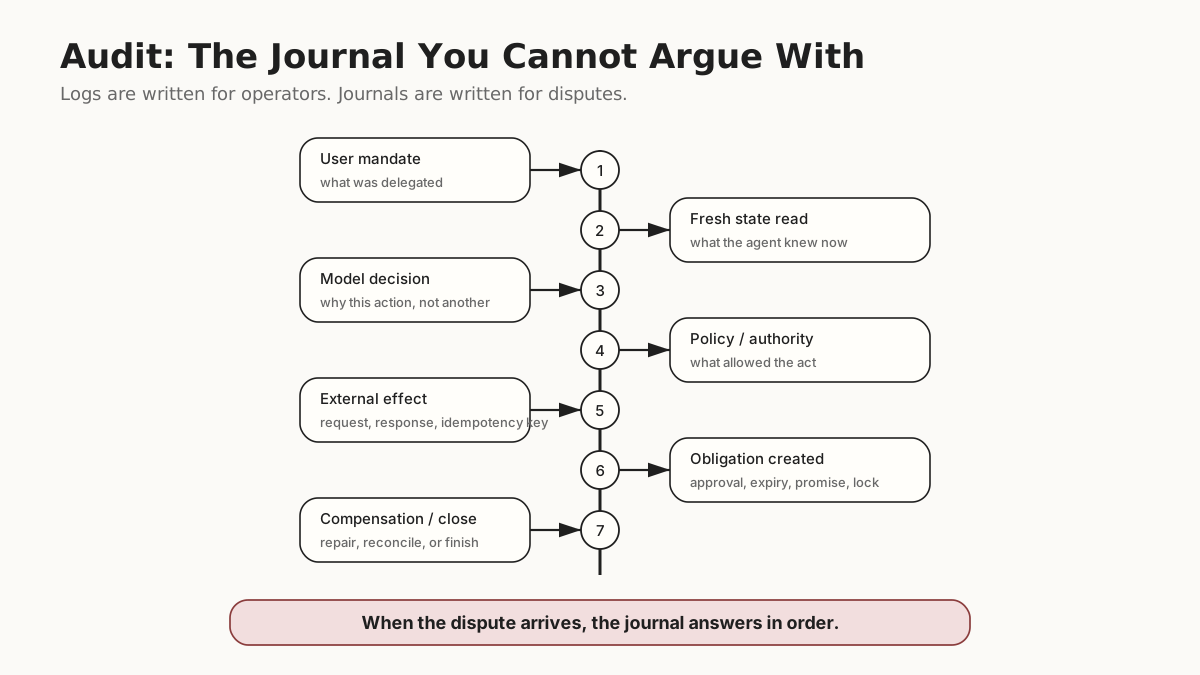
AUDIT JOURNAL

1. mandate received
        │
2. fresh state read
        │
3. model decision recorded
        │
4. policy / authority checked
        │
5. external effect submitted
        │
6. obligation created
        │
7. compensation or close

When the dispute arrives, order matters.
Logs are written for operators. Journals are written for disputes.
What the three frameworks share⌗
11/ One scenario. Three frameworks. The same six points wired in by hand inside each tool. The same seventh point — why — captured as a string parameter and hoped to be enough.
12/ The CFO's policy is in session state in ADK, in graph state in LangGraph, in task context in CrewAI. None of those places is the journal that survives the day.
13/ The retry decorator is the tell. The compensation registration is the tell. The kickoff wrapper is the tell. Each is the developer rebuilding, badly, what the boundary already knew how to do.
14/ The treasury agent does not need a smarter model. It needs a tape underneath the model that the regulator can read.
The thread⌗
1/ What unites the three is that the agent is not the protagonist. The protagonist is the world. The merchant's inventory. The airline's seat map. The custodian's order book. The agent is a small program negotiating commitments with larger systems that have their own opinions about what just happened.
2/ The runtime's job is to keep the agent's view of those commitments and the world's view of them in agreement across crashes, deploys, and time.
3/ Most current agent frameworks treat this as somebody else's problem. The retry decorator is the tell.
4/ Multiplied across every tool call in a multi-step agent, the developer reimplements a poor version of Temporal inside their own application, integration by integration, discovering the same edge cases in the same order the workflow community discovered them between 2014 and 2020.
III. What the Old Texts Already Say⌗
1/ Distributed systems research has spent forty years saying things that turn out to apply to agent systems with the parameters adjusted.
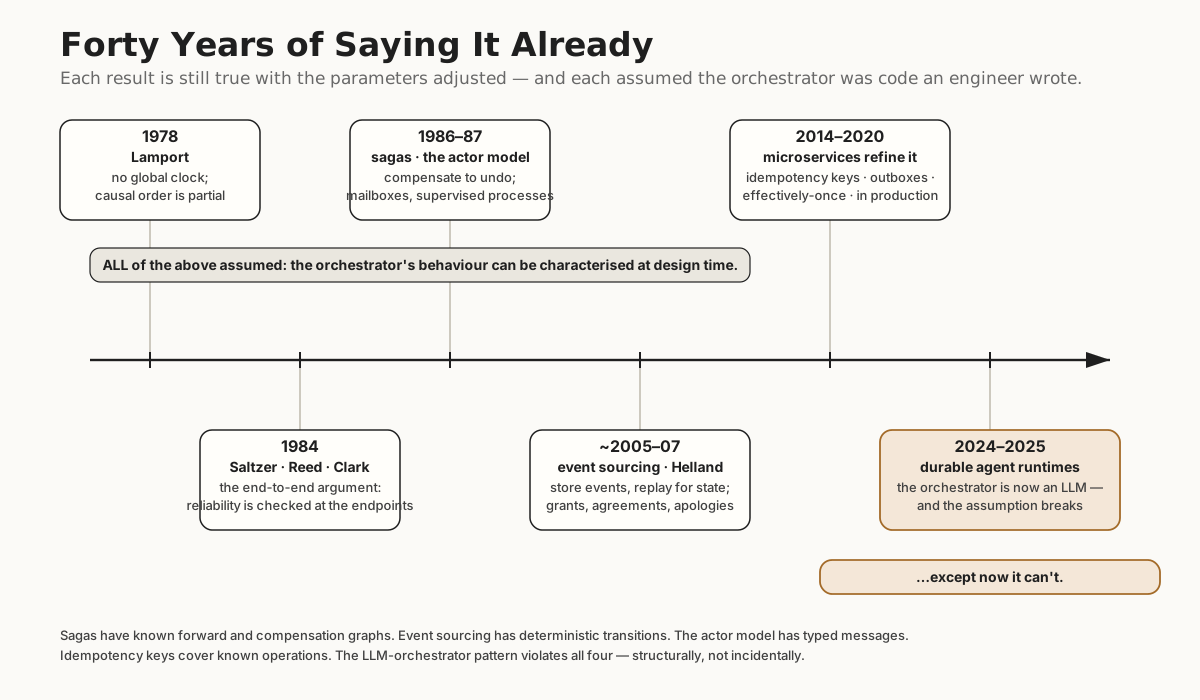
1978 ──── 1984 ────── 1986–87 ─────── ~2005–07 ───────── 2014–2020 ───────── 2024–2025
Lamport   Saltzer et  sagas · the     event sourcing ·   microservices       durable agent
no global al · end-   actor model:    Helland (grants,   refine it: idem-    runtimes —
clock;    to-end:     compensate to   agreements,        potency keys,       the orchestrator
partial   check at    undo; mailboxes apologies; store   outboxes, "effec-   is now an LLM
order     the ends    + supervisors   events, replay     tively once")        → it breaks

ALL of the above assumed: the orchestrator's behaviour can be characterised at design time.   …except now it can't.
Each result is still true with the parameters adjusted — and each assumed the orchestrator was code an engineer wrote. Sagas have known forward and compensation graphs; event sourcing has deterministic transitions; the actor model has typed messages. The LLM-orchestrator pattern violates all of it, structurally.
2/ Lamport, 1978. Time, Clocks, and the Ordering of Events. There is no global clock. Events are ordered only by their causal relationships, and that order is partial, not total.
3/ Helland. Life Beyond Distributed Transactions. ACID across services is not available. What you have are grants, agreements, and partial failures.
4/ Helland again. Memories, Guesses, and Apologies. Distributed systems live in a world of inexact information. The right primitive is often I think this is true; if I am wrong, I will apologise.
5/ Saltzer, Reed, Clark, 1984. The end-to-end argument. Reliability must be verified at the endpoints. Intermediate components cannot guarantee what the endpoint cares about.
6/ A network can promise delivery. Only the receiver can confirm it. The implication for agents is direct. The vendor's confirmation is the only commitment that counts. The agent's local belief that the order was placed is not the same thing as the order having been placed.
7/ Garcia-Molina and Salem, 1987. The saga paper. Compensation as the way to maintain weakened consistency over long-running operations. If step C fails, run ¬B and ¬A.
8/ Event sourcing. Store events. Derive state by replay. The journal becomes the source of truth.
9/ The actor model. Hewitt, Agha, Erlang/OTP. Message-driven concurrency through mailbox ordering and supervised processes that survive their own faults.
10/ Every one of these primitives assumes that the orchestrator's behaviour can be characterised at design time. Sagas have known forward graphs and known compensation graphs. Event sourcing has deterministic state transitions. Idempotency keys cover known operations. The actor model has typed messages.
11/ They were designed for a world where the orchestrator was code an engineer wrote. The engineer's job was to handle network failure within the bounds of decisions the engineer had pre-specified.
12/ This is the assumption the LLM-as-orchestrator pattern violates. The violation is structural, not incidental.
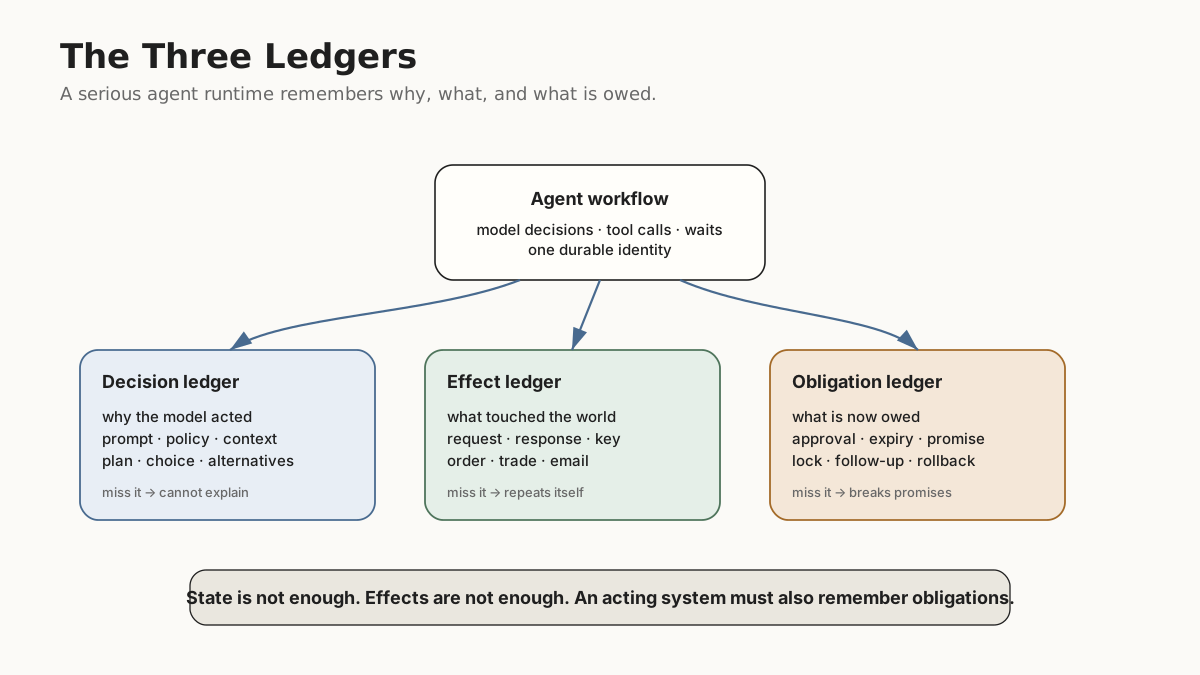
                 AGENT WORKFLOW
                       │
        ┌──────────────┼──────────────┐
        │              │              │
        ▼              ▼              ▼

DECISION LEDGER   EFFECT LEDGER   OBLIGATION LEDGER
why it acted      what it did     what it owes

prompt            request         approval pending
policy            response        quote expiry
context           idempotency key customer promise
choice            order id        incident lock
alternative       trade id        rollback due

miss it:          miss it:        miss it:
cannot explain    repeats itself  breaks promises
State is not enough. An acting system must remember why, what, and what is owed.
IV. The Assumption Breaks⌗
1/ The orchestrator's decisions are no longer pre-specified. They are sampled at runtime from a model whose policy was learned, not written.
2/ The difference is visible if you write the two side by side.
# Classical saga: the engineer wrote the graph at design time.
def transfer(from_acc: str, to_acc: str, amount: int) -> Receipt:
    saga = Saga()
    saga.add(debit,  from_acc, amount, compensate=credit)
    saga.add(credit, to_acc,   amount, compensate=debit)
    saga.add(notify, from_acc, to_acc, amount, compensate=None)
    return saga.execute()
# Forward path:  known.   Compensation: known.   Each step has a key.

# LLM-orchestrated agent: the trajectory is sampled at runtime.
async def agent(goal: str) -> State:
    state = State.from_goal(goal)
    while not state.done:
        action = await llm.choose_action(state, available_tools)   # ← runtime
        result = await invoke_tool(action)
        state  = state.update(action, result)
    return state
# Forward path:  not enumerable.
# Compensation:  depends on what was sampled.
# Each tool call has a key. The sequence does not.
3/ The first function is a graph. The second is a loop with a coin flip in the middle. The first can be reasoned about by induction. The second cannot.
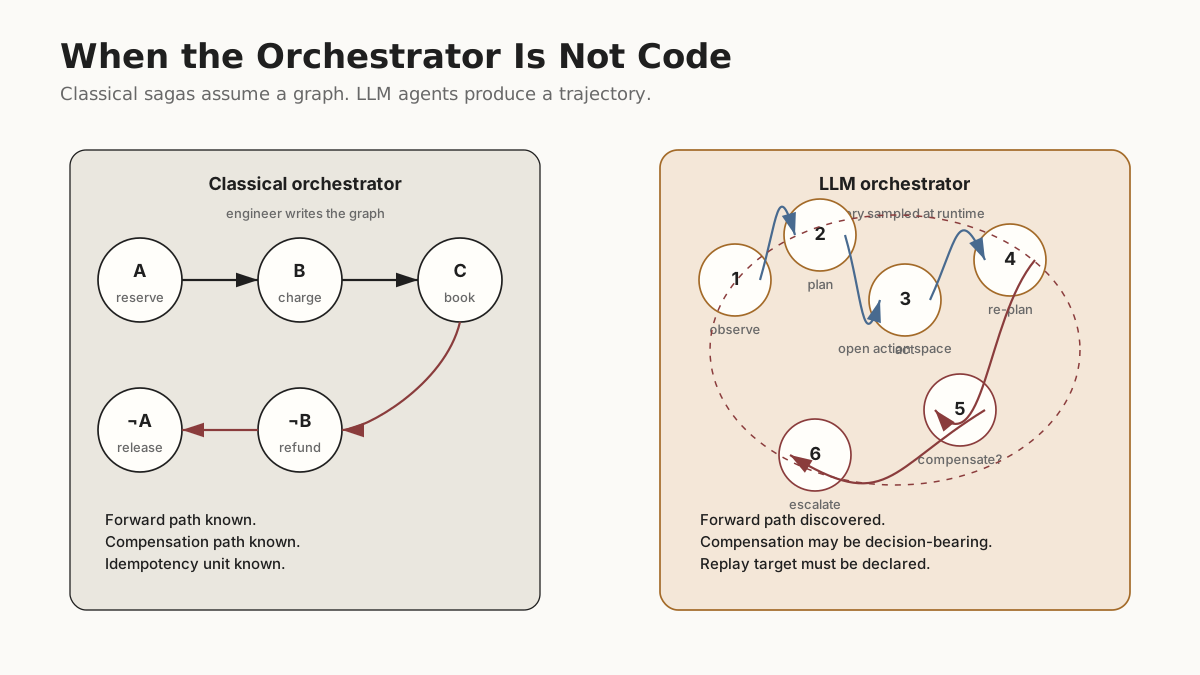
CLASSICAL SAGA                         LLM AGENT TRAJECTORY

A ──► B ──► C                          observe ─► plan ─► act
│     │     │                              ▲        │       │
│     │     └─ fail                        │        ▼       ▼
│     └──────► ¬B ──► ¬A               verify ◄─ re-plan ◄─ state changed

forward path known                    forward path sampled
rollback path known                   compensation may be decision-bearing
idempotency unit known                idempotency unit must be chosen
Classical orchestration is authored. Agent orchestration is discovered.
4/ Four consequences follow.
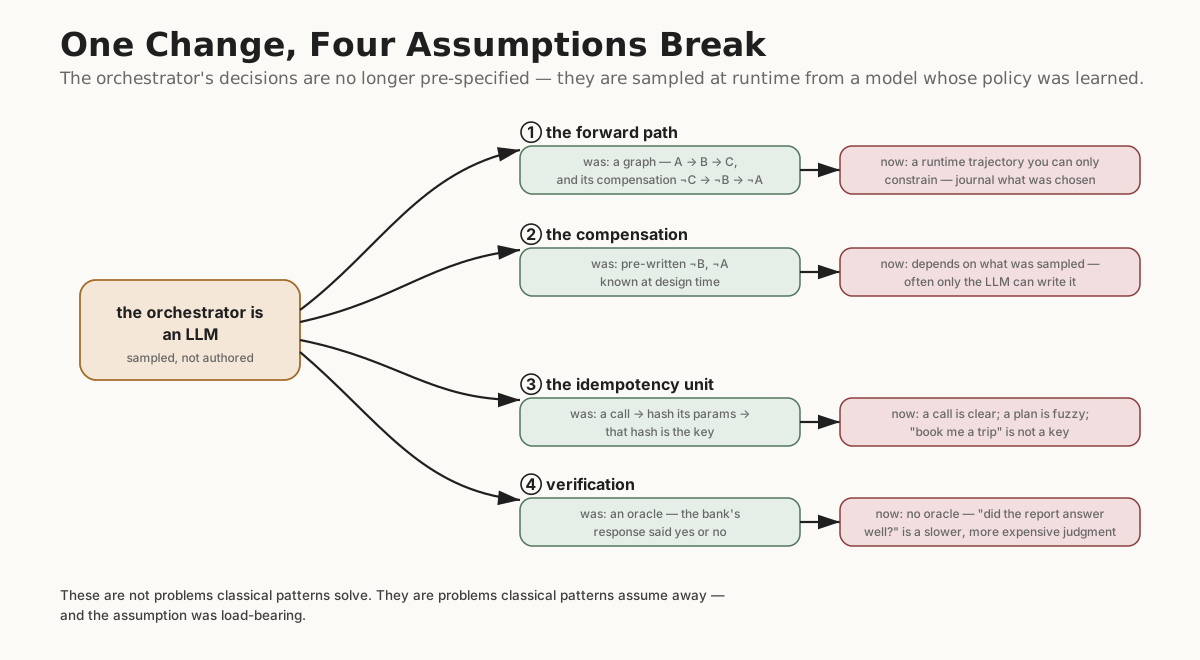
                                ┌─ ① forward path:    a graph (A→B→C; ¬C→¬B→¬A)   →  a runtime trajectory you can only constrain
   the orchestrator is an LLM ──┼─ ② compensation:    pre-written ¬B, ¬A           →  depends on what was sampled; often only the LLM can write it
   (sampled, not authored)      ├─ ③ idempotency unit: a call → hash → key          →  a call is clear, a plan is fuzzy, "book me a trip" is no key
                                └─ ④ verification:    an oracle said yes / no       →  no oracle; "did the report answer well?" is a slower judgment
One change — the orchestrator's decisions are sampled, not written — and four classical assumptions stop holding. These are not problems classical patterns solve; they are problems classical patterns assume away, and the assumption was load-bearing.
5/ The forward path is not a graph the engineer can enumerate. It is a runtime trajectory the engineer can only constrain. Where the saga literature said here is A → B → C and here is its compensation ¬C → ¬B → ¬A, the agent literature has to say the agent will choose actions from this space at runtime, and we will have to journal what it chose so we can compensate it.
6/ The compensation depends on what the LLM did. It cannot be pre-written, because the forward path was not pre-written. Often the only thing positioned to write the compensation is the LLM itself, given the partial state and the goal.
7/ The idempotency unit is fuzzy. A single tool call is clear; the call has parameters, the parameters can be hashed, the hash is the key. An LLM-generated plan is less clear; the same prompt can produce different plans, and the plans are not naturally addressable. An agentic objective is very unclear. Book me a trip to Singapore is not a key.
8/ The verification gap widens. Classical patterns assumed there was an oracle for did the operation succeed. The bank's response said yes or no. For an agent task — did the research report answer the question well, did the support response satisfy the customer, did the coding agent fix the bug — there is no oracle. There is only a slower, more expensive judgment, often by another model, often by a human.
9/ These are not problems classical patterns solve. They are problems classical patterns assume away.
V. Six Places It Breaks⌗
A short tour. Six classes of agent. Six places the inherited toolkit runs out.
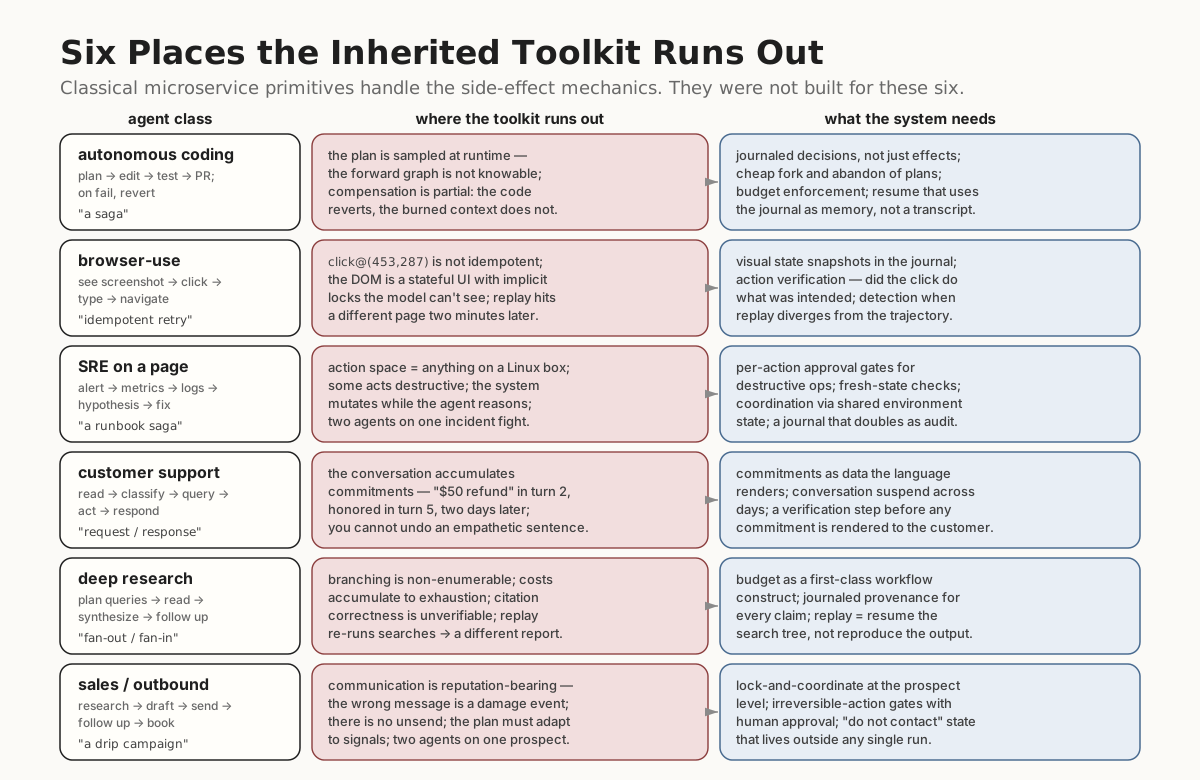
AGENT CLASS            WHERE THE TOOLKIT RUNS OUT             WHAT THE SYSTEM NEEDS
-----------            --------------------------             ---------------------
coding agent           plan sampled at runtime →              journaled decisions · cheap
"a saga"               graph unknowable; revert undoes        fork/abandon · budgets ·
                       code, not burned context              journal-as-memory replay

browser agent          click@(x,y) not idempotent;            visual snapshots · action
"idempotent retry"     the DOM has hidden locks;              verification · replay-divergence
                       replay hits a later page              detection

SRE agent              action space = the whole box;          per-action approval gates · fresh-
"a runbook saga"       destructive acts; world moves          state checks · shared-state
                       while you reason; agents fight        coordination · journal = audit

support agent          commitments pile up across turns       commitments as data the language
"request/response"     and days; no undo for an               renders · suspend across days ·
                       empathetic sentence                   verify before promising

research agent         branching non-enumerable; costs        budget as a workflow construct ·
"fan-out / fan-in"     unbounded; citations unverifiable;     journaled provenance per claim ·
                       replay re-runs the searches           replay = resume the search tree

sales agent            sending is irreversible &              prospect-level locks · irreversible
"a drip campaign"      reputation-bearing; plan must          gates with human approval ·
                       adapt; two agents = damage            "do not contact" outside any run
Classical microservice primitives handle the side-effect mechanics — idempotency on the call, durability on the write, compensation on the partial commit. Decision journaling, action-space management, multi-agent coordination, fresh-state verification, budget enforcement, non-deterministic replay — these are the gaps the new tools are filling.
The autonomous coding agent⌗
1/ The LLM reads a ticket, plans an implementation, edits files, runs tests, iterates, opens a pull request.
2/ Classical reading: a saga. Plan, implement, test, PR. On failure, revert.
3/ The pattern breaks in three places. The plan is generated at runtime, so the saga's forward graph is not knowable when the workflow is defined. Compensation is partial: the code can be reverted, the LLM cannot. The context window has been consumed. The cost has been burned. Decisions whose value cannot be undone have been made.
4/ Replay does not reconstruct the same plan, because the plan was non-deterministic in the first place. On long-running jobs — a coding agent that owns a feature across a sprint — the journal of what the agent did is large and partly irrelevant.
5/ What the system actually needs. Journaled decisions, not just side effects. The ability to fork and abandon plans cheaply. Budget enforcement. Resumption that uses the journal as memory rather than as a transcript to replay verbatim.
6/ The bug, in code. The plan lives nowhere durable — it is in the model's head and, half-applied, on disk:
# naive — the plan is re-sampled on restart, and it comes back different
async def coding_agent(ticket: str) -> None:
    plan = await llm.plan(ticket)                   # sampled — non-deterministic
    for step in plan.steps:
        edit_files(step.patch)
    if not run_tests().ok:
        git.reset_hard()                            # "compensation" = throw it all away
    open_pr()
# Crash after edit 3 of 7. On restart llm.plan() returns a DIFFERENT plan.
# The three edits already on disk belong to a plan that no longer exists.

# durable — the plan is an activity result; replay returns *this* plan
@workflow.defn
class CodingAgent:
    @workflow.run
    async def run(self, ticket: str) -> PR:
        plan = await workflow.execute_activity(plan_implementation, ticket, ...)
        for i, step in enumerate(plan.steps):
            await workflow.execute_activity(
                apply_patch, PatchCmd(step, idempotency_key=f"{plan.id}/patch/{i}"), ...)
        tests = await workflow.execute_activity(run_tests, ...)
        if not tests.ok:
            # not "reset" — "here is a half-applied plan and N failing tests: repair or abandon"
            await workflow.execute_activity(
                repair_or_abandon, RepairCtx(plan, applied=i + 1, tests=tests), ...)
        return await workflow.execute_activity(open_pull_request, plan, ...)
The browser-use agent⌗
1/ The LLM looks at a screenshot, decides where to click, types text, navigates, fills forms.
2/ Classical idempotency does not apply. Click at (453, 287) is not idempotent. The page state changes between attempts.
3/ The DOM is not a database with versioned writes. It is a stateful UI with implicit locks the LLM cannot see. Replay against the page produced two minutes later is interaction with a different page.
4/ Compensation is wildly contextual. Undo this booking is not a database revert. It is another agent run that must discover the booking, navigate to the cancellation flow, and confirm.
5/ What the system needs. Visual state snapshots in the journal. Action verification — did the click do what was intended. The ability to detect when replay has diverged from the journaled trajectory.
6/ The check, in code. A click is addressed by pixel; the journal records the pixel and a hash of the screen it was taken against; replay re-screenshots first:
async def durable_click(target: Point, expected_view: ViewHash) -> ViewHash:
    before = perceptual_hash(await screenshot())
    if before != expected_view:
        raise ReplayDiverged(expected=expected_view, found=before)   # this is not the page we planned against
    await click(target)
    after = perceptual_hash(await screenshot())
    if after == before:
        raise ActionHadNoEffect(target)                              # the click did nothing — do not proceed as if it did
    return after                                                     # journaled; the next action plans against this
The SRE agent responding to a page⌗
1/ The LLM reads the alert, queries metrics, tails logs, runs probes, forms a hypothesis, applies a fix.
2/ The action space is anything you would run on a Linux box. It is unbounded. Some actions are destructive. Restart a service. Scale down a fleet. Drain a node. Compensation is partial.
3/ The system being diagnosed is changing while the agent reasons. Events that occurred while the agent was thinking are not in its context.
4/ Multiple agents on the same incident can fight. One scales up. Another scales down.
5/ Audit is not optional. Regulators and incident reviewers will ask what the agent did, why, and with what authority.
6/ What the system needs. Action-level approval gates for destructive operations. Fresh-state verification before each significant action. Multi-agent coordination via shared environment state. A journal that doubles as audit.
7/ The gate, in code (in full in Section IX):
DESTRUCTIVE = {"restart_service", "scale_down", "drain_node", "delete_pv"}

async def run_action(a: Action) -> Result:
    if a.name in DESTRUCTIVE:
        ok = await workflow.wait_condition(lambda: approval_for(a.id) is not None,
                                           timeout=timedelta(minutes=15))
        if not ok or approval_for(a.id).verdict != "approve":
            return Skipped(a)
    if not await workflow.execute_activity(precondition_still_holds, a, ...):   # the box changed while we waited
        return Stale(a)
    return await workflow.execute_activity(execute_on_host, a, ...)
The customer support agent⌗
1/ The LLM reads messages, classifies intent, queries account state, decides actions, responds.
2/ The conversation accumulates commitments. I will refund $50 said in turn 2 must be honoured in turn 5. State persists across long gaps. The customer may respond two days later.
3/ Compensation logic is awkward. How do you undo an empathetic response?
4/ The LLM might commit, in language, to something the system cannot deliver. The gap between the language commitment and the system action is where the failure lives.
5/ What the system needs. Structured commitment tracking that the conversational layer renders as language but the durable layer enforces as data. Conversation suspend across days. A verification step before any commitment is rendered to the customer.
6/ The gap, in code. The model writes prose; the durable layer writes a claim — before the prose is sent:
async def respond(turn: Turn, account: Account) -> None:
    draft = await workflow.execute_activity(draft_reply, DraftCtx(turn, account), ...)
    for promise in extract_commitments(draft):              # "$50 refund", "by Friday", "I'll escalate this"
        if not policy.permits(promise, account):
            draft = await workflow.execute_activity(redraft_without, RedraftCtx(draft, promise), ...)
            continue
        await workflow.execute_activity(record_obligation, Obligation.of(promise, turn), ...)   # data, not language
    await workflow.execute_activity(send_message, draft,
                                    idempotency_key=f"{turn.conversation_id}/{turn.n}")
# Turn 5, two days later: the workflow is still alive (durable suspend); the
# obligation recorded in turn 2 is in history; the fulfilment activity fires.
The deep-research agent⌗
1/ Open-ended question. The agent plans search queries, reads results, synthesises, follows up, builds a report.
2/ Branching is non-enumerable. What to follow up on depends on what was found.
3/ Costs accumulate. LLM calls, search calls. Without budget enforcement the agent runs to exhaustion.
4/ Citation correctness is a verification problem the system cannot easily check. Replay re-does searches and may find different results, producing a different report.
5/ What the system needs. Budget as a first-class workflow construct. Journaled provenance for every claim in the output. The recognition that replay for this class of agent means resume the search tree from where it stopped, not reproduce the same outputs.
6/ The shape, in code (budget in full in Section IX):
@workflow.defn
class ResearchAgent:
    @workflow.run
    async def run(self, question: str) -> Report:
        frontier: list[Query] = [Query.seed(question)]            # the frontier is workflow state — in history
        findings: list[Finding] = []
        while frontier:
            q = frontier.pop()
            hits = await workflow.execute_activity(search, q, ...)
            for h in hits:
                c = await workflow.execute_activity(extract_claim, h, ...)
                findings.append(c.with_provenance(query=q, url=h.url, snippet=h.snippet))
                frontier.extend(await workflow.execute_activity(followups, c, ...))
        return await workflow.execute_activity(synthesize, findings, ...)
        # replay resumes the frontier from history; it does not re-run a single search.
The sales or outbound agent⌗
1/ The LLM researches a prospect, drafts an outreach, sends, follows up, books meetings.
2/ Communication is reputation-bearing. Sending the wrong message is not an idempotency problem to retry through. It is a damage event. Compensation is impossible. You cannot unsend an email.
3/ The agent's plan adapts to responses or non-responses. Pre-written drip sequences cannot adapt to the prospect's signals.
4/ Cross-agent coordination is critical. Two agents working the same prospect is a serious failure.
5/ What the system needs. Lock-and-coordinate primitives at the prospect level. Irreversible-action gates with human approval. Explicit do not contact state that lives outside any single workflow run.
6/ The guard, in code (coordination in full in Section IX):
async def send_outreach(prospect_id: str, draft: Email) -> Result:
    async with prospect_lock(prospect_id):                           # durable, journaled — outlives any one run
        if await workflow.execute_activity(on_do_not_contact, prospect_id, ...):
            return Suppressed(prospect_id)
        if draft.is_first_touch:
            ok = await workflow.wait_condition(lambda: approved(prospect_id),
                                               timeout=timedelta(hours=24))
            if not ok:
                return AwaitingApproval(prospect_id)
        await workflow.execute_activity(send_email, draft,           # no compensation exists — there is no unsend
                                        idempotency_key=f"{prospect_id}/{draft.seq}")
        await workflow.execute_activity(mark_contacted, prospect_id, ...)
The pattern across the six⌗
1/ Classical microservice primitives handle the side-effect mechanics. Idempotency on the API call. Durability on the database write. Compensation on the partial commit.
2/ They do not handle decision journaling. They do not handle action-space management. They do not handle multi-agent coordination. They do not handle fresh-state verification. They do not handle budget enforcement. They do not handle non-deterministic replay.
3/ These are the gaps the new tools are trying to fill.
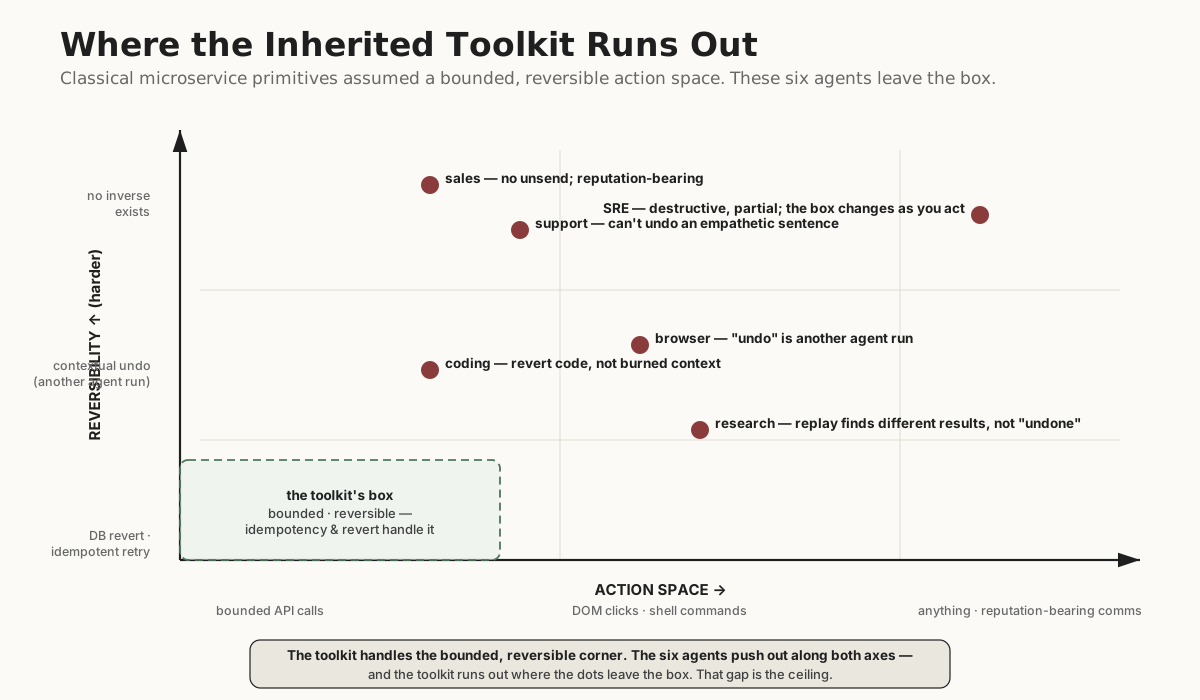
  reversibility ↑ (harder to undo)
   no inverse      │ sales ●            ● support               ● SRE
   exists          │ (no unsend)          (empathetic sentence)   (destructive, partial)
   contextual undo │      ● coding              ● browser
   (another run)   │      (revert code,           ("undo" = another run)
                   │       not burned context)        ● research (replay ≠ reproduce)
   DB revert ·     │ ┌───────────────────┐
   idempotent retry│ │  the toolkit's box │  bounded · reversible — idempotency & revert handle it
                   └─┴───────────────────┴──────────────────────────────────────────► action space
                     bounded API calls   DOM clicks · shell      anything · reputation-bearing comms
The toolkit handles the bounded, reversible corner — idempotency on the call, revert on the write. The six agents push out along both axes, and the toolkit runs out where the dots leave the box. That gap is the ceiling.
VI. The Idempotent-API Defence⌗
1/ The most reasonable objection, made well, sounds like this. Stripe is idempotent on charge. The airline API is idempotent on booking. The broker is idempotent on clOrdID. A retry of the workflow re-fires the same call with the same key. The merchant dedupes. We do not need a durable runtime. We need disciplined idempotency.
2/ The objection is right and incomplete. Five specific ways. Each is best shown in code.
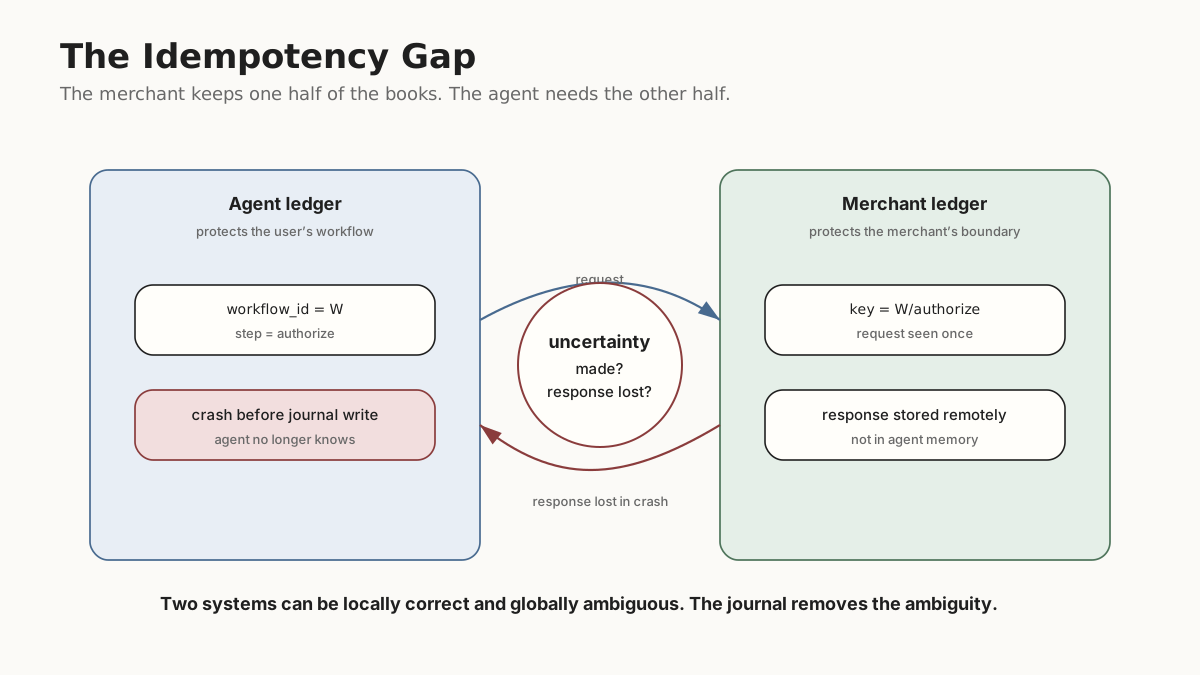
AGENT LEDGER                                      MERCHANT LEDGER
protects user workflow                           protects merchant boundary

workflow W                                       key W/authorize
step authorize                                   request seen once
request sent ─────────────────────────────────► response stored

                   CRASH
                   response lost

agent after restart:
  did the call happen?
  did only the response disappear?
  should I retry?
  should I resume?

without the agent’s journal, the answer is guesswork
The merchant can be correct, the agent can be correct, and the workflow can still be ambiguous.
① Fresh UUID per attempt is not idempotency. It is a guarantee of duplication.⌗
@retry(stop=stop_after_attempt(3))
def execute_sweep(state):
    key = uuid.uuid4().hex                       # ← regenerated every retry
    bank.wire(state.account, state.amount, idempotency_key=key)
3/ The bank receives three different keys across three attempts. It dedupes none of them. The developer wrote @retry and idempotency_key= and felt safe. Both are doing the opposite of safety.
def execute_sweep(state):
    key = derive(state.workflow_id, "sweep", state.step_position)
    bank.wire(state.account, state.amount, idempotency_key=key)
4/ The fix needs a stable workflow identity that survives the agent's restart. The identity must come from the runtime, not from the wall clock. If the framework does not supply it, the developer has to invent it. Inventing it correctly is the job of a workflow runtime.
② Per-integration dedup does not produce workflow-level idempotency.⌗
def workflow():
    bank.wire(amount, key=k1)        # ✓ dedupes at the bank
    # ... process dies here ...
    custodian.book(amount, key=k2)   # never fired
5/ On retry, the workflow has no record of having reached step one. bank.wire fires again with k1 — the bank dedupes correctly and returns the original confirmation. But the workflow does not know this happened the first time. It sees no confirmation in its own books. It may abort. It may retry from elsewhere. It may falsely report failure to the user.
6/ The journal answers this. Idempotency at the layer below the journal does not.
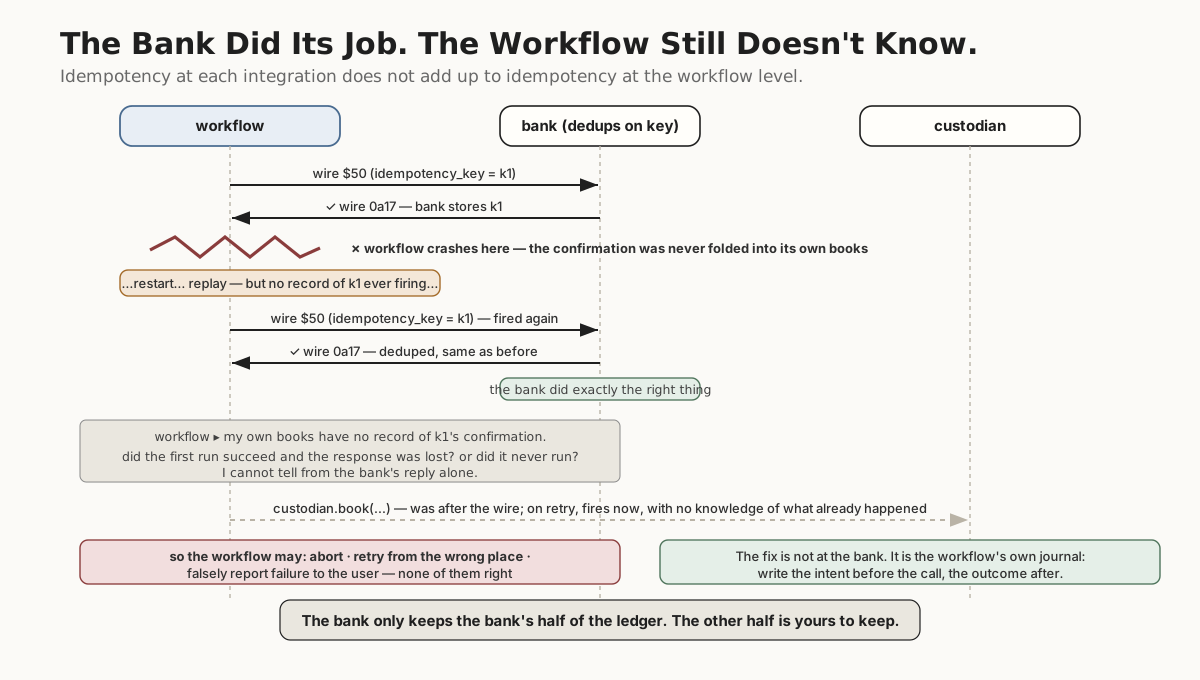
workflow                          bank (dedups on key)        custodian
 │ wire $50 (key=k1) ───────────────►│ ✓ stores k1
 │◄────────────────── ✓ wire 0a17 ───┤
 ✗ workflow crashes — the confirmation was never folded into its own books
 …restart… replay — but no record of k1 ever firing…
 │ wire $50 (key=k1) ───────────────►│ ✓ wire 0a17  (deduped — the bank did exactly right)
 │◄────────────────── ✓ wire 0a17 ───┤
 │ but: my own books have no record of k1's confirmation. did the first run succeed
 │      and the response was lost? or did it never run? I can't tell from the reply.
 │ custodian.book(...) — was after the wire; on retry, fires now, with no knowledge ───►│
 │ → so the workflow may: abort · retry from the wrong place · falsely report failure

The fix is not at the bank. It is the workflow's own journal: intent before the call, outcome after.
Per-integration dedup is necessary; it is not workflow-level idempotency. The bank dedupes correctly and the workflow still cannot reconstruct what happened — because the bank only keeps the bank's half of the ledger.
③ Compensation is not retry.⌗
@retry(stop=stop_after_attempt(3))
def transfer(from_acc, to_acc, amount):
    debit(from_acc, amount)         # succeeds
    credit(to_acc,  amount)         # fails — counterparty closed account
    # @retry replays the WHOLE function. debit fires twice (or dedupes).
    # credit will never succeed. It cannot.
    # The compensation — refund the debit — is never reached.
7/ When step two succeeded and step three fails, the system must run ¬2. ¬2 is a different operation than 2. Idempotent APIs help if the compensation needs to retry. They do not write the compensation. Frameworks that hand-wave compensation with use try/except are not handling it.
④ Idempotency windows are bounded.⌗
def workflow():
    key = derive(...)
    bank.wire(amount, key=key)
    await human_approval()           # ← may take 48 hours
    bank.wire(remaining, key=key)    # bank's key cache is 24 hours
8/ Stripe holds keys for twenty-four hours. Travel approvals, settlement cycles, multi-day human-in-the-loop flows routinely run longer. The second wire is treated as new. The dedup fails silently. The runtime must either complete the operation within the window, or detect expiry and choose a recovery strategy. That logic does not exist at the API layer.
⑤ Reasoning is not in any API contract.⌗
def execute_sweep(state):
    key = derive(state)
    bank.wire(state.account, state.amount, idempotency_key=key)
    # The bank journal records: account, amount, key, timestamp.
    # No record of WHY this account, this amount, this counterparty,
    # this minute. The bank does not care.
    # The auditor will.
9/ The agent decided to pick vendor A because of search snapshot X. It decided to allocate Y because of policy version Z. It decided to escalate because of error pattern W. None of this is an API call. None of it has an idempotency key. All of it is part of what makes the agent's behaviour auditable, replayable, defensible. The journal is where this lives. The API has no story for it.
10/ Idempotency at the API is necessary. It is not sufficient. The gap between necessary and sufficient is exactly the work the new tools are doing.
VII. The Reactive Defence⌗
1/ The other reasonable objection, and it has gotten more reasonable as the tools have gotten better. We do not write await chains. We write reactions. On a state-key change, if a condition holds, the next node fires. The state machine is the orchestration; the graph runs itself; there is no imperative flow to lose. Statecharts have done this for forty years; LangGraph does it now; we do not need a durable runtime — we need a good reactive one.
2/ The objection is right about something real. For a large class of agent work — multi-agent coordination, long-lived entities, "react to whatever happens" rather than "execute this plan" — the reactive shape is the better way to write it. The treasury walk's seven-point ceremony is imperative drudgery; an onEvent graph hides the drudgery behind declarations. And there is a genuine architectural gift in it: when the orchestration is the state, "where was I?" has an answer — read the state — that an imperative call stack does not.
3/ But it is incomplete in exactly the way the idempotency defence was incomplete. The reactive model is a choice on one axis; durability is the other axis; choosing the first says nothing about the second. Seven questions do not go away because you wrote onEvent.
① Is the state itself durable?⌗
4/ "On state-key change" presupposes a place the state lives. If that place is process memory, a cache, or a graph object on the heap, a crash takes your program counter with it — and the whole appeal of the model (the state is where you resume) only holds if the state outlives the crash.
graph = StateGraph(AgentState)
graph.add_conditional_edges("plan", lambda s: "act" if s["ready"] else "wait")
app = graph.compile()                                   # ← in memory. crash here and the run is gone.
app = graph.compile(checkpointer=PostgresSaver(...))    # ← now it persists — at node boundaries
5/ So the floor of the reactive model is a durable state store. That is the easy ten per cent. Note where the checkpointer cuts: at node boundaries, not effect boundaries — the bolt-on granularity this treatise has flagged before — and the next six questions are why it matters. (LangGraph's Functional API moves the cut closer with @task — a completed task's result is cached on the checkpointer and returned-from-history when the surrounding entrypoint re-runs — and the durability="sync"|"async"|"exit" knob lets you choose how often the cut commits. The granularity gain is real; the contract is the same one Section XI names: the user wraps each non-deterministic or side-effecting region in @task, and on resume the entrypoint re-executes around the cached tasks. Effect-level guarantees still ride on the counterparty's idempotency, not on the checkpointer.)
② Does the trigger fire exactly once?⌗
6/ The process watching state.x changed crashes between observing the change and running the handler. Did the handler run? Will it run again on recovery? A reactive system needs a durable change feed with a cursor — an outbox, or change-data-capture with offsets — plus idempotent handlers, or it drops reactions and double-fires them. Postgres LISTEN/NOTIFY drops notifications when nobody is listening. "Poll the table for rows changed since my offset" is an outbox. "Exactly-once stream processing" is Flink and Kafka-Streams machinery. The seam did not vanish; it moved from the workflow crashed mid-await to the trigger loop crashed mid-react — and the second seam is the one the demo never shows.
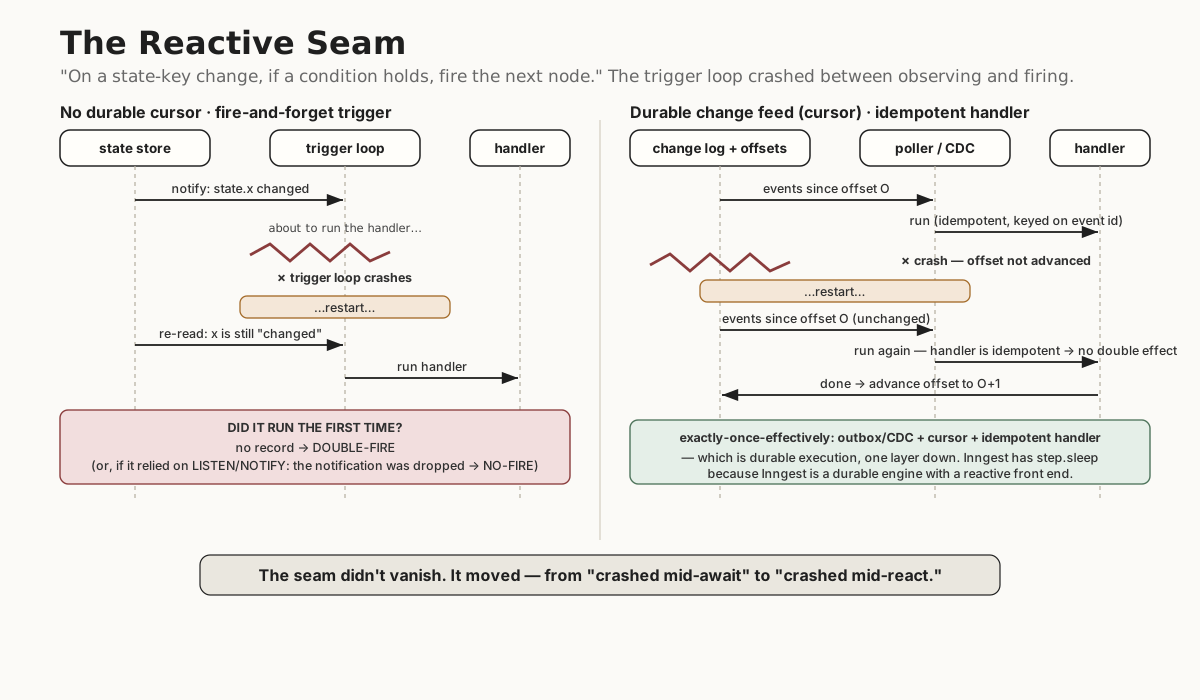
NO DURABLE CURSOR                                 DURABLE CHANGE FEED + IDEMPOTENT HANDLER

state ──notify: x changed──► trigger loop         log+offsets ──events since O──► poller ──run──► handler
                              │ about to run…                                                   (idempotent,
                            ✗ CRASH                            ✗ CRASH — offset not advanced     keyed on event id)
                            …restart…                          …restart…
state ──re-read: x still changed──► loop          log ──events since O (unchanged)──► poller ──run again──► handler
                              │ run handler                                                (idempotent → no double effect)
                                                                                    └─► advance offset to O+1
DID IT RUN THE FIRST TIME?  no record →
DOUBLE-FIRE  (or, on LISTEN/NOTIFY: dropped → NO-FIRE)         exactly-once-effectively — durable execution, one layer down
The seam didn't vanish — it moved, from "the workflow crashed mid-await" to "the trigger loop crashed mid-react." Closing it needs a durable change feed with a cursor and an idempotent handler. Inngest has step.sleep because Inngest is a durable engine with a reactive front end.
③ Is the handler itself durable?⌗
7/ The "next node" does work — calls the model, calls the bank, books the flight. If that node is more than one step, it has the identical crash-in-the-middle problem the imperative version had: authorise succeeded, order did not, process died. The reactive shell relabelled the box; the problem is inside it. So the handler must be a journaled, resumable, idempotent unit of work — which is durable execution, one layer down, doing exactly what Section VIII shows it doing.
④ Where is the timer?⌗
8/ If no approval within forty-eight hours, escalate. That is a durable timer — it has to fire after deploys, restarts, the cluster rescheduling. A reactive system needs durable scheduled events for it. Inngest has step.sleep; that is not Inngest being reactive, that is Inngest being a durable execution engine with a reactive front end. A reactive system without durable timers can react to everything except the passage of time, which is half of what agents wait on.
⑤ Is the condition still true when the handler runs?⌗
9/ You evaluated if state.x > threshold and scheduled the next node; two more transitions land before it runs. That is the time-of-check-to-time-of-use race the coordination primitive in Section IX ⑥ is built to close — and the close (@workflow.update, an atomic check-and-set that returns whether you won) is a durable-execution primitive. Conditional triggers do not escape stale-read coordination; they are made of it.
⑥ Where is the journal?⌗
10/ A reactive store gives you, at best, a sequence of state versions. It does not give you why the transition happened, what effects it fired, what the model decided and on what evidence, what obligation it created. The decision, effect, and obligation ledgers from Section III do not fall out of an onEvent hook. You build them — or you have a state history where you wanted an audit, which is the difference between a log and a journal restated for the reactive paradigm.
⑦ Is the replay deterministic?⌗
11/ If the reactive system rebuilds state by replaying its transition log — and the durable ones do — the replay must be deterministic for the reasons Section XI spends a section on. And if the condition, or the choice of next node, is computed by the model rather than by state.x > threshold, the whole non-determinism problem is now living inside the reactive layer, in the place that looked declarative and safe.
The shape of the answer⌗
12/ Same shape as the idempotency defence. The reactive model is right that there is a better interface for a lot of agent orchestration. It is incomplete as a replacement for durable execution, because durable state, plus reliable triggers, plus resumable handlers, plus durable timers, plus idempotency, plus a journal — that list is durable execution. Put the onEvent model on top of a durable runtime — Inngest, Convex, Restate's virtual objects, Temporal with signals and updates, DBOS — and you get the declarative surface and the guarantees. Put it on a plain database and a polling loop and you will re-derive the list one entry at a time, in the order the workflow community derived it, and you will not notice you are doing it until the second seam crashes in production.
13/ Two axes. Declarative versus imperative is how the orchestration is expressed. Durable versus ephemeral is whether it survives a crash, a deploy, a forty-eight-hour wait. They are orthogonal. The reactive model picks a point on the first and is silent on the second.
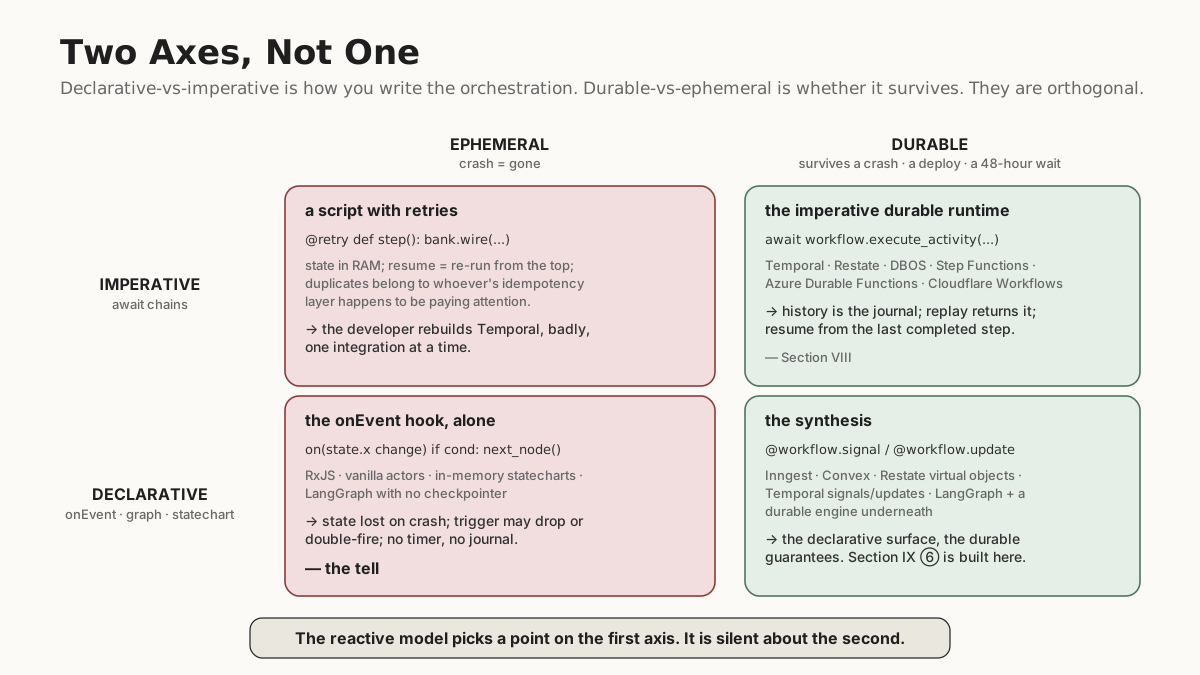
                    EPHEMERAL                          DURABLE
                    crash = gone                       survives crash · deploy · 48h wait
                    -----------                        ---------------------------------
IMPERATIVE          a script with @retry decorators    Temporal · Restate · DBOS ·
await chains        — the developer rebuilds Temporal, Step Functions · Cloudflare Workflows
                    badly, one integration at a time   — the imperative durable runtime

DECLARATIVE         RxJS · vanilla actors · in-memory  Inngest · Convex · Restate virtual
onEvent · graph     statecharts · LangGraph with no    objects · Temporal signals/updates ·
                    checkpointer  ←  the tell          LangGraph + a durable engine underneath
The reactive model picks a point on the first axis. It says nothing about the second. LangGraph is the case in the open — strong on axis one, thin on axis two — which is the configuration Section XII names as the one to put a durable engine underneath, not the one that replaces it.
14/ The one thing the reactive model genuinely buys, restated honestly: it makes durability easier to achieve once the substrate is there, because state-as-program-counter is a resumption-friendly design — the reason event-sourced and statechart systems sit so well on durable runtimes. But "read the durable state, run the idempotent handler, having survived on a durable timer" — every adjective in that sentence is the thing the objection hoped it would not need.
VIII. What the New Layer Actually Does⌗
1/ Read the documentation for any current agent runtime. Temporal. Restate. DBOS. The durability features being retrofitted into LangGraph and CrewAI. What they are converging on is a layer above the classical patterns, not a replacement for them.
2/ The clearest way to see the convergence is to walk the same treasury workflow through a runtime that takes the ceremony seriously. Compare what the developer writes.
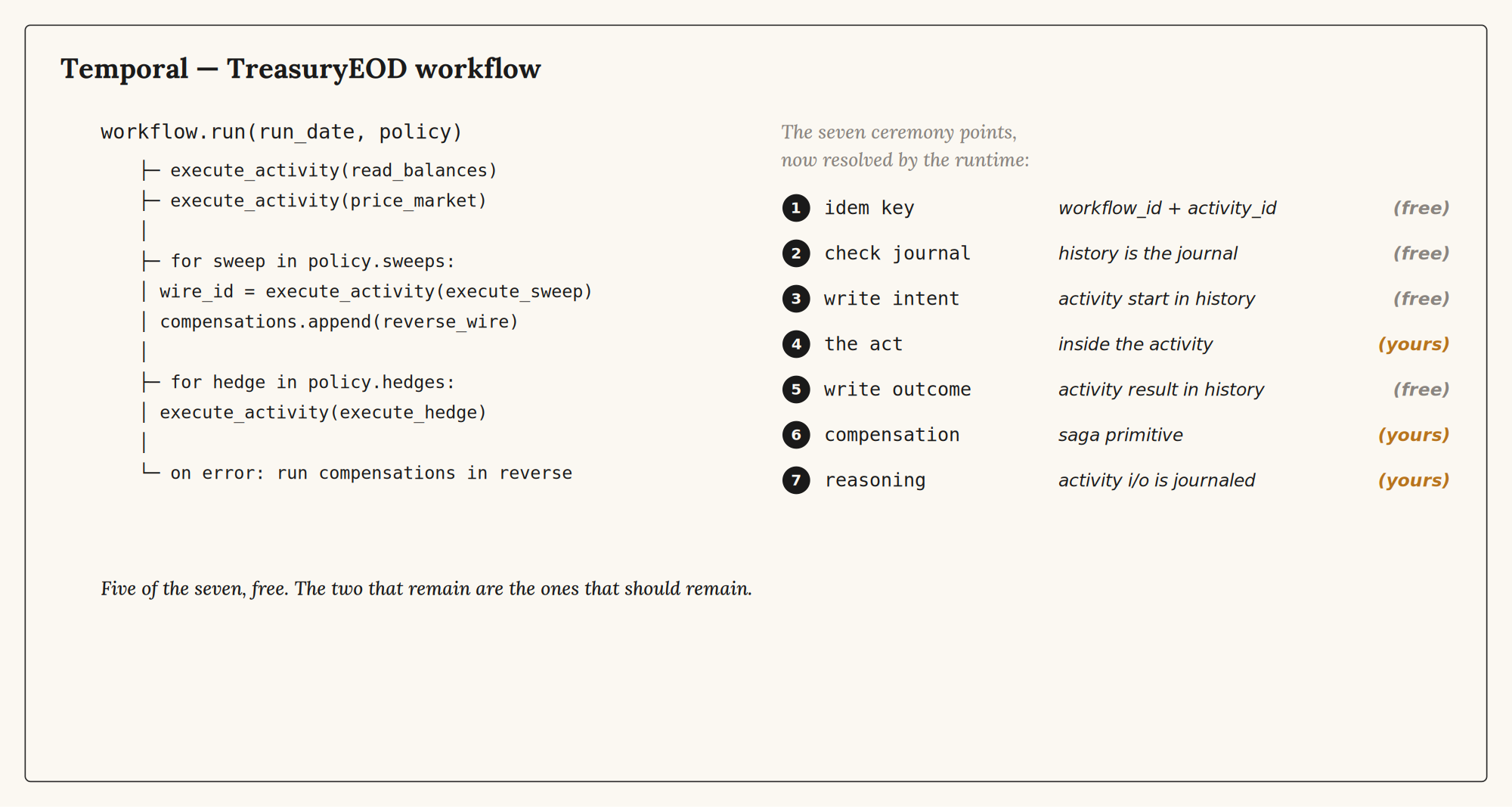
from datetime import timedelta
from temporalio import workflow, activity

@activity.defn
async def execute_sweep(sweep: SweepInput) -> str:
    # ① idempotency key — derived from runtime identity, not invented
    info = activity.info()
    key  = f"{info.workflow_id}:{info.activity_id}"
    # ④ the act — and only the act
    return await bank.wire(
        sweep.account_id, sweep.amount_minor, sweep.target,
        idempotency_key=key,
    )

@workflow.defn
class TreasuryEOD:
    @workflow.run
    async def run(self, run_date: str, policy: Policy) -> Summary:
        balances = await workflow.execute_activity(
            read_balances, run_date,
            schedule_to_close_timeout=timedelta(minutes=2),
        )
        rates = await workflow.execute_activity(
            price_market, balances.currencies,
            schedule_to_close_timeout=timedelta(minutes=2),
        )

        compensations: list[tuple] = []
        try:
            for sweep in policy.compute_sweeps(balances, rates):
                wire_id = await workflow.execute_activity(
                    execute_sweep, sweep,
                    schedule_to_close_timeout=timedelta(minutes=5),
                )
                compensations.append((reverse_wire, wire_id))

            for hedge in policy.compute_hedges(balances, rates):
                await workflow.execute_activity(
                    execute_hedge, hedge,
                    schedule_to_close_timeout=timedelta(minutes=5),
                )

            await workflow.execute_activity(
                post_gl, balances, rates,
                schedule_to_close_timeout=timedelta(minutes=2),
            )
        except ActivityError:
            for fn, arg in reversed(compensations):
                await workflow.execute_activity(
                    fn, arg, schedule_to_close_timeout=timedelta(minutes=5),
                )
            raise

        return Summary(...)
How replay actually works⌗
The Temporal version looks like ordinary async Python, and that is the trick: it is ordinary Python that gets re-executed from the top every time the workflow recovers. What makes that safe is the workflow's history — an append-only log of events, owned by the runtime, not by your code.
On the first run, each await workflow.execute_activity(...) does what it looks like: it schedules the activity, a worker runs it, the result is appended to history as an event. On every run after that — after a crash, a deploy, a reschedule, a worker dying mid-step — the workflow function is replayed from the start, but now each execute_activity call returns the recorded result from history instead of running the activity again. The function re-derives its control flow; the side effects do not re-fire, because the second time through they are reads, not calls. Timers, signals, child workflows, workflow.now(), a workflow.random() draw — all recorded the first time, all replayed from history thereafter.
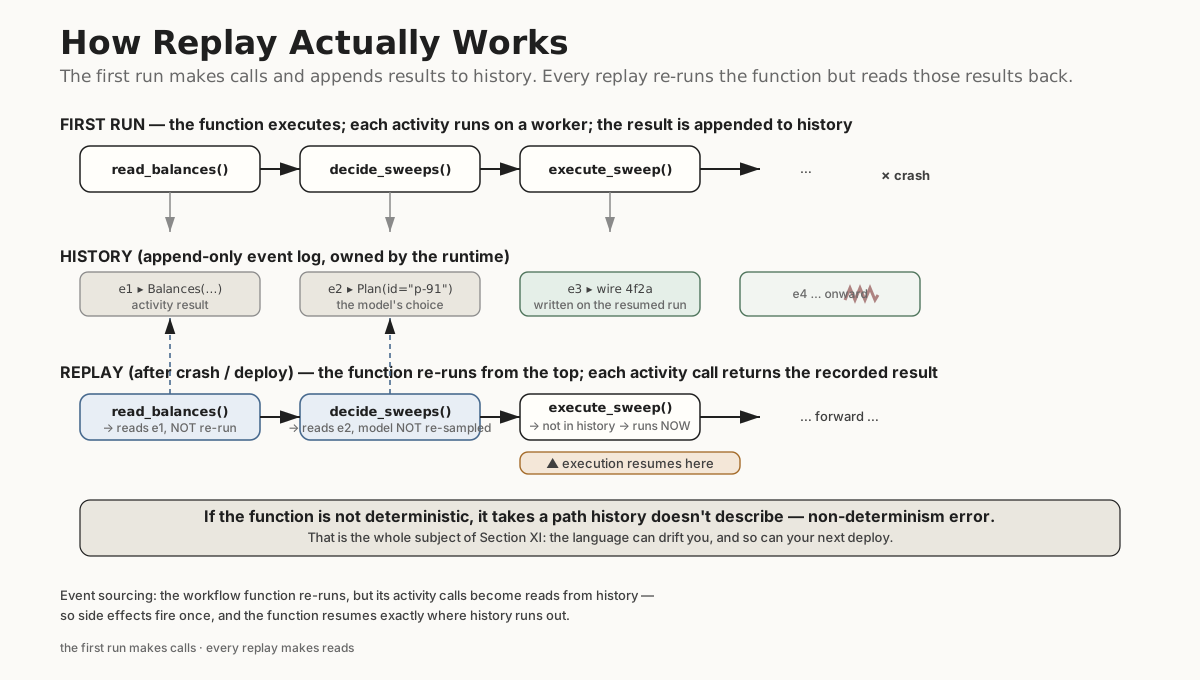
FIRST RUN                                   REPLAY (after crash / deploy)
---------                                   -----------------------------
execute_activity(read_balances)  ───►        read from history  ───►  Balances(...)
   a worker runs it; result → history           (the activity is NOT re-run)
execute_activity(decide_sweeps)  ───►        read from history  ───►  Plan(id="p-91", …)
   a worker runs it; result → history           (the model is NOT re-sampled)
execute_activity(execute_sweep)  ───►        ── not in history yet ──►  a worker runs it now
   ↑ the crash happened around here             this is where execution resumes
This is event sourcing, and it is why "replay returns this object" — the sentence the next several sections lean on — is a guarantee rather than a hope. It also says exactly what you may not do: anything in workflow code whose value is not recorded in history must produce the same answer on every replay, or the function takes a different path than the one history describes and the engine raises a non-determinism error. That constraint is the whole subject of Section XI — and it has two faces the section takes in turn: the language can betray you, and so can your own next deploy.
3/ Compare to the LangGraph version. What disappeared.
4/ The retry decorator. Temporal retries activities by configured policy.
5/ The idempotency key derivation. workflow_id and activity_id are supplied. The developer does not invent stability; the runtime guarantees it.
6/ The pending write before the act. The activity start is recorded in workflow history before the activity runs. History is the journal.
7/ The confirmed / failed / unknown write after the act. The activity result is recorded in history when it returns. The unknown case becomes a known runtime concept (HEARTBEAT_TIMEOUT, RETRY_POLICY) rather than a custom field in a side table.
8/ The check-the-journal lookup at the top of every tool. Replay reads from history. The agent does not re-fire confirmed activities.
9/ The kickoff resumption wrapper. Workflows resume from the last completed activity automatically.
10/ What still belongs to the developer. The idempotency key handed to the bank — Temporal supplies the stable identity, but the bank still needs a key on its API, and the developer still passes it. The compensation logic — Temporal gives saga primitives, the developer writes the compensating activities. The reasoning — the why — is still passed as an activity input or output, journaled because Temporal journals all activity inputs and outputs, but with no richer semantics than that.
11/ This is the floor closing. The exactly-once writes, the compensation paths, the idempotency at workflow scope, the long-running suspend-and-resume — these are no longer the developer's invention. They are the runtime's job.
12/ The ceiling is still being built. Reasoning provenance. Action-space gates that surface destructive or irreversible actions to a human and suspend until approved. Multi-agent coordination through journaled state — when N agents share a problem, they coordinate through a journaled consistent view rather than direct messaging. Budget — token, dollar, time — as a first-class workflow construct, not a wrapper that fires after the fact. Verification at consumption — re-reading fresh state before any consequential action rather than trusting the journal. Replay semantics tuned per agent class. The runtimes are converging on these. None has the full set yet.
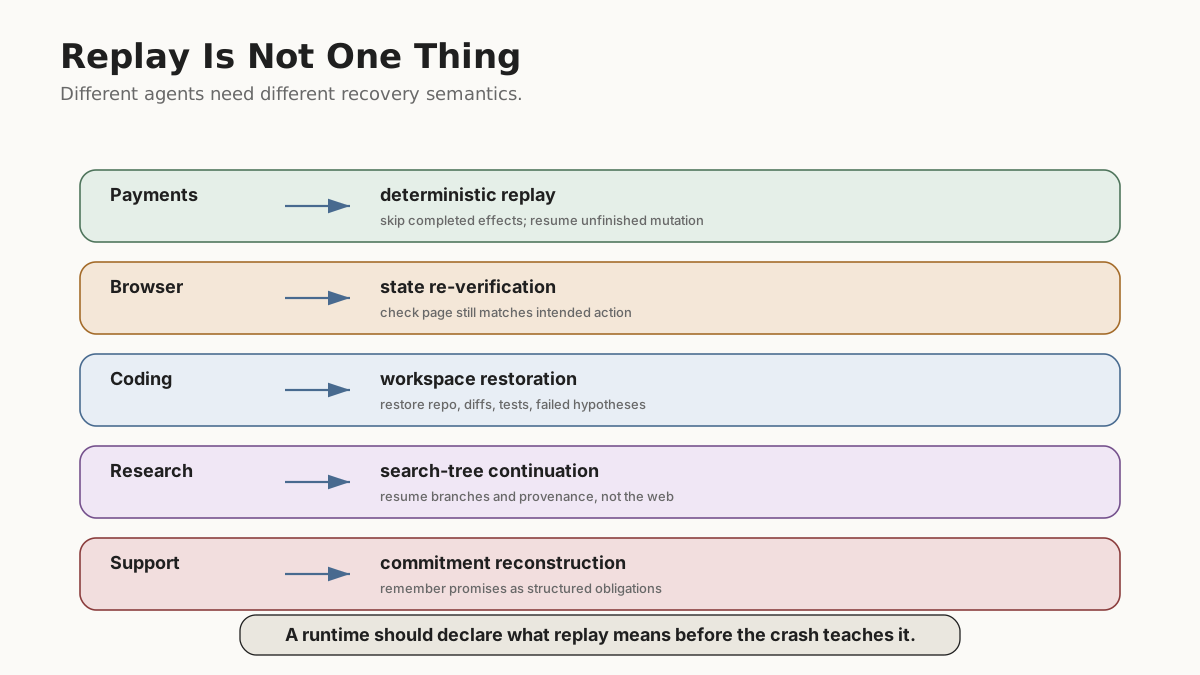
AGENT TYPE     REPLAY MEANS
----------     ------------
payments       deterministic replay; skip completed effects
browser        re-verify page state before repeating action
coding         restore workspace, diffs, tests, failed hypotheses
research       resume the search tree and provenance
support        reconstruct commitments and obligations

One word, many semantics.
Good runtimes declare what replay means before the crash teaches them.
13/ None of this is solved by Postgres plus Kafka plus a saga library. None of it is a problem Postgres plus Kafka plus a saga library was designed for. The classical toolkit handles the plumbing. What sits above the plumbing is genuinely new work.
14/ The shape of the stack, when the dust settles, looks like this.
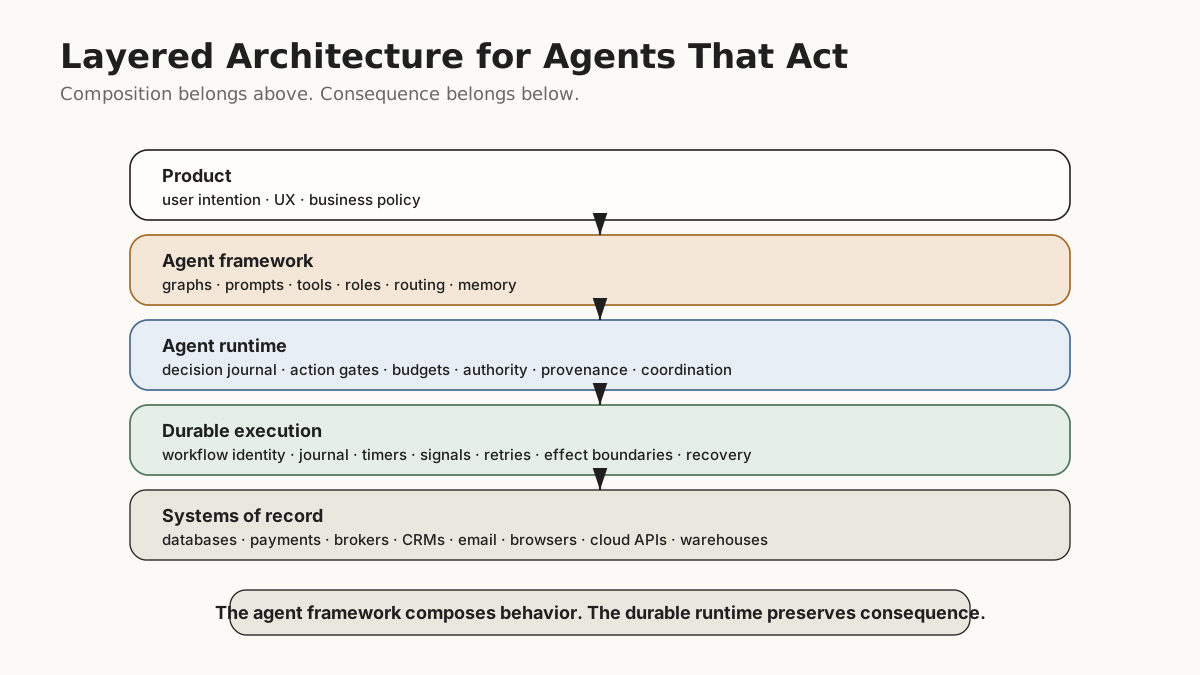
┌────────────────────────────────────────────────────┐
│ PRODUCT                                            │
│ user intention · UX · business policy              │
├────────────────────────────────────────────────────┤
│ AGENT FRAMEWORK                                    │
│ graphs · prompts · tools · roles · routing         │
├────────────────────────────────────────────────────┤
│ AGENT RUNTIME                                      │
│ decisions · gates · budgets · authority · provenance│
├────────────────────────────────────────────────────┤
│ DURABLE EXECUTION                                  │
│ identity · journal · timers · signals · recovery   │
├────────────────────────────────────────────────────┤
│ SYSTEMS OF RECORD                                  │
│ payments · brokers · CRMs · email · cloud · DBs    │
└────────────────────────────────────────────────────┘
Composition belongs above. Consequence belongs below. The agent framework composes behaviour; the durable runtime preserves consequence.
IX. Six Primitives of the Ceiling⌗
1/ Section VIII showed a runtime closing the floor — retries, idempotency at workflow scope, suspend-and-resume, the compensation stack folded into a try/except. The ceiling is not one thing. It is a handful of primitives, each with a naive form that demos cleanly and a durable form that survives the year. Six of them, in code. Assume the Temporal vocabulary from Section VIII: workflow.execute_activity, workflow.wait_condition, workflow.now, workflow.sleep, @workflow.signal, @workflow.query, activity.info.
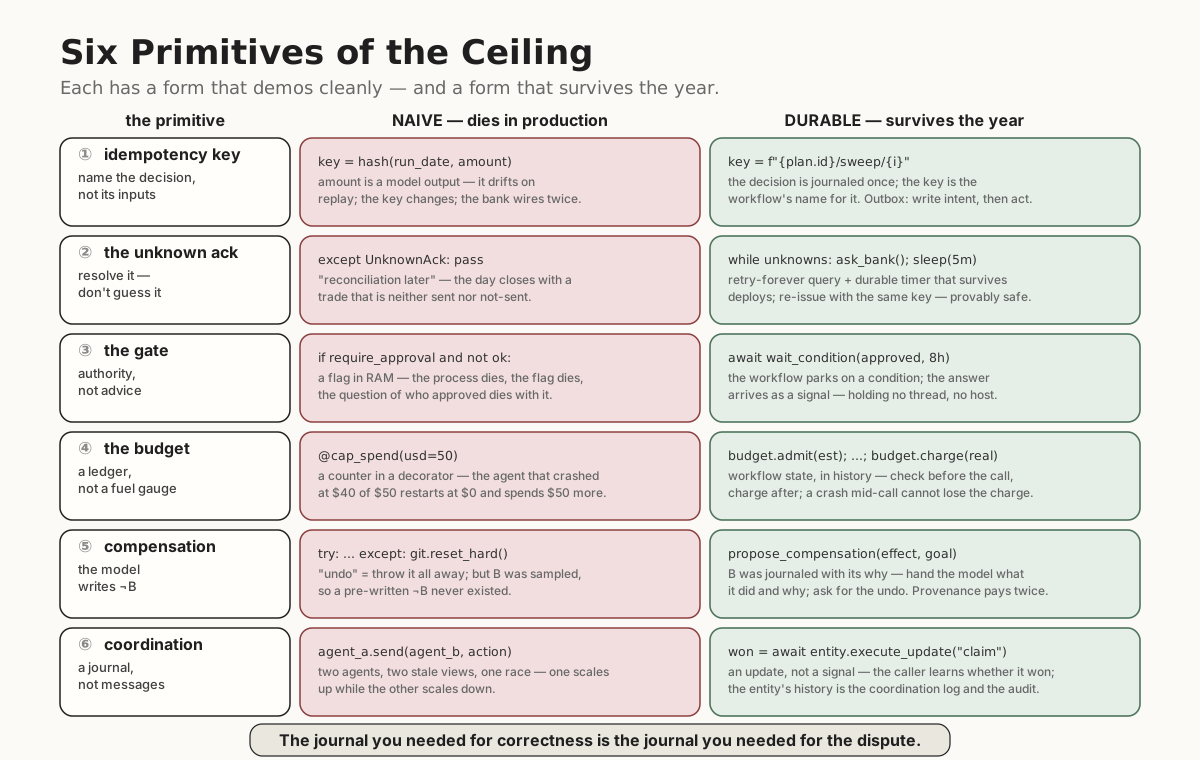
PRIMITIVE                NAIVE — dies in production             DURABLE — survives the year
---------                --------------------------             ---------------------------
① idempotency key        key = hash(run_date, amount)           key = f"{plan.id}/sweep/{i}"
  name the decision      amount drifts on replay → two wires    decision journaled once; key names it

② the unknown ack        except UnknownAck: pass                while unknowns: ask_bank(); sleep(5m)
  resolve, don't guess   "reconciliation later"                 retry-forever query + durable timer

③ the gate               if require_approval and not ok: ...    await wait_condition(approved, 8h)
  authority, not advice  a flag in RAM — dies with the process  the answer arrives as a signal

④ the budget             @cap_spend(usd=50)                     budget.admit(est); ...; budget.charge(real)
  a ledger, not a gauge  resets to $0 on restart                workflow state — check before, charge after

⑤ compensation           try: ... except: git.reset_hard()      propose_compensation(effect, goal)
  the model writes ¬B    "undo" = throw it all away             ask the model, from the journaled why

⑥ coordination           agent_a.send(agent_b, action)          won = await entity.execute_update("claim")
  a journal, not messages two stale views, one race             an update (not a signal) linearizes the effects
The journal you needed for correctness turns out to be the journal you needed for the dispute.
① The idempotency key must name the decision, not its inputs⌗
2/ Look again at the treasury key: sha256(run_date, account_id, amount_minor, target). amount_minor is not an input. It is an output — the model computed it from the day's balances. And the day's balances can change between the original run and the replay: a late credit posts, a settlement clears an hour after cutoff.
3/ So on replay the model recomputes amount_minor, gets a different number, the key changes, and the bank — correctly, by its own rules — treats the instruction as new. Two wires. The idempotency layer did its job. The key was the bug.
# WRONG — the key is a function of values the model recomputes on replay.
def execute_sweep(state):
    amount = policy.sweep_amount(state.balances)             # recomputed on replay
    key    = sha256(f"{state.run_date}:{state.account}:{amount}".encode()).hexdigest()
    bank.wire(state.account, amount, idempotency_key=key)
# A late credit lands; read_balances returns a higher figure on the retry;
# `amount` changes; `key` changes; the bank sees a brand-new instruction. Two wires.

# RIGHT — the decision is journaled once; the key names the journal entry.
@workflow.defn
class TreasuryEOD:
    @workflow.run
    async def run(self, run_date: str, policy: Policy) -> Summary:
        balances = await workflow.execute_activity(read_balances, run_date, ...)
        # decide ONCE. the result lives in history. replay returns *this* plan,
        # not a fresh computation against possibly-changed balances.
        plan = await workflow.execute_activity(decide_sweeps, DecideIn(balances, policy), ...)
        for i, sweep in enumerate(plan.sweeps):
            await workflow.execute_activity(
                execute_sweep,
                SweepCmd(sweep, decision_id=f"{plan.id}/sweep/{i}"),     # ← stable; cannot drift
                ...,
            )

@activity.defn
async def execute_sweep(cmd: SweepCmd) -> str:
    # the key the bank sees is the workflow's name for this decision —
    # not a hash of figures the model might recompute differently next time.
    return await bank.wire(cmd.account, cmd.amount_minor, cmd.target,
                           idempotency_key=cmd.decision_id)
4/ The unit of idempotency is the decision, and the decision has to be a durable record before it is an action. That is the outbox pattern — write the intent, then do the effect — the same pattern the treasury walk hand-rolled in point ③, now placed where it belongs: the decide step, not the act step.
② The third outcome, and the loop that resolves it⌗
5/ Ceremony point ⑤ named a third status — unknown — for the wire whose acknowledgement was lost, then waved at it: reconciliation will resolve this later. Later is now. The bank is the end-to-end check; its record is the truth; the workflow cannot close the day until every unknown has been turned into a known.
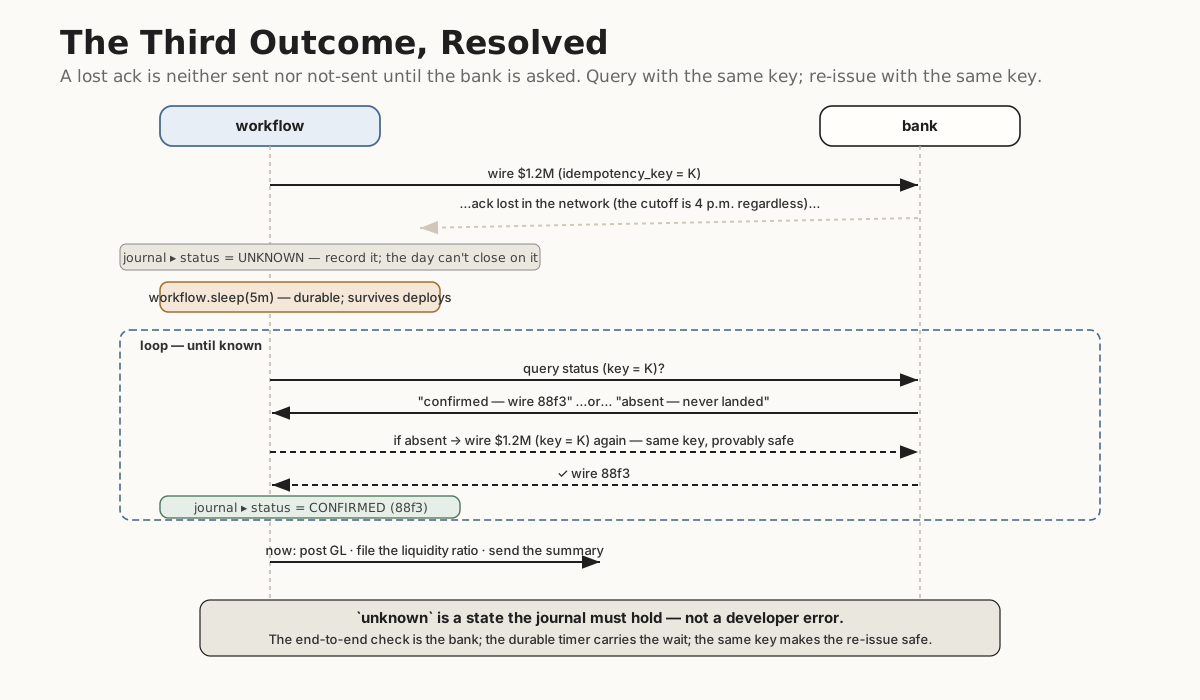
workflow                                      bank
 │ wire $1.2M (key=K) ─────────────────────────►│
 │◄┄┄┄┄┄┄ …ack lost in the network… ┄┄┄┄┄┄┄┄┄┄┄┤   (the cutoff is 4 p.m. regardless)
 │ journal ▸ status = UNKNOWN — record it; the day can't close on it
 │ workflow.sleep(5m) — durable; survives deploys
 │ ┌─ loop: until known ─────────────────────────────────────────────┐
 │ │ query status (key=K)? ───────────────────────►│
 │ │◄──── "confirmed — wire 88f3"  …or…  "absent" ──┤
 │ │ if absent → wire $1.2M (key=K) again ─────────►│   (same key, provably safe)
 │ │◄────────────────────────── ✓ wire 88f3 ───────┤
 │ │ journal ▸ status = CONFIRMED (88f3)
 │ └──────────────────────────────────────────────────────────────────┘
 │ now: post GL · file the liquidity ratio · send the summary
A lost ack is neither sent nor not-sent until the bank is asked. Query with the same key; re-issue with the same key; the durable timer carries the wait across deploys. unknown is a state the journal must hold — not a developer error.
@workflow.defn
class TreasuryEOD:
    # ...read, decide, sweep, hedge as above, each appending to self.wires...

    async def _settle_unknowns(self) -> None:
        unresolved = [w for w in self.wires if w.status == "unknown"]
        while unresolved:
            for w in unresolved:
                truth = await workflow.execute_activity(
                    query_wire_status, w.decision_id,
                    schedule_to_close_timeout=timedelta(seconds=30),
                    retry_policy=RetryPolicy(maximum_attempts=0),   # the bank owes us an answer; wait for it, across deploys
                )
                if truth.status == "confirmed":
                    w.status, w.wire_id = "confirmed", truth.wire_id
                elif truth.status == "absent":
                    # it never landed. re-issue with the SAME key — provably safe.
                    w.wire_id = await workflow.execute_activity(execute_sweep, w.cmd, ...)
                    w.status = "confirmed"
            unresolved = [w for w in self.wires if w.status == "unknown"]
            if unresolved:
                await workflow.sleep(timedelta(minutes=5))          # the bank is slow; sleep, durably
        # only now: post GL, file the liquidity ratio, send the summary.
6/ Two things here do real work a non-durable agent cannot. maximum_attempts=0 — retry forever, across deploys, until the bank answers. And workflow.sleep — a multi-hour wait that holds no thread, no socket, no host, and survives the operator shipping a release in the middle of it. time.sleep in a worker process is a held resource and, if the worker dies, a lost wait.
And notice what this loop is and is not. It is not the journal overruling the bank. It is the journal asking the bank — because outcomes are the bank's to know, and intents are the journal's. The journal owns what the agent meant to do, in what order, and why; the counterparty owns what actually happened; the unknown lives in the gap between them. A status query — retrieve the PaymentIntent, ask FIX for OrdStatus, pull the PNR — is how the gap closes when the API offers one. Many do. Some do not, and there the journal is genuinely all you have. Build for that case; use the query when you can. (This is the honest reading of "the merchant only keeps their half of the ledger": a claim about who is obligated to remember, not a claim that the counterparty has nothing to tell you.)
③ The action gate is a signal, not a flag⌗
7/ A flag — if require_approval and not approved — lives in the process. The process dies; the flag dies; the question of whether anyone approved dies with it. The durable form parks the workflow on a condition and lets the answer arrive as a signal, possibly hours later, possibly after three deploys, while the workflow holds nothing.
@workflow.defn
class GuardedAction:
    def __init__(self) -> None:
        self._verdict: Verdict | None = None

    @workflow.signal
    def decide(self, v: Verdict) -> None:        # arrives from Slack, an email link, an ops console
        self._verdict = v

    @workflow.run
    async def run(self, action: Action) -> Result:
        if action.risk == "irreversible":
            await workflow.execute_activity(notify_approver, action,
                                            schedule_to_close_timeout=timedelta(seconds=30))
            got = await workflow.wait_condition(lambda: self._verdict is not None,
                                                timeout=timedelta(hours=8))
            if not got or self._verdict.outcome != "approve":
                return Result.declined(action, self._verdict)
        # the world may have moved during the wait — re-verify; do not trust the journal
        if not await workflow.execute_activity(precondition_holds, action, ...):
            return Result.stale(action)
        return await workflow.execute_activity(perform, action, ...)
8/ The prompt is advice. The gate is authority. The model can propose the irreversible action all day; the gate is the only thing that lets it happen, and the gate is durable state, not a runtime boolean.
④ Budget is a workflow object, not a wrapper⌗
9/ A budget enforced by a decorator is a counter in memory. The agent that crashed at $40 of a $50 cap restarts at $0 and spends $50 more. A real budget is workflow state — in history, surviving replay — checked before the spend and charged after it, so a crash mid-call cannot lose the charge and cannot double it.
@dataclass
class Budget:
    usd_cap: float
    token_cap: int
    usd_spent: float = 0.0
    tokens_spent: int = 0

    def admit(self, est_usd: float, est_tokens: int) -> None:
        if self.usd_spent + est_usd > self.usd_cap:         raise BudgetExceeded("usd")
        if self.tokens_spent + est_tokens > self.token_cap: raise BudgetExceeded("tokens")

    def charge(self, usd: float, tokens: int) -> None:
        self.usd_spent += usd
        self.tokens_spent += tokens

@workflow.defn
class ResearchAgent:
    @workflow.run
    async def run(self, question: str, budget: Budget) -> Report:
        frontier: list[Query] = [Query.seed(question)]
        findings: list[Finding] = []
        while frontier:
            budget.admit(est_usd=0.03, est_tokens=8_000)            # refuse BEFORE the call
            q = frontier.pop()
            hits = await workflow.execute_activity(search, q, ...)
            budget.charge(hits.usd, hits.tokens)                    # recorded in history, exactly once
            for h in hits:
                claim = await workflow.execute_activity(extract_claim, h, ...)
                findings.append(claim.with_provenance(query=q, url=h.url, snippet=h.snippet))
                budget.charge(claim.usd, claim.tokens)
                if budget.usd_spent < 0.8 * budget.usd_cap:         # chase follow-ups only while there's room
                    frontier.extend(await workflow.execute_activity(followups, claim, ...))
        # replay resumes the frontier *and* the spent counters from history.
        # it does not re-run the searches, and it does not re-spend the budget.
        return await workflow.execute_activity(synthesize, findings, ...)
10/ Note with_provenance. Every claim in the report carries the query that found it, the URL it came from, the snippet it was extracted from — all journaled at the moment the claim entered the report, not reconstructed afterward from logs that may not exist. That is the answer to how do you know this is true, recorded when the knowing happened.
⑤ Adaptive compensation: the model writes the inverse⌗
11/ A pre-written ¬B does not exist when B was sampled rather than authored. But B was journaled — its request, its response, its rationale — and that is exactly enough context to ask the model to undo it.
@dataclass
class Effect:
    kind: str
    decision_id: str
    request: dict
    response: dict
    rationale: str            # the model's why, journaled — now load-bearing twice

KNOWN_INVERSES = {            # where a deterministic undo exists, prefer it
    "wire":      reverse_wire,
    "book_room": cancel_room,
    "gl_post":   reverse_gl_entry,
}

async def unwind(effects: list[Effect], goal: str) -> None:
    for e in reversed(effects):                                       # LIFO, like a saga
        if e.kind in KNOWN_INVERSES:
            await workflow.execute_activity(KNOWN_INVERSES[e.kind], e,
                                            idempotency_key=f"comp/{e.decision_id}", ...)
            continue
        # no canned inverse — hand the model what it did and why; ask for the undo
        plan = await workflow.execute_activity(propose_compensation, CompIn(effect=e, goal=goal), ...)
        await workflow.execute_activity(validate_compensation, ValidateIn(e, plan), ...)   # cheap guardrail before any act
        for step in plan.steps:
            await workflow.execute_activity(
                perform, ToolCmd(step, idempotency_key=f"comp/{e.decision_id}/{step.seq}"), ...)
12/ This is why the journal records why and not only what. The auditor needs the why; so does the rollback. Provenance is not overhead carried for the regulator — it is the input to your own recovery path.
⑥ Coordination through journaled state, not messages⌗
13/ Two SRE agents on one incident. Two sales agents on one prospect. The failure is one acting on the other's stale view — one scales up while the other scales down, one emails while the other is mid-call. Do not let them message each other; that trades a stale view for a racing one. Mediate through a durable entity that linearises their effects and, in doing so, is the coordination log.
@workflow.defn
class IncidentEntity:                            # one per incident, long-lived
    def __init__(self) -> None:
        self.lease: Lease | None = None
        self.log: list[tuple] = []

    @workflow.update                             # an update, not a signal — the caller must learn whether it won
    def claim(self, agent: str, ttl: timedelta) -> bool:
        if self.lease is None or self.lease.deadline <= workflow.now():
            self.lease = Lease(holder=agent, deadline=workflow.now() + ttl)
        return self.lease.holder == agent        # atomic check-and-set; the return value *is* the answer

    @workflow.update
    def record(self, agent: str, action: Action) -> bool:
        if not (self.lease and self.lease.holder == agent):
            return False                         # you do not hold the lease — your record is rejected
        self.log.append((workflow.now(), agent, action))
        return True

    @workflow.query
    def view(self) -> IncidentView:
        return IncidentView(lease=self.lease, log=self.log)

# an SRE agent, before anything destructive:
if not await incident.execute_update("claim", me, timedelta(minutes=10)):
    return Yield(to=(await incident.query("view")).lease.holder)   # someone else holds it — stand down
await incident.execute_update("record", me, action.starting())
await workflow.execute_activity(perform, action, ...)
await incident.execute_update("record", me, action.completed())
14/ An update, not a signal — and the distinction is the whole point of a coordination primitive. A signal is fire-and-forget; a check-and-set is only safe if the caller learns whether it won; and signal("claim"); query("view") is a race against another agent's signal arriving in between. The update returns the verdict atomically with the change. (One workflow serialising every claim from N agents is correct and, past a certain rate, slow — the coda in Section X owes that an honest word.)
15/ The entity's history is the coordination protocol and the incident timeline and the audit trail — one structure, three readers. That is the shape of every ceiling primitive: the journal you needed for correctness turns out to be the journal you needed for the dispute.
X. The Loop, Made Durable⌗
1/ Put the six primitives together and the agent loop — observe, decide, gate, verify, act, fold, judge, compensate — fits in about seventy lines, with the durability underneath the loop rather than threaded through every tool body.
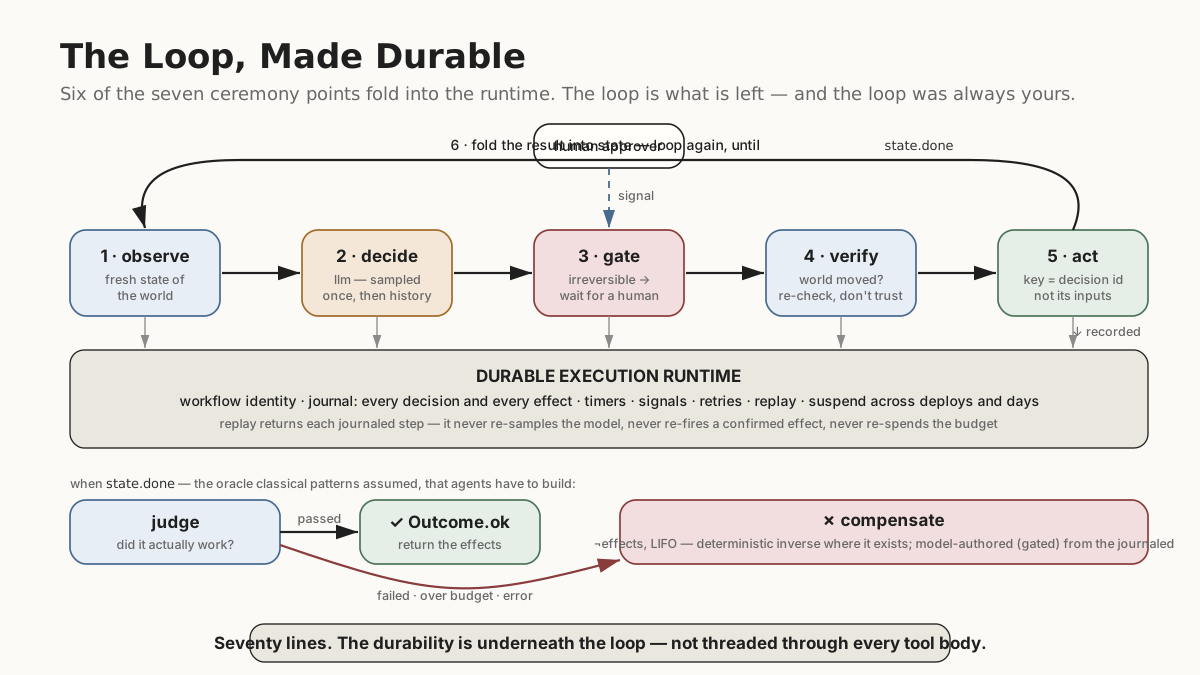
        ┌────────────────── 6 · fold the result into state, loop until state.done ──────────────────┐
        ▼                                                                                           │
   ┌──────────┐    ┌──────────┐    ┌──────────┐    ┌──────────┐    ┌──────────┐                     │
   │1 observe │──► │2 decide  │──► │3 gate    │──► │4 verify  │──► │5 act     │─────────────────────┘
   │fresh     │    │llm: once,│    │human sig.│    │world     │    │key =     │
   │state     │    │then hist.│    │if irrev. │    │moved?    │    │decision id│
   └────┬─────┘    └────┬─────┘    └────┬─────┘    └────┬─────┘    └────┬─────┘
        └───────────────┴───────────────┴───────────────┴───────────────┘   every step → journaled
                                        │
   ═════════════════════════════════════▼══════════════════════════════════════════════════════════
    DURABLE EXECUTION RUNTIME — workflow identity · journal (every decision + every effect) ·
    timers · signals · retries · replay · suspend across deploys and days.
    Replay returns each step: never re-samples the model, never re-fires a confirmed effect,
    never re-spends the budget.
   ═══════════════════════════════════════════════════════════════════════════════════════════════

   when state.done →  judge ──deterministic pass · or confident pass──► ✓ Outcome.ok
                        ├──uncertain──► human review ──accept──► ✓ Outcome.ok
                        │                            └──reject──┐
                        └──failed / over budget / error─────────┴──► compensate
                              ¬effects, LIFO — known inverse, or model-authored (gated) from the why;
                              a compensation that itself fails ──► stuck, and a page
Six of the seven ceremony points fold into the runtime. What is left is the loop — observe, decide, gate, verify, act, fold — which was always yours.
from datetime import timedelta
from temporalio import workflow, activity
from temporalio.common import RetryPolicy

# ── activities: every boundary-crossing thing, and nothing else, is one ───────
@activity.defn
async def observe(handle: EnvHandle) -> Observation: ...        # fresh state of the world
@activity.defn
async def llm_decide(ctx: DecideCtx) -> Decision: ...           # the one non-determinism, captured in history
@activity.defn
async def precondition_holds(ctx: PreCtx) -> bool: ...          # did the world move since `observe`?
@activity.defn
async def perform(cmd: ToolCmd) -> ToolResult: ...              # carries cmd.idempotency_key to the counterparty
@activity.defn
async def judge(ctx: JudgeCtx) -> Verdict: ...                  # the "did it actually work" oracle
@activity.defn
async def notify_approver(a: Action) -> None: ...
@activity.defn
async def propose_compensation(c: CompIn) -> CompPlan: ...
@activity.defn
async def validate_compensation(c: ValidateIn) -> None: ...     # cheap guardrail before any model-authored undo
@activity.defn
async def alert_oncall(c: StuckCtx) -> None: ...                # a saga that cannot finish unwinding pages a human

KNOWN_INVERSES: dict[str, object] = {...}

# ── the workflow: the agent loop, durable end to end ──────────────────────────
@workflow.defn
class Agent:
    def __init__(self) -> None:
        self._approval: Verdict | None = None      # human verdict on a gated action
        self._review:   Verdict | None = None      # human verdict on a low-confidence judge result
        self._effects: list[Effect] = []

    @workflow.signal
    def approve(self, v: Verdict) -> None:
        self._approval = v

    @workflow.signal
    def review(self, v: Verdict) -> None:
        self._review = v

    @workflow.query
    def trace(self) -> list[dict]:                              # a live audit feed, no extra plumbing
        return [e.public() for e in self._effects]

    @workflow.run
    async def run(self, goal: str, policy: Policy, budget: Budget) -> Outcome:
        state = State.from_goal(goal)
        try:
            while not state.done:
                # 1. observe — fresh, never carried over from the last iteration
                obs = await workflow.execute_activity(
                    observe, state.handle, schedule_to_close_timeout=timedelta(seconds=30))

                # 2. decide — sampled once; from here on it is history
                budget.admit(est_usd=0.04, est_tokens=12_000)
                decision = await workflow.execute_activity(
                    llm_decide, DecideCtx(goal, state, obs, policy),
                    schedule_to_close_timeout=timedelta(minutes=2))
                budget.charge(decision.usd, decision.tokens)
                decision_id = f"{workflow.info().workflow_id}/{decision.seq}"
                if decision.kind == "stop":
                    break

                # 3. gate — irreversible acts wait for a human, durably, holding nothing
                if policy.is_gated(decision.action):
                    await workflow.execute_activity(notify_approver, decision.action,
                        schedule_to_close_timeout=timedelta(seconds=30))
                    ok = await workflow.wait_condition(
                        lambda: self._approval is not None
                                and self._approval.decision_id == decision_id,
                        timeout=timedelta(hours=8))
                    if not ok or self._approval.outcome != "approve":
                        state = state.note_declined(decision); continue

                # 4. verify at consumption — the world may have moved since step 1
                if not await workflow.execute_activity(precondition_holds,
                        PreCtx(decision.action, obs.version),
                        schedule_to_close_timeout=timedelta(seconds=30)):
                    state = state.mark_stale(decision); continue

                # 5. act — idempotency key = the decision's identity, not its inputs
                result = await workflow.execute_activity(
                    perform, ToolCmd(decision.action, idempotency_key=decision_id),
                    schedule_to_close_timeout=timedelta(minutes=5),
                    retry_policy=RetryPolicy(maximum_attempts=8))
                self._effects.append(Effect.of(decision, result))      # decision ⊕ effect ⊕ rationale

                # 6. fold the result back; loop
                state = state.update(decision, result)

            # 7. the oracle classical patterns assumed and agents have to build —
            #    but an LLM oracle is fallible in both directions, so do not let a
            #    guess trigger an irreversible rollback.
            verdict = await workflow.execute_activity(
                judge, JudgeCtx(goal, state, self._effects),
                schedule_to_close_timeout=timedelta(minutes=2))
            if verdict.confidence == "deterministic":
                # tests passed / the API returned ok / an invariant holds: this is a `verify`,
                # not a judgment — act on it. (Financial agents live here and need no LLM judge.)
                if verdict.passed:
                    return Outcome.ok(state, self._effects)
            elif verdict.passed and verdict.confidence == "high":
                return Outcome.ok(state, self._effects)
            else:
                # low confidence, or any failure an LLM judged: ask a human, the same
                # way a gated action does. The judge proposes; a person disposes.
                got = await workflow.wait_condition(lambda: self._review is not None,
                                                    timeout=timedelta(hours=8))
                if not got or self._review.outcome == "escalate":
                    return Outcome.needs_review(state, self._effects, verdict)
                if self._review.outcome == "accept":
                    return Outcome.ok(state, self._effects)
                # the human (or the next, more expensive judge) says it is broken → compensate
            return await self._compensate(state, goal, policy, GoalNotMet(verdict.why))

        except (BudgetExceeded, ActivityError) as failure:
            return await self._compensate(state, goal, policy, failure)

    async def _compensate(self, state, goal, policy, failure) -> Outcome:
        # 8. compensation — a deterministic inverse where one exists; otherwise model-authored,
        #    but every model-authored step runs through the same gate as a forward act, an
        #    irreversible undo is escalated rather than improvised, and — because compensations
        #    fail too — the honest end-state when one does is `stuck`, which pages a human.
        stuck: list[Effect] = []
        for e in reversed(self._effects):                          # LIFO, like a saga
            try:
                if e.kind in KNOWN_INVERSES:
                    await workflow.execute_activity(KNOWN_INVERSES[e.kind], e,
                        idempotency_key=f"comp/{e.decision_id}",
                        schedule_to_close_timeout=timedelta(minutes=5))
                    continue
                plan = await workflow.execute_activity(propose_compensation,
                    CompIn(e, goal), schedule_to_close_timeout=timedelta(minutes=2))
                await workflow.execute_activity(validate_compensation, ValidateIn(e, plan),
                    schedule_to_close_timeout=timedelta(seconds=30))
                if any(s.risk == "irreversible" or policy.is_gated(s) for s in plan.steps):
                    stuck.append(e); continue                      # do not let the model improvise an irreversible undo
                for s in plan.steps:
                    await workflow.execute_activity(perform,
                        ToolCmd(s, idempotency_key=f"comp/{e.decision_id}/{s.seq}"),
                        schedule_to_close_timeout=timedelta(minutes=5))
            except ActivityError:
                stuck.append(e)                                    # the compensation itself failed
        if stuck:
            await workflow.execute_activity(alert_oncall, StuckCtx(stuck, failure),
                schedule_to_close_timeout=timedelta(seconds=30))
            return Outcome.stuck(state, self._effects, stuck, failure)
        return Outcome.compensated(state, self._effects, failure)
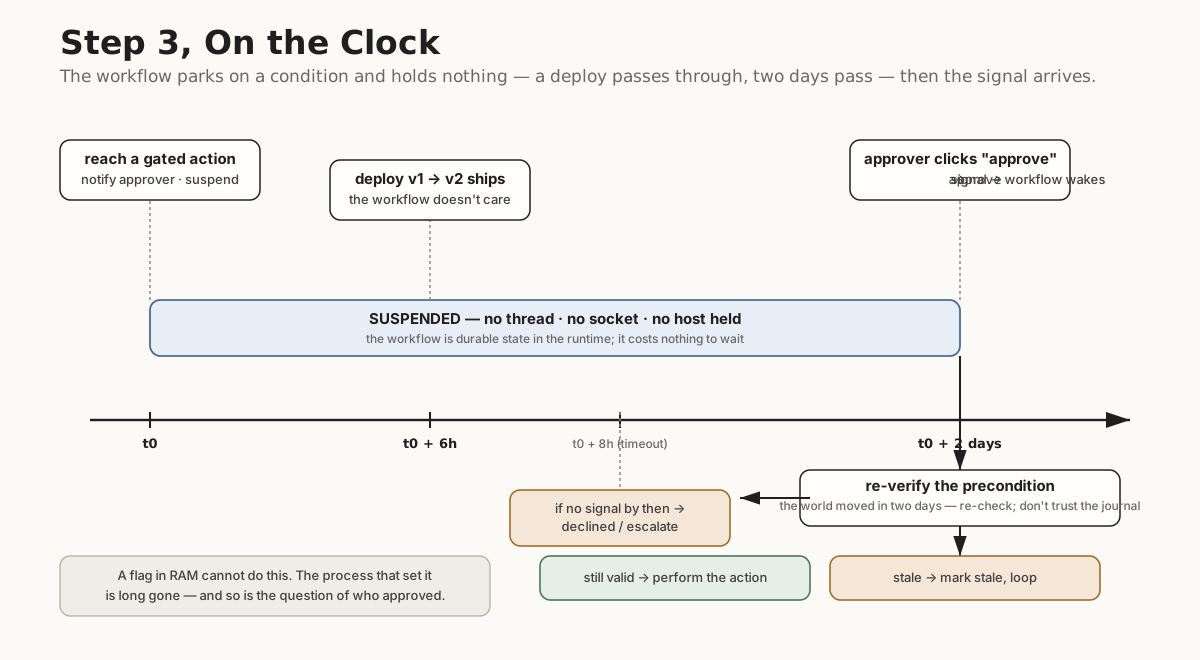
 t0 ─────────────── t0+6h ──────── t0+8h ──────────────── t0+2 days ──────────────►
 reach a gated      deploy v1→v2   timeout would          approver clicks "approve"
 action; notify     ships — the    fire here →            → `approve` signal
 approver; SUSPEND  workflow        declined / escalate   → workflow wakes
        │           doesn't care                                  │
        └────────── SUSPENDED: no thread · no socket · no host held ┘
                                                                   ▼
                                          re-verify the precondition (the world moved in 2 days)
                                            ├─ still valid → perform the action
                                            └─ stale → mark stale, loop

 A flag in RAM cannot do this: the process that set it is long gone — and so is the question of who approved.
The gate is a signal, not a flag: the workflow parks on a condition, holds nothing, survives a deploy mid-wait, wakes when the signal arrives, re-verifies the world, and acts.
2/ Walk what each line bought. Step 2 — replay returns the same decision, because the decision is an activity result in history, not a fresh sample. Step 3 — the human gate survives a deploy, because it is a wait_condition, not a held connection. Step 5 — the idempotency key cannot drift, because it is the workflow's name for the decision, not a hash of recomputed figures; and the budget cannot reset, because it is workflow state. Step 7 — the judge is in history, so replay does not re-grade; and because the judge is fallible, a deterministic verdict is acted on, a confident pass is taken, and anything weaker escalates to a human rather than triggering a blind rollback. Step 8 — compensation is adaptive where it has to be (the model writes the inverse from the journaled rationale) and gated where it must be (a model-authored, irreversible undo is escalated, never improvised); and when a compensation itself fails, the loop ends in stuck with a page, not a lie. The trace query is the audit, live, for free.
3/ Seventy lines. Six of the treasury walk's seven ceremony points are gone — folded into execute_activity, wait_condition, and workflow state. The seventh — why — is the decision object, journaled because every activity input and output is journaled. What stays visible is the loop itself: observe, decide, gate, verify, act, fold, judge, compensate. That was always the part that was supposed to be yours.
What is still hard, even here⌗
4/ The judge is an LLM, and journaling it makes replay consistent — the same verdict every replay — without making it correct. The loop above mitigates the asymmetry: a deterministic verdict is trusted, a confident pass is taken, anything weaker escalates to a human instead of unwinding the run. But mitigation is not a solution. A false fail still costs you a rollback of something that was fine; a false pass still ships something broken; the escalation still depends on a human noticing. Verification is the open frontier. Where you have a real oracle — tests, an API status, an invariant — use it and never reach for the model; that is what the treasury agent does, and it is why a treasury agent needs no judge at all.
5/ Compensation is dirtier than for e in reversed(effects) makes it look. A model-authored undo can be wrong for the same reason the forward act was wrong, so it is bounded to reversible steps and gated like any other act. A compensation can itself fail, and then the honest state is stuck — a human and an alert, not a clever retry; a saga library with no stuck state has not finished modelling sagas. And some effects have no inverse at all — the sent email, the trade past settlement — so calling the result compensated is sometimes a lie. The treasury agent does not let an LLM author its wire reversal. Neither should yours, unless the stakes are small.
6/ Step 4 is a precondition check, not a divergence check. For a stateful environment — the browser, a half-edited workspace — you need more: did the observation at iteration N+1 still match what the decision at iteration N assumed? When it does not, the right move is sometimes to re-decide and sometimes to abort, and knowing which means comparing journaled trajectory against live state, not just re-reading a version number.
7/ The journal is not free. A coding agent that owns a feature for a sprint accumulates a history that is large and mostly irrelevant on replay. continue-as-new, history pruning, summarising old segments into a checkpoint — these are real operational work, and they are the price of the property, not a bug in it.
8/ decision_id-as-key assumes perform reaches a counterparty that accepts a key. Some effects have no key: a shell command, a UI click, a robot arm in a warehouse. There the journal is the only record, and did it happen is answered by re-observation, not by asking the other side. The end-to-end argument bites hardest exactly where there is no other end to ask.
9/ Multi-agent coordination through a journaled entity (Section IX ⑥) linearises effects but can become the bottleneck — every agent funnelling through one workflow's history. Sharding the entity, leasing sub-regions, reconciling shards: the same scaling problems the workflow community already has, now with agents as the clients.
10/ None of these are reasons to skip the loop. They are the shape of the work that is left once the loop is durable — which is the shape of the ceiling, still being built. And the next-to-last section says the rest of it plainly: what is missing is large.
XI. On Substrate⌗
1/ Most of these systems are written in Python. Python is structurally hostile to most of what they require. The problems compound rather than cancel.
2/ Determinism within workflow code. Python permits non-deterministic constructs — time, random, hash randomisation, dict iteration in some contexts, threading — anywhere. Sandboxes mitigate but cannot enforce. In a world where the LLM is already a non-determinism source, having a second non-determinism source in the runtime is a recipe for replay drift.
# This compiles. This runs. This passes the demo. This is wrong.
@workflow.defn
class Pricer:
    @workflow.run
    async def run(self, order: Order) -> Quote:
        jitter = random.uniform(0.98, 1.02)        # ← re-evaluated on replay → different value
        asof   = datetime.now()                    # ← re-evaluated on replay → different value
        if jitter < 1.0:
            return await workflow.execute_activity(price_low, order, asof, ...)
        return await workflow.execute_activity(price_high, order, asof, ...)
        # On replay the workflow re-derives `jitter`, takes the *other* branch,
        # expects a different activity result than the one already in history —
        # and the engine raises a non-determinism panic, or, worse, silently diverges.

# The fix: anything non-deterministic is a runtime call or an activity result.
@workflow.defn
class Pricer:
    @workflow.run
    async def run(self, order: Order) -> Quote:
        jitter = await workflow.execute_activity(roll_jitter, ...)   # journaled — same on every replay
        asof   = workflow.now()                                       # the runtime's deterministic clock
        branch = price_low if jitter < 1.0 else price_high
        return await workflow.execute_activity(branch, order, asof, ...)
The first version is not exotic. It is the obvious way to write it, and nothing in the language or the type checker objects. That is the point: in a system where the model is already one source of non-determinism, the substrate must not be a second — and Python is a second, unless you spend continuous effort fighting it. Don't use time.sleep in workflow code is not documentation. It is a load-bearing rule with no enforcement behind it.
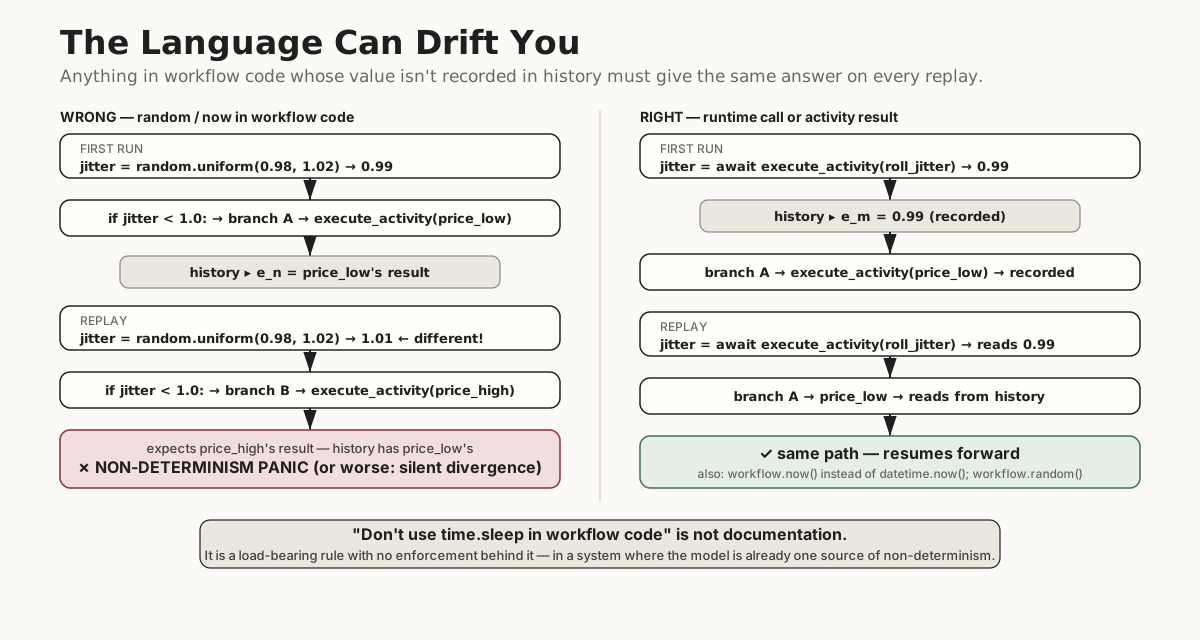
WRONG — random in workflow code                     RIGHT — a runtime call or an activity result
 FIRST RUN  jitter = random.uniform(0.98,1.02)→0.99  FIRST RUN  jitter = await execute_activity(roll_jitter)→0.99
            if jitter<1.0 → branch A → price_low                history ▸ 0.99 (recorded) → branch A → price_low
            history ▸ price_low's result
 REPLAY     jitter = random.uniform(...)→1.01  ← !   REPLAY     jitter = await execute_activity(roll_jitter)→reads 0.99
            if jitter<1.0 → branch B → price_high               branch A → price_low → reads from history
            expects price_high's result;                        ✓ same path — resumes forward
            history has price_low's → ✗ NON-DETERMINISM PANIC   (also: workflow.now() not datetime.now(); workflow.random())
Anything in workflow code whose value isn't recorded in history must produce the same answer on every replay. random() and datetime.now() don't — so they become workflow.random(), workflow.now(), or an activity result.
3/ Concurrency. Python's three concurrency models — sync, asyncio, threading — compose poorly with each other and with durable execution. Most agent libraries mix all three. Workflow engines have to constrain user code to one model, fighting the language.
4/ State serialisation. pickle is fragile across Python versions and class definitions. The first deploy after a workflow goes long-running is the deploy where pickle breaks. Strongly typed alternatives like Pydantic help but are not pervasive.
5/ Hot reload. Not really possible. Long-running agents that need to be patched mid-flight are a Python anti-pattern. Erlang/BEAM was designed for this case. Python was not.
6/ Sandbox enforceability. Python's dynamism — __import__, ctypes, exec, monkey-patching — means the workflow sandbox is best-effort. Static-typed languages such as Go, Rust, and TypeScript with strict typing make the equivalent guarantees enforceable rather than documented.
7/ Process model. Python has no first-class actor model. Multi-agent systems on Python are bolted on with Ray, Dask, or custom infrastructure. None integrate with workflow journals natively.
8/ The cumulative effect. Durable agent execution tools targeting Python ship with dialect restrictions — don't use time.sleep in workflow code. Failure modes documented as developer rules rather than runtime guarantees. State-serialisation edge cases that surface at the worst possible moment.
9/ The TypeScript and Rust equivalents do not have these. The engineering economics of building durable agent execution in Python are uphill in a way that does not show up in greenfield benchmarks but compounds in production over months.
10/ The honest position. The next generation of agent infrastructure will probably not be Python at the runtime layer, even if it remains Python at the application layer. Python will write the agent. Something else will run it.
When the workflow code changes under you⌗
11/ There is a determinism problem you cannot fix by being careful with random, and it is not about Python at all. The workflow code itself changes. You deploy version two while version-one instances are mid-flight — and a multi-day suspend guarantees that some are. Replay of a version-one history through version-two code reaches a branch the new code structures differently, takes the path history does not describe, and the engine refuses to proceed.
12/ Every durable runtime has an answer, and the answer is a discipline, not a switch. Temporal: workflow.patched("v2-revalue-before-hedge") — a marker that reads true in new code and false in replayed old code, so both paths stay consistent until every old instance has drained, after which you delete the marker, which is itself a versioned change. AWS Step Functions: version the state machine, pin executions. Restate, DBOS, the others: variations on the same idea.
@workflow.run
async def run(self, run_date: str, policy: Policy) -> Summary:
    balances = await workflow.execute_activity(read_balances, run_date, ...)
    if workflow.patched("v2-revalue-before-hedge"):
        balances = await workflow.execute_activity(revalue, balances, ...)   # new in v2
    # ...v1 replays skip the branch; v2 runs take it; both reach here with consistent history...
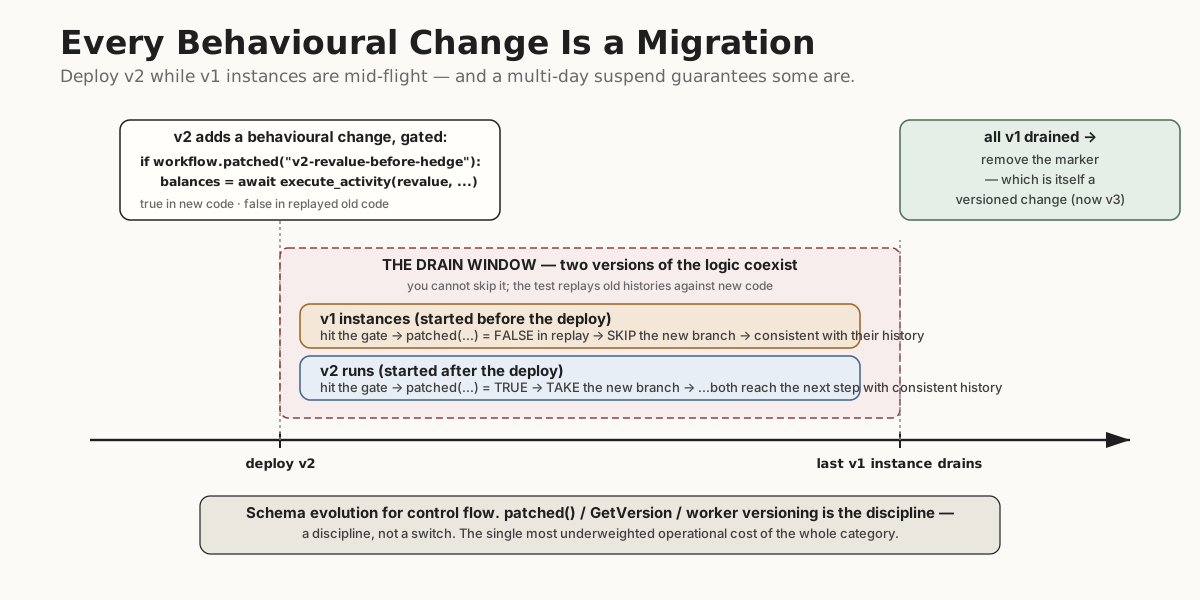
 deploy v2 ─────────────────── THE DRAIN WINDOW ─────────────────── last v1 instance drains ──►
 adds, gated:                  two versions of the logic coexist —   all v1 drained → remove the
   if workflow.patched(         you can't skip it; the test           marker (itself a versioned
     "v2-revalue-before-hedge") replays old histories vs new code     change → now v3)
   → revalue(...)
              ┌─ v1 instances: hit the gate → patched()=FALSE in replay → SKIP the new branch
              └─ v2 runs:      hit the gate → patched()=TRUE → TAKE the new branch
                                                 ...both reach the next step with consistent history
Schema evolution for control flow. patched() / GetVersion / worker versioning is the discipline — a discipline, not a switch: every behavioural change to a long-running workflow comes with a drain window and a cleanup step you cannot skip.
13/ The consequence is the part nobody prints on the box. Every behavioural change to a long-running workflow is a migration — a window where two versions of the logic coexist, a cleanup step you cannot skip, a test that replays old histories against new code. It is schema evolution for control flow, and it is the single most underweighted operational cost of the whole category: it does not show up in a demo and it does not go away in production.
XII. The Landscape⌗
1/ The category has converged on a small set of architectural patterns implemented in different deployment models.
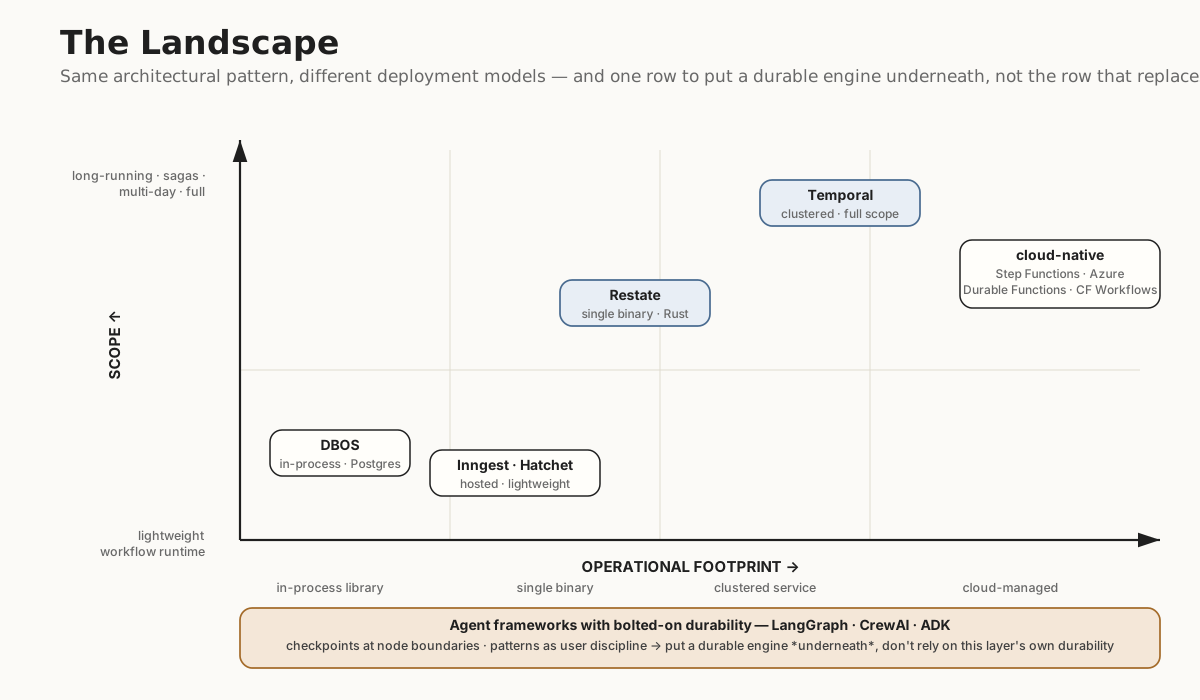
 scope ↑                                     Temporal (clustered · full scope)
 long-running ·                Restate (single binary · Rust)        cloud-native:
 sagas · multi-day                                                    Step Functions ·
                                                                      Azure Durable Fns ·
                                                                      Cloudflare Workflows
 lightweight     DBOS (in-proc · Postgres)   Inngest · Hatchet (hosted · lightweight)
 workflow rt     └──────────────────────────────────────────────────────────────────► operational footprint
                 in-process library  single binary  clustered service  cloud-managed

 ── Agent frameworks with bolted-on durability: LangGraph · CrewAI · ADK ──
    checkpoints at node boundaries · patterns as user discipline  →  put a durable engine *underneath*
 ── Agent framework as application of the runtime layer: Pydantic AI + DBOS (DBOSAgent) ──
Same architectural pattern, different deployment models. The runtime layer is being built; the agent-framework layer is increasingly an application of it — the realistic move is a durable engine beneath the framework, not the framework's own durability features.
2/ Temporal. The most mature. Built by the team behind Cadence at Uber. Workflows written as code in Go, Java, TypeScript, Python, .NET, Ruby. Self-hosted cluster or Temporal Cloud. Production users include Snap, Netflix, HashiCorp, Box, Datadog, JPMorgan Chase. Agent integrations announced across the OpenAI Agents SDK and the Vercel AI SDK in 2025. Strong on long-running workflows and complex saga patterns. Heavier operational footprint than alternatives.
3/ Restate. Newer, from former Apache Flink and Meta engineers. Single-binary Rust runtime. Optimised for low-latency durable execution and serverless or edge deployment. Strong agent positioning with integrations across the Vercel AI SDK, the OpenAI Agent SDK, and Google ADK. Production users include 21Bitcoin for trade orchestration, Coralogix for agentic observability fleets, Deliveru for recruiting research agents. Lighter than Temporal. More opinionated about deployment.
4/ DBOS. The simplest operational model. Durable execution as an in-process library backed by Postgres. No new infrastructure beyond your existing database. Fits teams that already have Postgres at the centre and do not want a new clustered service. As of 2025, Pydantic AI ships a first-class DBOSAgent wrapper that wraps Agent.run() as a @DBOS.workflow, model calls and MCP communication as DBOS steps, and sub-agent runs as child workflows — the canonical example of an agent framework adopting a durable engine wholesale rather than bolting one on. Step identity is by call order (the same recovery model Tape's seq alignment uses).
5/ Cloud-provider-native. AWS Step Functions. Azure Durable Functions. Cloudflare Workflows. Step Functions is the oldest and predates the modern category, using a JSON-based state language. Azure Durable Functions runs in-process to the Functions runtime. Cloudflare brought step-based durable execution to the edge in 2025, with multi-day execution and Python support.
6/ Hosted lightweight. Inngest. Hatchet. TypeScript- and Python-first. Targeting application teams that want durable execution without standing up Temporal. Lighter integration. Narrower scope. Simpler deployment.
7/ The agent framework category. LangGraph, CrewAI, ADK, Pydantic AI. A different layer. LangGraph, CrewAI, and ADK are graph runtimes or orchestration libraries with bolted-on durability. LangGraph's checkpointers are the most mature of the bolt-ons; the Functional API's @task and interrupt() / Command(resume=…) (HITL) and the durability="sync"|"async"|"exit" knob narrow the gap, but the granularity remains at node / entrypoint boundaries, replay re-executes the surrounding code with completed tasks returned from the checkpointer, and the wrapping is still user discipline. Pydantic AI is the counterexample: rather than bolting durability into its own runtime it ships DBOSAgent, which wraps the agent under DBOS's workflow engine — agent framework above, durable engine below, exactly what this section names as the realistic move.
8/ The realistic move for any team building an agent system that needs the properties this essay has been describing. Put a durable execution engine underneath the agent framework. Do not rely on the framework's own durability features.
9/ The integrations announced in 2025 across Temporal, Restate, and the major agent SDKs reflect this. The agent framework community is ceding the runtime layer to the durable execution category and focusing on the composition layer above it.
10/ The honest read of the landscape. The runtime layer is being built. The agent framework layer is, increasingly, an application of it.
XIII. Field Report: Coding Harnesses as Proto-Journals⌗
A grounded interlude. The treatise has argued from first principles; here is where the argument already lives — half-built — in the coding agents you use every day: Codex (CLI and cloud), Claude Code, Gemini CLI. Read the boxed lines for the gist; read the beats for the case; read the figures for the shape. This is progressive disclosure: stop wherever you have what you need.
In one breath. A coding harness's "rewind" is two things stapled together: a transcript — a real, append-only decision ledger; they all have it, and (rightly) they use it as memory, not as a replay log — and a filesystem snapshot — a coarse, local-files-only effect ledger; only some of them have it. What it can't undo — a
git push, annpm publish, a PR comment, a CI run — it doesn't even try to. And under all of it sits git, which is itself a journal: commits, branches, stash, reflog, worktrees. So a coding agent gets away with a proto-journal because its default world is small, local, reversible, and single-actor. Scale the world — a second agent, a remote, CI, a publish — and it breaks in exactly the ways Section V and Section XIV predict.
1 · The lay of the land — four harnesses, four proto-journals⌗
Gist. All four record the conversation (the decision ledger). Two of them (Claude Code, Gemini CLI) also snapshot the working tree before edits (the effect ledger); Codex CLI delegates that to your git; Codex cloud's "effect ledger" is a git branch plus a disposable container. None records what it owes — no obligation ledger. Granularity ranges from per-prompt (Claude) to per-file-modifying-tool-call (Gemini) to none-at-all (Codex CLI).
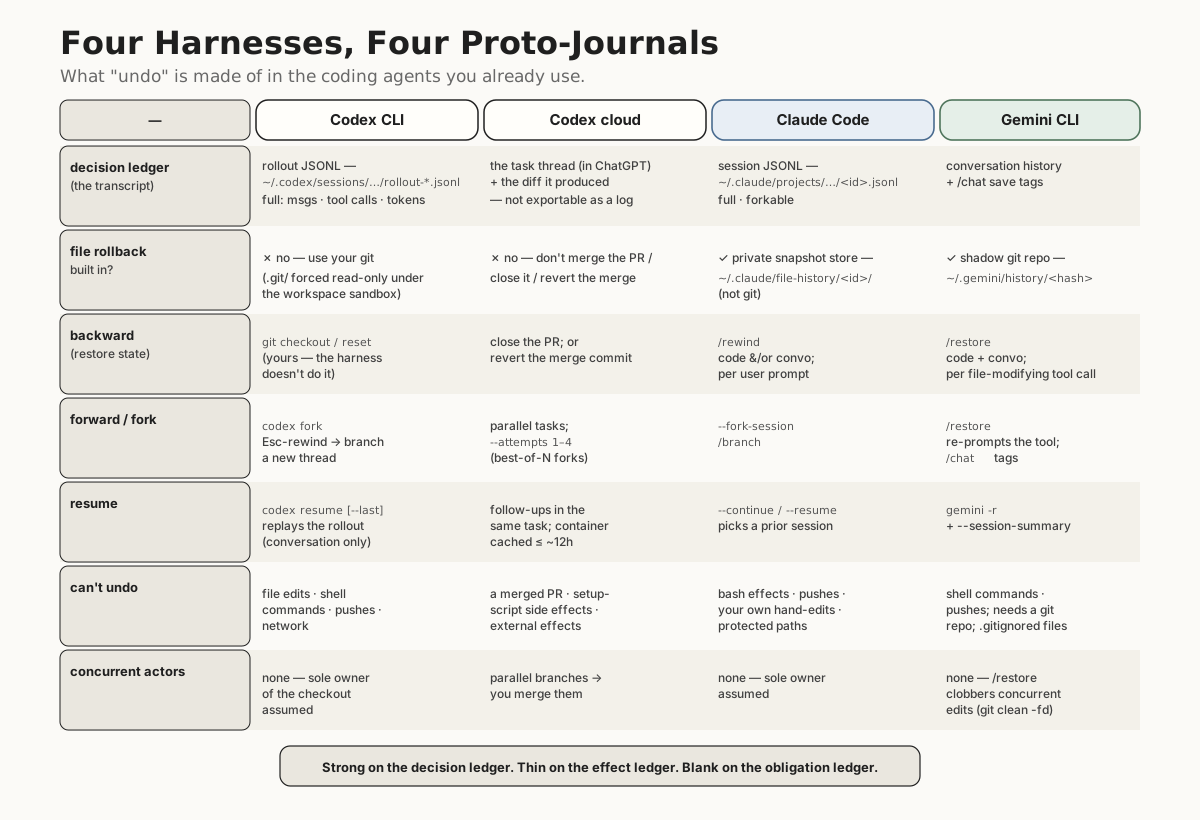
                  Codex CLI               Codex cloud             Claude Code             Gemini CLI
decision ledger   rollout JSONL           the task thread         session JSONL           conversation +
(the transcript)  ~/.codex/sessions/…     (in ChatGPT) + the diff ~/.claude/projects/…    /chat save tags
file rollback?    ✗ — use your git        ✗ — don't merge /       ✓ — private store       ✓ — shadow git repo
                  (.git/ forced read-only)  revert the PR           ~/.claude/file-history/  ~/.gemini/history/<hash>
backward (state)  git checkout (yours)    close the PR            /rewind: code &/or      /restore: code + convo,
                                                                    convo · per prompt      per file-modifying tool call
forward / fork    codex fork; Esc-rewind  parallel tasks;         --fork-session;         /restore re-prompts;
                  (branch a thread)         --attempts 1–4          /branch                 /chat tags
resume            codex resume [--last]   follow-ups in the       --continue / --resume   gemini -r
                  (replays the rollout)     task; container ≤12h
can't undo        edits · shell cmds ·    a merged PR · setup-    bash effects · pushes · shell cmds · pushes;
                  pushes · network          script side effects     hand-edits · protected   needs a git repo;
                                                                    paths                    .gitignored content
concurrent actors none — sole owner       parallel branches →    none — sole owner       none — /restore clobbers
                  assumed                   you merge them          assumed                 concurrent edits (git clean -fd)
Strong on the decision ledger (the transcript). Thin on the effect ledger (the snapshot, where it exists at all). Blank on the obligation ledger. The shape Section V predicted for the coding agent.
1/ Codex CLI has no filesystem snapshot. It edits your real working tree, kernel-sandboxed (Seatbelt on macOS, Landlock+seccomp on Linux), and under workspace-write it forces .git/ and .codex/ read-only so the agent can't rewrite history behind your back. File-undo is your job (git checkout/stash/reset). What it does keep is the rollout file — ~/.codex/sessions/YYYY/MM/DD/rollout-<ts>-<uuid>.jsonl, a SessionMeta header (id, cwd, model, git info) then every message, tool call, and token count. codex resume [<id>|--last] replays that to reconstruct the conversation; codex fork branches a new thread from an earlier user message; codex exec --ephemeral writes no rollout at all.
2/ Codex cloud runs each task in an isolated container that checks out your repo at a branch/SHA, runs a setup script (with internet), then the agent (internet off by default). Containers aren't purely ephemeral — they're cached up to ~12h, so follow-ups reuse them; the cache invalidates on script/env/secret changes. The output is a diff; you open a PR or send follow-ups (which can push commits onto an existing PR branch); parallel tasks and --attempts 1–4 fork N independent solutions, each its own container/branch/diff. The "undo" is git/GitHub: don't merge, close the PR, or revert. The container is disposable; only the branch/PR persists.
3/ Claude Code keeps both. The session JSONL — ~/.claude/projects/<project>/<session-id>.jsonl, one object per line: every message, every tool call + result, timestamps; oversized outputs spill to a tool-results/ dir; 30-day retention. And rewind (/rewind, Esc Esc): per-user-turn checkpoints, with pre-edit snapshots of touched files in a private store at ~/.claude/file-history/<session-id>/ (not git — no commits, doesn't touch .git); the menu restores code only / conversation only / both. It tracks only files edited through Claude's edit tools — bash side effects, hand-edits, and a protected-paths list are not captured. Hooks (PreToolUse can deny/rewrite; PostToolUse observes the result) are a programmable journal-write seam; --fork-session//branch copy the transcript prefix into a new session.
4/ Gemini CLI has the finest grain. With checkpointing on (general.checkpointing.enabled, or --checkpointing), before every file-modifying tool call it commits a whole-project snapshot into a shadow git repo at ~/.gemini/history/<project_hash> (a real but separate repo — your git log/branches/index untouched) and saves conversation + the pending tool call to ~/.gemini/tmp/<project_hash>/checkpoints/<ts>-<file>-<tool>.json. /restore [checkpoint] rewinds both files (git restore --source <hash> . + git clean -fd) and conversation, and re-shows the tool prompt for re-approval. It mirrors your .gitignore/.geminiignore (so node_modules is excluded; git clean -fd on restore deletes files created since the snapshot); it silently no-ops outside a git repo. Plus /chat save|resume|list (conversation-only tags) and gemini -r (resume the last session).
2 · Anatomy of one turn — what gets written, what doesn't⌗
Gist. When the agent does a turn, the transcript captures the whole thing (prompt, plan, every tool call and result). The snapshot store captures only the local files the agent's edit tools touched — and only those. A
git commitis partly modeled (the SHA may be in the transcript text). Agit push, annpm publish, a PR comment, a CI trigger: not captured, not reversible, no compensation handle. So "rewind a turn" means "restore those files and truncate the transcript" — which is exactly enough when the turn was only file edits, and exactly nothing when it wasn't.
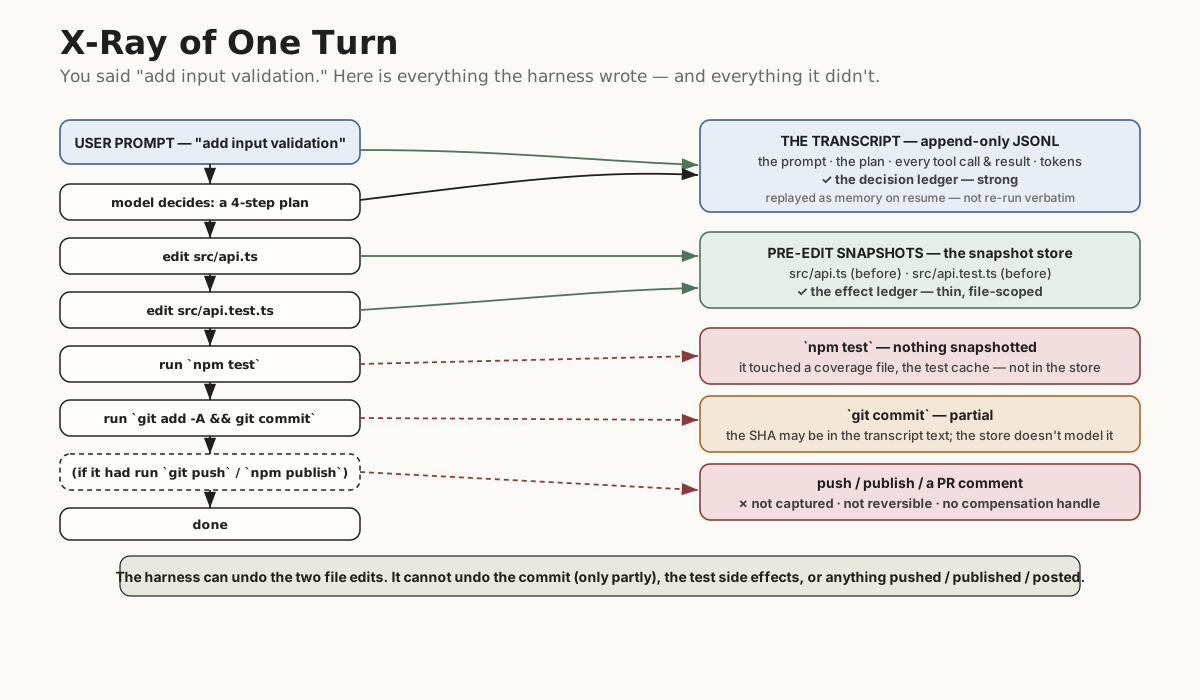
you: "add input validation"
   │
   ├─ model plans a 4-step plan ───────────────────────► transcript (prompt · plan · every    ✓ decision ledger — strong
   ├─ edit src/api.ts ──── (pre-edit snapshot) ────────► snapshot store   tool call & result · ✓ effect ledger — thin,
   ├─ edit src/api.test.ts ─ (pre-edit snapshot) ─────►                   tokens)                  file-scoped
   ├─ run `npm test` ──────────────────────────────────► ✗ nothing snapshotted (a coverage file, the test cache — not in the store)
   ├─ run `git commit` ────────────────────────────────► ◐ the SHA may be in the transcript text; the store doesn't model it
   └─ (had it run `git push` / `npm publish` / a PR comment) → ✗ not captured · not reversible · no compensation handle

undoable: the two file edits.   not undoable: the commit (partly), the test side effects, anything pushed / published / posted.
The transcript is the decision ledger and it's good. The effect ledger is whatever local files the agent's edit tools touched — and that's it. Everything else is git's problem, or nobody's.
5/ This is the whole proto-journal story in one picture. The decision side is rich and append-only and the harnesses do the right thing with it (next subsection). The effect side is a coarse undo buffer scoped to "files my edit tool wrote," at turn or tool-call granularity, with no model of commits, no model of pushes, no compensation handles for the irreversible. The treatise's coding-agent line — "the code can be reverted, the LLM cannot" — is true here, and there's a second clause the field report adds: the outside world can't be reverted either, and the harness knows it, so it doesn't pretend to.
3 · Backward, forward, fork — none of them replay⌗
Gist. Backward = truncate the transcript at message N and restore the file snapshot taken there. Forward = re-run from N — and the model re-samples, so you get a different plan and different edits; "forward" is redo knowing what you knew then, not replay. Fork = keep the original thread and start a new branch from N (Codex
fork/--attempts N, Claude--fork-session//branch, Gemini/restorere-prompting). The harnesses already treat the transcript as memory, not a deterministic log — which is precisely what Section V said a coding agent needs.
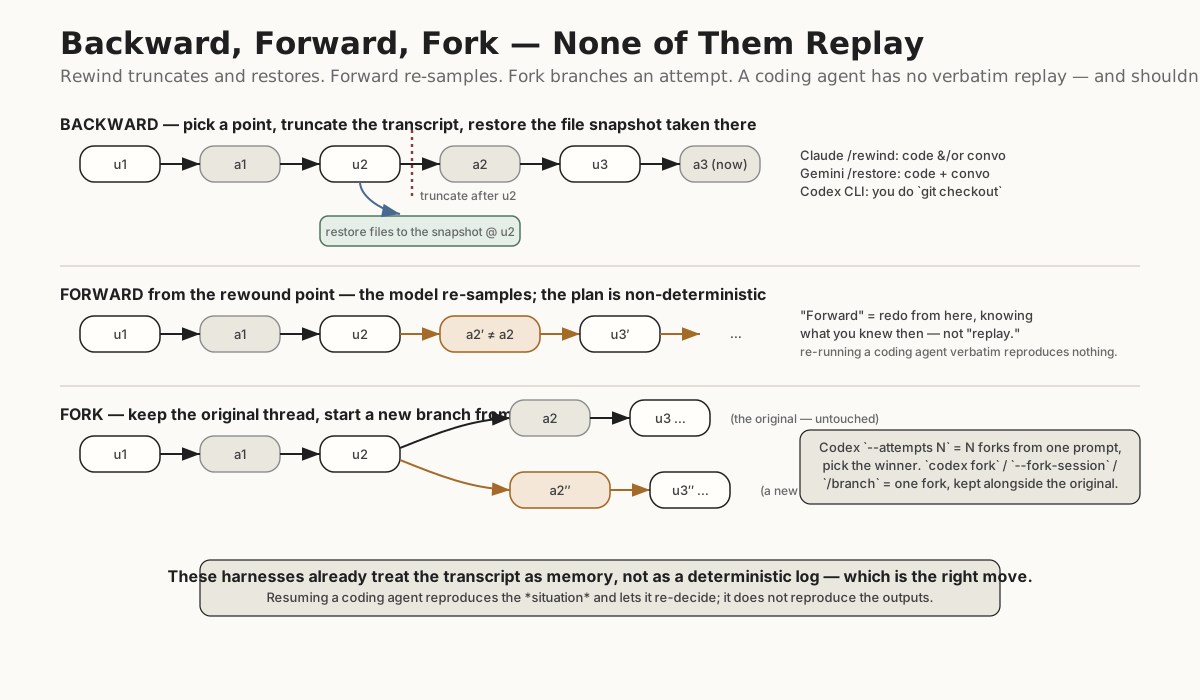
BACKWARD   u1─►a1─►u2─►a2─►u3─►a3(now)         pick u2 → truncate after u2 + restore files to the snapshot @ u2
                       ╳ truncate here           (Claude: code &/or convo · Gemini: code + convo · Codex CLI: you `git checkout`)

FORWARD    u1─►a1─►u2 ─► a2′(≠a2) ─► u3′ …      re-run from u2 → the model re-samples. "Forward" = redo knowing what
                                               you knew then — NOT replay. A coding agent re-run verbatim reproduces nothing.

FORK       u1─►a1─►u2 ─┬─► a2 ─► u3 …  (original — untouched)
                       └─► a2″ ─► u3″ …  (a new attempt)    Codex `--attempts N` = N forks from one prompt, pick the winner.
These harnesses already treat the transcript as memory, not a deterministic log — which is the right move. Resuming a coding agent reproduces the situation and lets it re-decide; it does not reproduce the outputs.
6/ This is the one place the proto-journals are already correct by the treatise's lights, not merely present. Section V: "replay does not reconstruct the same plan, because the plan was non-deterministic in the first place… resumption that uses the journal as memory rather than as a transcript to replay verbatim." That is exactly what codex resume (replay the rollout to rebuild the conversation, then let the model continue), --fork-session, and /restore (re-show the tool prompt for re-approval) do. Forward is not replay; it never could be; the tools don't pretend it is.
4 · The three ledgers, audited⌗
Gist. Map the harnesses onto Section III's three ledgers — decision (why), effect (what), obligation (owed). They score: decision = strong, all four (the transcript). Effect = thin, two of four (the snapshot — Codex CLI has none; Codex cloud has it as a branch). Obligation = essentially zero (the closest is Codex cloud's open PR, which GitHub tracks, not the harness). And — the load-bearing caveat — none of the three is the source of truth for state. The working tree is. The transcript records intent; the filesystem records what happened; they diverge the moment a second actor (you, another agent, a
git pull, annpm install) touches the tree outside the harness.
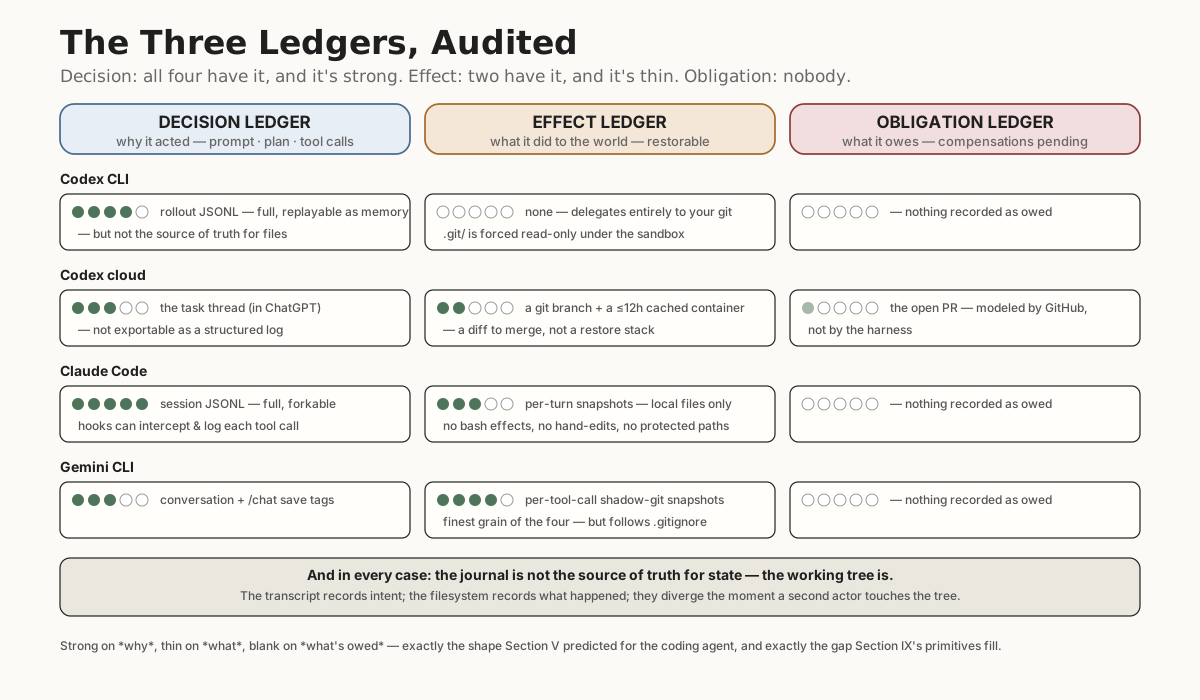
                       DECISION LEDGER (why)        EFFECT LEDGER (what — restorable)     OBLIGATION LEDGER (owed)
Codex CLI              ●●●●  rollout JSONL, full     ○○○○  none — delegates to your git    ○  nothing
Codex cloud            ●●●   the task thread          ●●    a git branch + a ≤12h container  ◐  the open PR (GitHub's, not the harness's)
Claude Code            ●●●●● session JSONL, forkable; ●●●   per-turn snapshots, local files  ○  nothing
                             hooks can intercept & log       only — no bash effects, no
                                                             hand-edits, no protected paths
Gemini CLI             ●●●   conversation + /chat     ●●●●  per-tool-call shadow-git;        ○  nothing
                                                             follows .gitignore

In every case: the journal is not the source of truth for state — the working tree is.
Strong on why, thin on what, blank on what's owed — exactly the shape Section V predicted, and exactly the gap Section IX's primitives fill.
7/ The "not the source of truth" point is the deep one, and it's the treatise's browser-agent observation transplanted: "the journal is the only record, and did it happen is answered by re-observation, not by asking the other side." A coding harness is in that boat for everything not in git — there's no API to ask the filesystem "did my edit survive?", so you re-read the file. Which is fine, until two actors are writing it, at which point "re-read the file" gives you whose version? — and the per-actor journal can't say, because it never modeled the shared state. (Hold that thought; it's subsection 6.)
5 · Seven upgrades — how the proto-journal becomes a real one⌗
Gist. The transcript is already a decent decision journal. Seven moves harden the effect side, and none of them is exotic — most of them already exist somewhere (Gemini's shadow-git is content-addressed and effect-grained; Codex's
--attempts Nis budget-aware forking). Roughly: incremental snapshots instead of whole-tree copies; effect-boundary granularity; diffs tagged with their decision; an effect taxonomy with gates and compensation handles; auto-commit to a hidden git ref (lean on the floor); compaction at decision boundaries; cost recorded next to each diff.
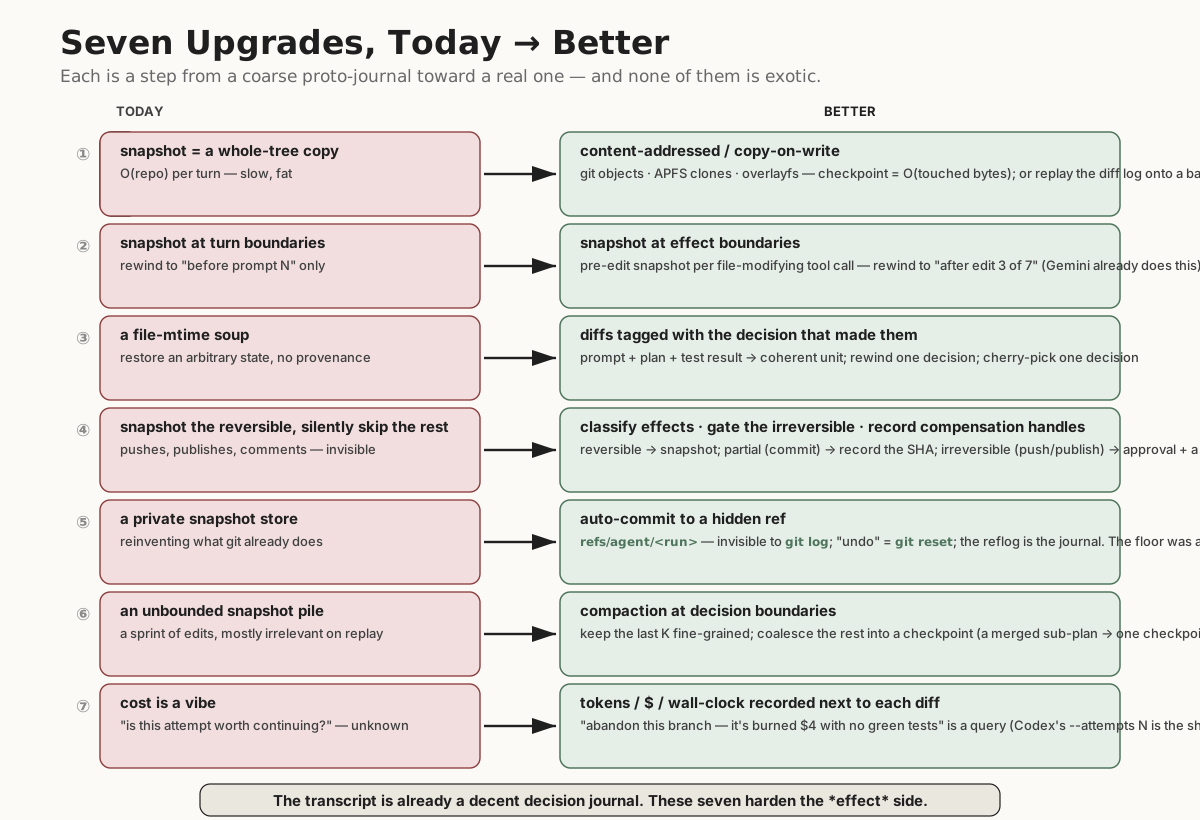
   TODAY                                          →  BETTER
① a whole-tree copy per turn                       →  content-addressed / copy-on-write (git objects · APFS clones · overlayfs) — O(touched bytes)
② snapshot at turn boundaries                      →  snapshot at effect boundaries — rewind to "after edit 3 of 7", not just "before prompt N"
③ a file-mtime soup, no provenance                →  diffs tagged with the decision that made them — rewind/cherry-pick one decision
④ snapshot the reversible, silently skip the rest →  classify effects · gate the irreversible (push/publish) · record compensation handles
⑤ a private snapshot store                          →  auto-commit to a hidden ref (refs/agent/<run>); the reflog is the journal — the floor was already there
⑥ an unbounded snapshot pile                        →  compaction at decision boundaries — keep the last K fine-grained, coalesce the rest
⑦ cost is a vibe                                   →  tokens/$/wall-clock recorded next to each diff — "abandon this $4 branch, no green tests" is a query
The transcript is already a decent decision journal. These seven harden the effect side — into something a runtime, or a worktree-aware orchestrator, could lean on.
8/ Notice that ⑤ is the treatise's whole "plug into old plumbing" move, applied to coding agents: don't reinvent a snapshot store, git commit each turn to a hidden ref (refs/codex/…, invisible to git log), so "undo" = git reset, "fork" = git branch, and git reflog is your journal — and if you do it in a worktree, you get isolation for free, which is the next subsection. And ④ is the treatise's action-space management and adaptive compensation, applied here: the dangerous thing today isn't that the harness can't undo a push — it's that it silently doesn't try, with no gate in front of it and no handle recorded to undo it later.
6 · Where git carries it — and where it doesn't⌗
Gist. A harness's "rewind" is local, optimistic, single-actor time-travel — and it works because the default world is one working tree of mostly-reversible file edits, with git underneath as a real journal. So a lot of the journaling machinery genuinely doesn't matter here: git already does it. It stays forgiving for committed work, one actor, worktree-isolated agents, and "it's just code." It stops being forgiving the moment a second actor, a remote, CI, a publish, or a deploy enters — and there the local journal is useless and you want the durable-execution machinery for real. The boundary is the answer to your question.
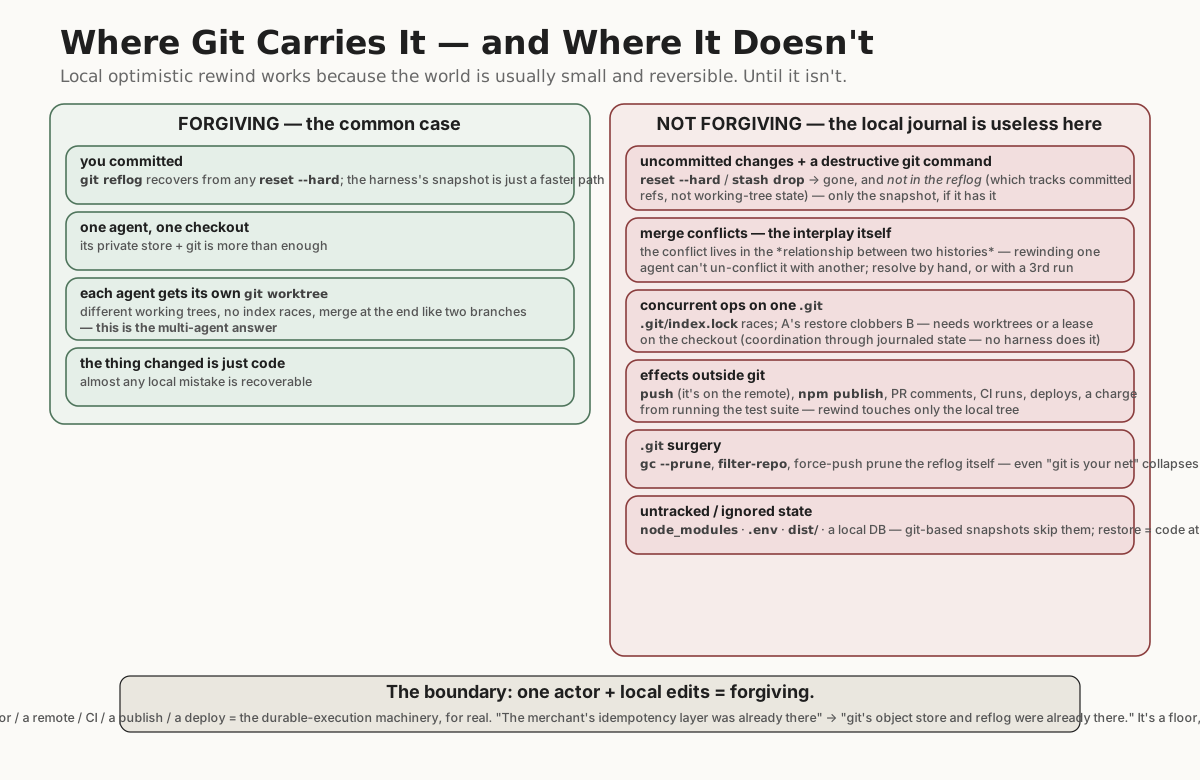
FORGIVING — git carries it                          NOT FORGIVING — the local journal is useless here
─────────────────────────                           ──────────────────────────────────────────────────
• you committed → `reflog` recovers any reset --hard • uncommitted changes + a destructive git command (reset --hard,
  (the harness's snapshot is just a faster path)      stash drop) → gone, and NOT in the reflog — only the snapshot, if it has it
• one agent, one checkout → its store + git is plenty • merge conflicts — the conflict is in the *relationship between two
• each agent gets its own `git worktree` → different  histories*; rewinding one agent can't un-conflict it with another
  trees, no index races, merge at the end like two   • concurrent ops on one `.git` → `index.lock` races; A's restore clobbers
  branches  ← this is the multi-agent answer          B — needs worktrees or a lease on the checkout
• the thing changed is just code → almost any        • effects outside git → `push` (it's on the remote), `npm publish`, PR
  local mistake is recoverable                        comments, CI runs, deploys, a charge from running the test suite
                                                     • `.git` surgery → `gc --prune`, `filter-repo`, force-push prune the reflog itself
                                                     • untracked / ignored state → node_modules · .env · dist/ · a local DB — git-
                                                       based snapshots skip them; restore = code at T, deps at T+5

boundary: one actor + local edits = forgiving · a second actor / a remote / CI / a publish / a deploy = not.
"The merchant's idempotency layer was already there" → "git's object store and reflog were already there." A floor, not a ceiling — and the working-tree interplay is the live demo of where the floor ends.
9/ The forgiving side is real and it's why these tools ship without a "real" journal: git is one. Committed work is recoverable from the reflog even after reset --hard; branches are free; stash parks dirty state. The harness's private snapshot is, in the common case, just a faster path to the same recovery — which is why Codex CLI can skip it entirely and tell you to use git.
10/ And worktrees are the actual answer to "multiple coding agents," and they make per-agent rewind sufficient: one .git object store, N working directories, each agent in its own — they edit different trees, can't stomp each other's index, and you merge at the end like any two branches. The coordination is pushed into git's merge machinery, which the agents don't have to model. Worktree-per-agent orchestrators (and there are several) are leaning on exactly this. It's the treatise's "coordinate through journaled shared state" — except the shared state is git's object graph, and the coordination is git merge.
11/ The unforgiving side is where the local journal is useless and you'd want the ceiling. Uncommitted changes are not in the reflog — the reflog tracks committed refs, not working-tree state — so a stray git checkout . or git reset --hard before the harness snapshotted is unrecoverable; the snapshot is the only net, and it's only as good as its granularity (Claude won't have it if the change came from a bash command; Codex CLI never has it). Merge conflicts are the purest case: the conflict lives in the relationship between two histories, not inside one — rewinding agent A doesn't un-conflict it with B, because there's nothing in A's history to rewind to that resolves it; you resolve by hand, or with a third agent run that takes both diffs as input. That's Section IX ⑥ — "two SRE agents on one incident fight; coordinate through journaled shared state, not direct messaging" — and git gives you the shared state (the merge base, the conflict markers) but only as a manual resolution surface.
12/ Concurrent operations on one .git are the same problem at the index level: two runs in one checkout race on .git/index.lock; one git commits while the other has staged changes; npm install rewrites package-lock.json under the other's edits. The per-agent snapshot can't model the shared state, so A's "restore" clobbers B. Fix: worktrees (separate trees), or a lease on the checkout — coordination-through-journaled-state, which no harness does today (they assume sole ownership). And effects outside git are the hard wall: push puts it on the remote where others may have pulled (reverting is a new commit, not an undo); npm publish (yanking ≠ unpublishing); PR comments, CI runs, deploys, a charge on a test Stripe account from running the suite — rewind and /restore touch only the local tree; none of this is reachable. The treatise: "communication is reputation-bearing… compensation is impossible." (And .git surgery — gc --prune, filter-repo, force-push — prunes the reflog itself, so even "git is your net" collapses; Codex forcing .git/ read-only during agent commands is a deliberate action-gate against exactly this.)
13/ One more, easy to miss: untracked and ignored state. Git-based snapshots (Gemini's shadow repo) follow .gitignore, so they don't capture node_modules, .env, dist/, generated migrations, a local SQLite file. A restore brings code back to T but leaves node_modules at T+5 — a state the snapshot calls consistent but isn't. Claude's protected-paths list has the same shape: some things are deliberately not snapshotted, so a restore is partial by design. This is the harness version of the treatise's freshness problem — the runtime has to declare which state is snapshot and which is live — and the harnesses mostly don't declare it; they just exclude.
7 · The synthesis — precursors, and the part with a name⌗
Gist. Coding harnesses are proto-journals, and the prototype is honest about what it is: small, local, optimistic, single-actor. They have the decision ledger (the transcript — strong, and used as memory, not as a replay log, which is the right move) and a thin effect ledger (the snapshot, where it exists), with git underneath as a real journal to lean on. They're missing the obligation ledger, the effect taxonomy, the action gates on
push/publish/deploy, and coordination through shared journaled state — which is to say, they're missing what the treatise calls the ceiling. The working-tree / worktree / merge interplay is the live demonstration of where the floor (git) holds and where it runs out — which is where a coding agent stops being able to coast on git, and where the durable-execution machinery would have to start.
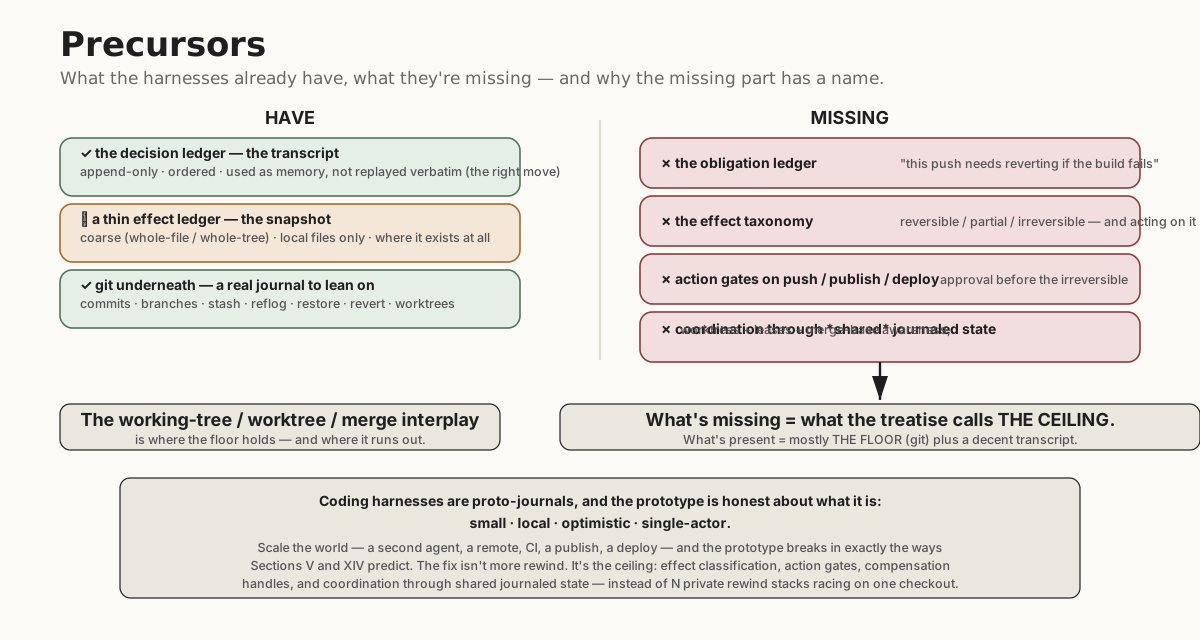
HAVE                                                MISSING  (= what the treatise calls THE CEILING)
✓ the decision ledger — the transcript              ✗ the obligation ledger ("this push needs reverting if the build fails")
  (append-only · used as memory, not replayed)      ✗ the effect taxonomy (reversible / partial / irreversible) — and acting on it
◐ a thin effect ledger — the snapshot               ✗ action gates on push / publish / deploy
  (coarse · local files only · where it exists)     ✗ coordination through *shared* journaled state — worktrees + leases +
✓ git underneath — a real journal to lean on          merge-base awareness, instead of N private rewind stacks racing on one checkout
  (commits · branches · stash · reflog · worktrees)

Precursors. The prototype is honest: small · local · optimistic · single-actor.
Scale the world and it breaks in exactly the ways Sections V and XIV predict. The fix isn't more rewind. It's the ceiling.
Coding harnesses are precursors to the journal. They have the decision ledger and a thin effect ledger; they're missing the obligation ledger, the effect taxonomy, the gates, and the shared-state coordination — which is to say, they're missing "the ceiling," and the working-tree / worktree / merge interplay is the live demonstration of where "the floor" (git) holds and where it runs out.
14/ So the answer, folded back into the treatise's frame: the harnesses already did the floor (or rather, git did it for them) and they already did the easy part of the ceiling — the decision ledger, used correctly as memory. What they haven't done is the hard part of the ceiling, and they haven't needed to, because their world is small. The day a coding agent's world stops being small — N agents on one repo, a shared remote, a CI pipeline that runs on push, a release that publishes — is the day "rewind" stops being enough and "the runtime" has to keep the contract. Until then: the transcript is the journal, git is the safety net, and the snapshot store is a faster path to a recovery git could have done anyway. Precursor, not the thing — but an honest precursor, which is the most you can ask of a prototype.
XIV. What This Treatise Is Glossing Over⌗
Section X named what is still hard inside the loop. This is what is still hard around it — the places this treatise, in the service of a clean argument, has quietly assumed away, smoothed over, or drawn as a cartoon. A treatise that does not do this is a brochure.
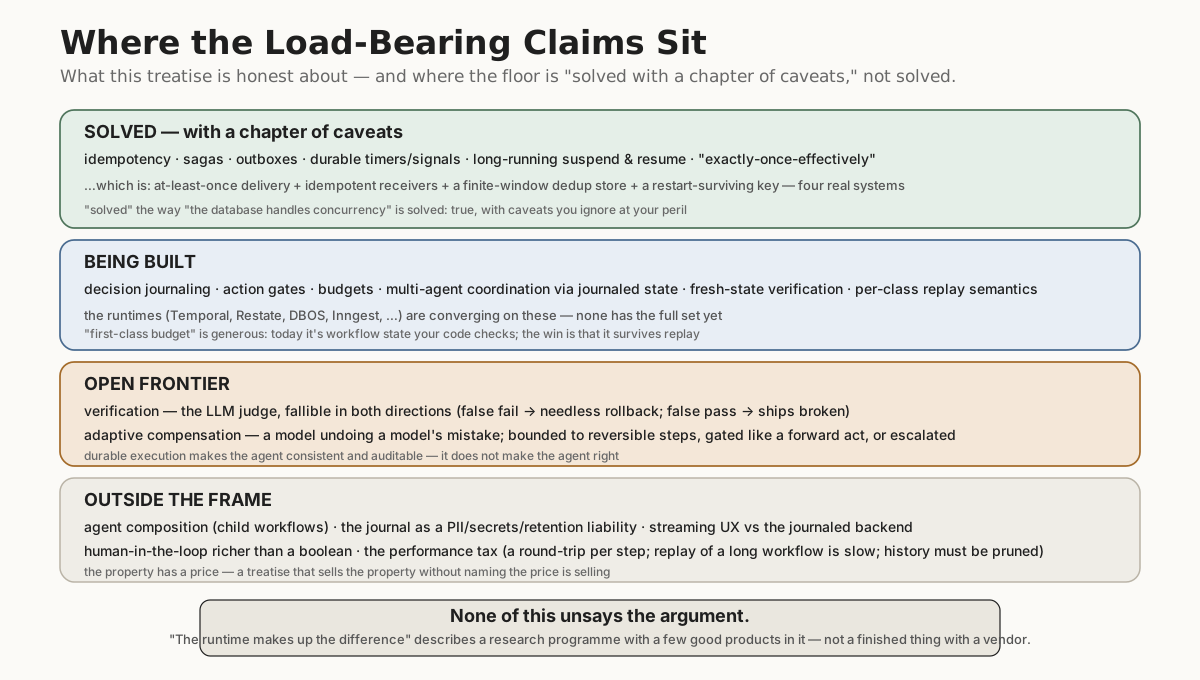
SOLVED — with a chapter of caveats  │ idempotency · sagas · outboxes · timers/signals · long-running suspend ·
                                    │ "exactly-once-effectively" (= at-least-once + idempotent receivers +
                                    │ a finite-window dedup store + a restart-surviving key — four real systems)
BEING BUILT                         │ decision journaling · action gates · budgets · multi-agent coordination ·
                                    │ fresh-state verification · per-class replay semantics  (no runtime has the full set)
OPEN FRONTIER                       │ verification — the LLM judge, fallible both ways · adaptive compensation —
                                    │ a model undoing a model, bounded & gated, or escalated
OUTSIDE THE FRAME                   │ agent composition (child workflows) · the journal as a PII/secrets liability ·
                                    │ streaming UX vs the journaled backend · richer HITL · the performance tax
Where the load-bearing claims actually sit. Durable execution makes the agent consistent and auditable — not right. None of this unsays the argument; "the runtime makes up the difference" describes a research programme with a few good products, not a finished thing with a vendor.
1/ "The floor is solved" is shorthand, and shorthand has a bill. What is actually solved is at-least-once delivery, plus idempotent receivers, plus a dedup store with a finite window, plus a key derivation that survives restart — four real systems with four sets of failure modes. The outbox pattern's relay crashes and re-emits. The dedup store fills and evicts. The window closes mid-flight — Section VI ④ named that and did not solve it, because for many APIs there is no clean recovery: you store the result object's id, not the key, and you hope you stored it before the crash. "Solved" here means what it means when someone says "the database handles concurrency": true, with a chapter of caveats you ignore at your peril.
2/ The journal does not own the truth; it owns half of it, and the essay's repeated "the merchant only keeps their half" is the half-true half. Section IX ② said the reconciled version: the journal is the source of truth for intent, decision, and order; the counterparty is the source of truth for outcome; the unknown is precisely the gap between them. When the counterparty exposes a status query — retrieve the PaymentIntent, FIX OrdStatus, the PNR — that gap is narrow. When it does not, the gap is wide and the journal is genuinely all you have. The honest framing is not "the journal answers everything" but "build for the wide case; use the query when you can."
3/ The replay mechanism — event-sourced history, activity results read back instead of re-run — is the load-bearing wall. Section VIII finally explains it; almost everything else in this treatise stands on the assumption that you poured it correctly. If the workflow function is not deterministic, none of the guarantees hold. "Deterministic" is harder than not calling random() (Section XI), and harder than that again because the function changes when you deploy (Section XI, the part that is really a migration problem). The category's central promise — your code, re-runnable — comes with a clause in small type: provided your code is, and stays, replayable.
4/ "Budget as a first-class workflow construct" is generous. In every runtime today it is workflow state that your code checks before a spend and charges after — no engine enforces a token cap, kills a workflow at a dollar ceiling, or surfaces spend as a runtime concept. That it lives in history, and so survives replay, is the real win; "first-class" is the slide, not the product. And the genuinely hard version — N agents drawing on one shared pool — is not the dataclass in Section IX ④ at all; it is the coordination entity from Section IX ⑥, with all of that entity's contention, back again.
5/ "Replay semantics tuned per agent class" launders patterns into features. The runtime gives you one generic mechanism: deterministic replay of recorded effects. "Re-verify the page," "restore the workspace," "resume the search tree" are things you build on top of it — the divergence check in Section V is application code; "resume the frontier" is just "the frontier is workflow state." The tuning is your code. Figure 10 is a menu of patterns, not a panel of knobs.
6/ The protocols in the code are cartoons, and they are cartoons in the direction that costs you. bank.wire(...) -> wire_id is not a treasury interface; real ones are ISO 20022 messages, host-to-host files, and settlement confirmations that arrive hours later on a different channel — which makes the durability problem harder, because now you are correlating asynchronous confirmations to initiations rather than awaiting a return value. clOrdID carries a FIX session's worth of sequencing, resend, and OrigClOrdID-chaining rules. Pre-trade compliance and regulatory filing are themselves stateful, slow, externally-arbitrated processes, not function calls. The patterns generalise; the surface area in the examples does not; production is messier in the direction that hurts.
7/ Verification has no answer here, and the treatise has been honest about that, but it is worth saying flatly: there is no general oracle for "did the agent do a good job," the LLM judge is a stopgap that is fallible in both directions, and a great deal of agent reliability — maybe most of it — lives in a problem this category does not solve. Durable execution makes the agent consistent and auditable. It does not make the agent right.
8/ What is outside the frame entirely. Composition: an agent that calls sub-agents is a workflow that starts child workflows, and durable agent composition — budgets and gates and provenance that compose across a tree of agents — is its own subject this treatise flattens into one loop. The journal as liability: it holds every input, every model response, every line of reasoning — which is PII, secrets, a retention question, a redaction question, an access-control question, and in some jurisdictions a disclosure obligation; the lone redact(args) call in the ADK example is not a treatment. Streaming versus journaled: the user wants live progress, the workflow is the source of truth, and "now" means different things to each — bridging them (queries, signals, side-channel event streams) is real work, unmentioned. Human-in-the-loop richer than a boolean: real HITL is the human editing the plan, supplying the missing field, taking over, handing back — not just clicking approve. The tax: every step is a round-trip to a persistence layer; every long workflow's replay is slow; every long history must eventually be pruned or continued-as-new — the property has a price, and a treatise that sells the property without naming the price is selling.
9/ None of this unsays the argument. The orchestrator stopped being code; the runtime has to make up the difference; the floor is old and the ceiling is new — that holds. But "the runtime makes up the difference" describes a research programme with a few good products in it, not a finished thing with a vendor. The honest version of this treatise ends where the honest version of every systems treatise ends: here is the shape of it, here is what we know, here is the part that is still hard, build carefully.
XV. Floor and Ceiling⌗
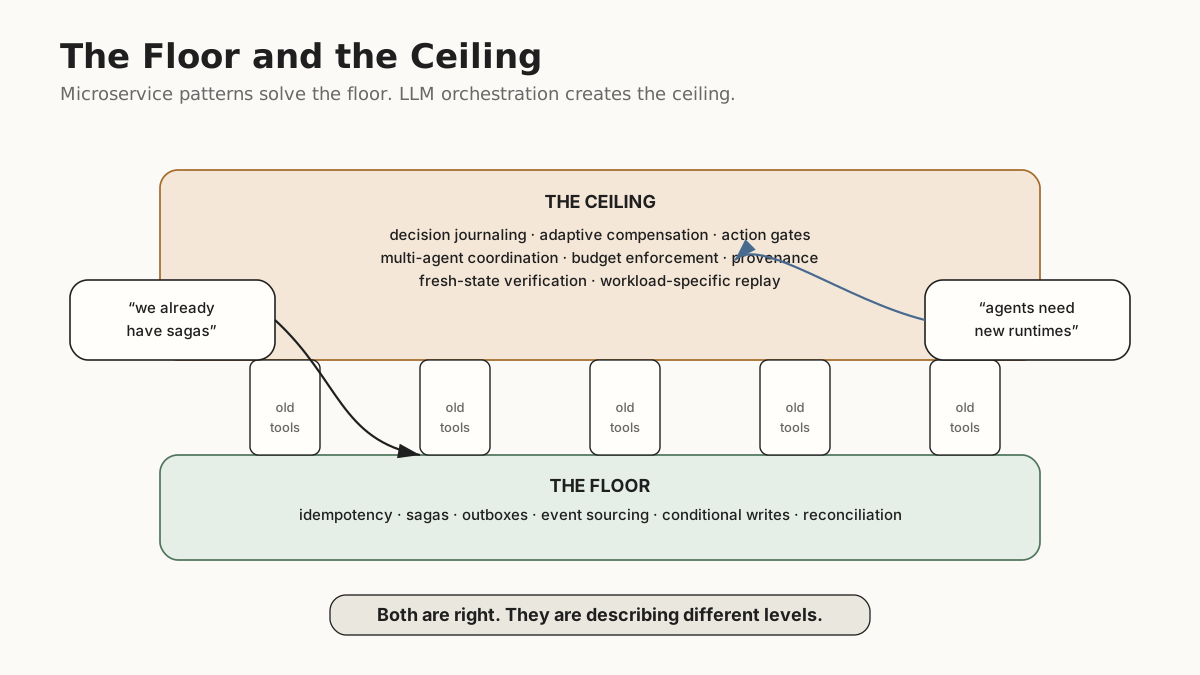
                 THE CEILING
   decision journaling · adaptive compensation
   action gates · budgets · provenance · replay semantics
                 ───────────────────────────────

        old tools hold the structure up

      │ idempotency │ sagas │ outboxes │ events │ locks │

                 ───────────────────────────────
                  THE FLOOR
   durable effects · retries · timers · signals · reconciliation
The old patterns are the floor. The new agent problems are the ceiling. Microservice engineering solved the floor; LLM orchestration created the ceiling. Both camps are right; they describe different levels.
1/ The deflationary argument — we already have sagas — is correct for the I/O layer and incomplete for everything above it.
2/ The exactly-once writes. The compensation. The idempotency. The long-running workflow primitives that Garcia-Molina and Salem named in 1987 and that two decades of microservice engineering refined into something operational. That is the floor. It is solved.
3/ Anyone building an agent that ignores the floor will discover the same edge cases in the same order the workflow community discovered them between 2014 and 2020.
4/ Decision journaling. Adaptive compensation. Action-space management. Multi-agent coordination. Fresh-state verification. Budget enforcement. Replay semantics tuned per agent class. That is the ceiling. It is being built.
5/ The saga literature does not solve it because the saga literature did not need to. The saga literature assumed the orchestrator was code. When the orchestrator is an LLM, the assumption no longer holds, and the work above the floor is genuinely new.
6/ The people who say we already have sagas are right that the floor is solved. The people who say we need new tools are right that the ceiling is not. Both are talking past each other because the language has not separated the two.
7/ The agent durable execution category, when it survives the marketing layer, is the ceiling.
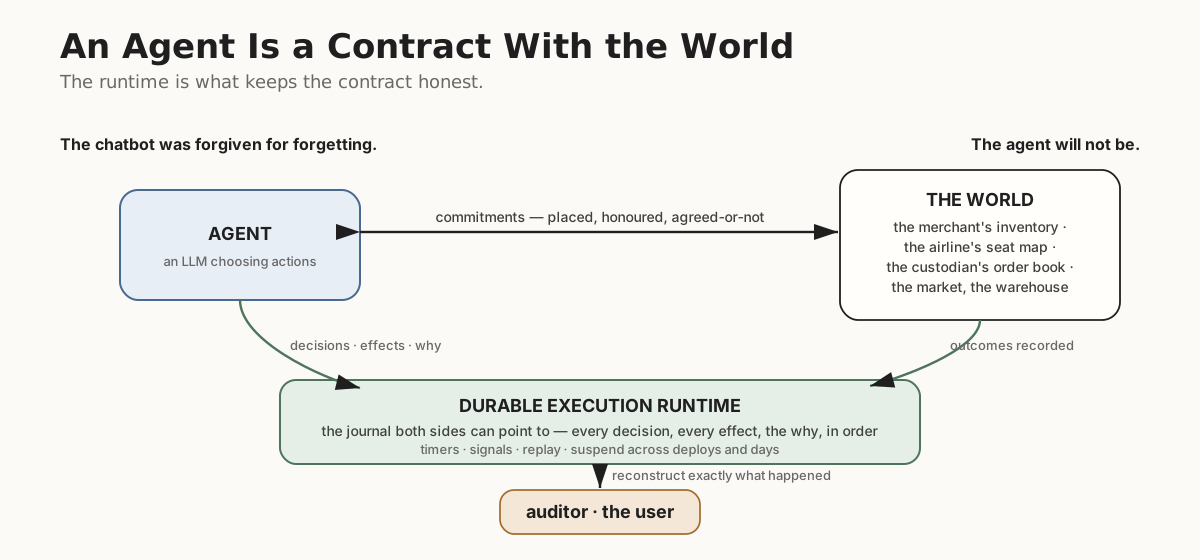
   AGENT ◄─────────────── commitments ───────────────► THE WORLD
   (an LLM            placed · honoured · agreed-or-not    the merchant's inventory ·
    choosing)                                              the airline's seat map ·
       │ decisions · effects · why          outcomes ▲     the custodian's order book
       ▼                                   recorded  │
   ════════════════════════════════════════════════════════════════════════
    DURABLE EXECUTION RUNTIME — the journal both sides can point to
    every decision · every effect · the why · in order · timers · signals · replay
   ════════════════════════════════════════════════════════════════════════
                              │ reconstruct exactly what happened
                              ▼
                      auditor · the user

   The chatbot was forgiven for forgetting.        The agent will not be.
An agent is a contract with the world. The runtime is what keeps the contract honest — the journal is the binding both sides can point to.
8/ The chatbot was forgiven for forgetting. The agent will not be. An agent is a contract with the world. The runtime is what keeps the contract honest.