Live Session Callbacks
Callbacks are how your application reacts to events from the Gemini Live API. The SDK routes events through two lanes with distinct performance contracts, and a third telemetry lane for usage metadata. Understanding the lanes prevents the most common audio-quality and deadlock bugs.
The Two-Lane Model
Section titled “The Two-Lane Model”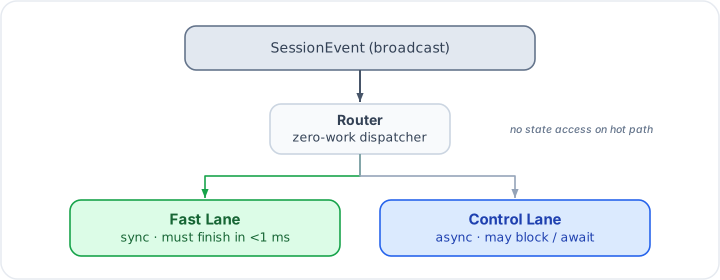
The router receives every incoming WebSocket event and dispatches it to the appropriate lane. It does zero work itself — no state reads, no allocations.
Fast lane callbacks are invoked synchronously on the dispatch thread. They
must complete in under 1 ms. No allocations, no mutex locks, no async work. A
channel try_send is acceptable; a channel send that can block is not.
Control lane callbacks run in a dedicated async task. They may perform I/O,
read shared state, call async functions, or do any other async work. Most
control-lane callbacks have a _concurrent variant that spawns the body as a
detached tokio task instead of blocking the control loop.
Fast-Lane Callbacks (sync, <1 ms)
Section titled “Fast-Lane Callbacks (sync, <1 ms)”Register these with the synchronous closure variants on Live::builder().
| Setter | Signature | Description |
|---|---|---|
.on_audio(f) |
f: Fn(&Bytes) |
Raw PCM audio chunk from the model (PCM16, 24 kHz, mono). Forward to a speaker buffer or channel. |
.on_text(f) |
f: Fn(&str) |
Incremental text delta as the model generates. Suitable for streaming display. |
.on_text_complete(f) |
f: Fn(&str) |
Full accumulated text for the current generation, delivered once per turn boundary. |
.on_input_transcript(f) |
f: Fn(&str, bool) |
ASR transcript of the user’s speech. Second argument is is_final. |
.on_output_transcript(f) |
f: Fn(&str, bool) |
Transcript of the model’s audio output. Second argument is is_final. |
.on_thought(f) |
f: Fn(&str) |
Thought summary chunk. Requires .include_thoughts(). Google AI only. |
.on_vad_start(f) |
f: Fn() |
Server-side VAD detected voice activity start. |
.on_vad_end(f) |
f: Fn() |
Server-side VAD detected voice activity end. |
.on_session_phase(f) |
f: Fn(SessionPhase) |
Wire-level session lifecycle phase changed (connecting, active, disconnecting, etc.) — not the PhaseMachine. Use for lightweight UI state updates. |
.on_usage(f) |
f: Fn(&UsageMetadata) |
Token usage delivered after each generation. Fires on the telemetry lane (not the audio hot path), but shares the sync-only constraint. |
Partial and Final Transcript Semantics
Section titled “Partial and Final Transcript Semantics”The callback signature includes an is_final flag, but the current fast-lane
dispatcher emits input and output transcription fragments with false. It does
not emit a final callback at the turn boundary. A consumer that waits for
true will not collect those turns.
If the application needs a retained transcript, explicitly accumulate fragments and close the record at an appropriate turn boundary. Test interruption and teardown as well as normal completion. Keep bounded buffering off the audio hot path, and apply the redaction limits to the accumulated record before retaining it.
The <1 ms Rule in Practice
Section titled “The <1 ms Rule in Practice”// OK: try_send never blocks.on_audio(|data| { playback_tx.try_send(data.clone()).ok();})
// OK: atomic store.on_vad_start(|| { is_speaking.store(true, Ordering::Relaxed);})
// BAD: blocking send can stall the audio pipeline.on_audio(|data| { blocking_channel.send(data.clone()).unwrap(); // DO NOT DO THIS})
// BAD: async work requires spawning, not direct await.on_text(|text| { // Cannot .await here — the closure is sync database.insert(text).await; // compile error anyway})Fast-lane delivery policy (backpressure)
Section titled “Fast-lane delivery policy (backpressure)”Internally the router forwards fast-lane events over a bounded channel. By default delivery is lossless — if a downstream consumer falls behind, the router awaits, which is the safe default but can stall routing under sustained back-pressure. For voice apps where a dropped frame is better than a stalled pipeline, opt into a lossy policy per event class:
use gemini_adk_rs::live::{Delivery, DeliveryConfig};
Live::builder()    // Convenience setters for the common cases:    .lossy_audio()          // drop newest audio frame instead of stalling    .lossy_transcript()    // …or configure every class explicitly:    .delivery(        DeliveryConfig::default()            .audio(Delivery::LossyDropNewest)            .transcript(Delivery::LossyDropNewest),    )
Delivery::Lossless (the default for every class) is byte-for-byte the historical
behavior. Delivery::LossyDropNewest uses a non-blocking try_send and drops the
newest frame when the channel is full, bumping an internal dropped-frame counter
rather than blocking the router. Control-lane events (tool calls, turn/generation
completion, etc.) are always lossless. Per-class classes are audio, text,
transcript, thought, vad, and phase.
Control-Lane Callbacks (async, may block)
Section titled “Control-Lane Callbacks (async, may block)”These are registered with async-closure variants. The control lane awaits each blocking callback in sequence; concurrent variants are spawned as detached tasks.
Lifecycle Callbacks
Section titled “Lifecycle Callbacks”| Setter | Signature | Description |
|---|---|---|
.on_connected(f) |
f: Fn(Arc<dyn SessionWriter>) -> impl Future |
Fires when the WebSocket setup completes. The SessionWriter can be cloned and stored for sending messages from outside callbacks. |
.on_disconnected(f) |
f: Fn(Option<String>) -> impl Future |
Fires on disconnect. Some(msg) indicates an error close; None is a clean close. |
.on_go_away(f) |
f: Fn(Duration) -> impl Future |
Server sent a GoAway signal with a time-to-disconnect hint. Save state and prepare for reconnect. |
.on_resumed(f) |
f: Fn() -> impl Future |
Fires after a session resumes from a persisted snapshot. Use to re-subscribe to external streams or reset UI state. Requires .persistence(...) on the builder. |
.on_error(f) |
f: Fn(String) -> impl Future |
Non-fatal error from the server or processor. The session continues. |
.on_interrupted(f) |
f: Fn() -> impl Future |
Model output was interrupted by barge-in. Flush your playback buffer here — audio forwarding resumes only after it returns. .on_interrupted_concurrent(f) exists for bookkeeping only (audio resumes without waiting). |
Tool Callbacks
Section titled “Tool Callbacks”| Setter | Signature | Description |
|---|---|---|
.on_tool_call(f) |
f: Fn(Vec<FunctionCall>, State) -> impl Future<Output = Option<Vec<FunctionResponse>>> |
Model requested tool execution. Return None to use auto-dispatch (ToolDispatcher); return Some(responses) to override. Receives the shared session State. Forced blocking — no _concurrent variant (return value is the tool response). |
.on_tool_cancelled(f) |
f: Fn(Vec<String>) -> impl Future |
Server cancelled pending tool calls. Argument is the list of cancelled call IDs. Use to clean up in-flight async work. |
Turn and Generation Callbacks
Section titled “Turn and Generation Callbacks”| Setter | Signature | Description |
|---|---|---|
.on_turn_complete(f) |
f: Fn() -> impl Future |
Turn boundary reached — the model has finished its (possibly truncated) response for this turn. |
.on_generation_complete(f) |
f: Fn() -> impl Future |
Provider emitted GenerationComplete; this does not recover unsent output. |
on_generation_complete vs on_turn_complete
Section titled “on_generation_complete vs on_turn_complete”These two callbacks mark different points in the generation lifecycle:
-
on_generation_completefires on the wireGenerationCompleteevent, when the model has finished generating a turn. Pair it with.extract_on_generation::<T>(llm, "...")to run a structured extractor on the model’s full text as soon as it is generated. An interrupted turn has noGenerationCompleteon current Live models: probed on Gemini 2.5 native audio and Gemini 3.8 Live, the server sendsinterruptedand thenturnComplete. To see everything the model produced, including what the listener never heard, read the partialon_output_transcriptchunks (is_final = false). -
on_turn_completefires at the turn boundary. After an interruption the turn holds only what the listener heard (see what the listener heard). Use this for turn-level bookkeeping: transcript commits, phase evaluation, extractor runs triggered by.extract_turns(), and downstream signals.
What the listener heard
Section titled “What the listener heard”The model streams audio faster than it plays, and its transcript runs further ahead still: measured on the Live API, output transcription arrives up to twice as far into the answer as the audio delivered with it. So when the listener barges in, the model’s transcript holds words they never heard.
On an interruption the runtime cuts the model’s side of the turn to what
was heard. The cut applies to the transcript buffer, the final
on_output_transcript(text, true) and the verbatim check. What was heard
comes from the session’s PlaybackClock (LiveHandle::playback()), which
whatever plays the audio reports to:
- The voice pump,
talk()and the Twilio and SIP bridges report on their own. - A custom player calls
playback().queued(duration)as it hands audio to the speaker, andplayback().flushed()when it drops audio on barge-in. - With no reporter, the cut is at the audio received, which bounds what could have been heard.
Heard audio becomes text through the session’s speaking rate. The rate is calibrated on the session’s uninterrupted turns and is 16 characters a second until then, which matches English on current Live models. The cut ends at the last whole word. A turn with no audio (a text session) is not cut. The model’s own context is unchanged: the Live API keeps what it sent, so the model may believe it finished its sentence.
Live::builder() // Capture full intent even when user interrupts .extract_on_generation::<FullIntent>(llm, "Extract model's intended action") .on_generation_complete(|| async { println!("Generation complete (pre-truncation)"); }) // Normal turn-level work .on_turn_complete(|| async { println!("Turn complete (post-truncation)"); })Extraction Callbacks
Section titled “Extraction Callbacks”| Setter | Signature | Description |
|---|---|---|
.on_extracted(f) |
f: Fn(String, serde_json::Value) -> impl Future |
An out-of-band extractor produced a result. First argument is the schema type name; second is the extracted JSON value. |
.on_extraction_error(f) |
f: Fn(String, String) -> impl Future |
An extractor failed. First argument is the schema type name; second is the error message. By default, extraction failures are logged via tracing::warn!; register this callback for custom handling. |
Outbound Interceptors
Section titled “Outbound Interceptors”These are not event callbacks but pipeline hooks that transform data on its way
out to Gemini. before_tool_response is always blocking (its return value is
the response); on_turn_boundary is blocking by default, with
on_turn_boundary_concurrent for observation-only bodies (the next turn does
not wait for context injected from a detached task).
before_tool_response
Section titled “before_tool_response”Intercept tool responses before they are sent back to the model. Use this to augment responses with conversation context, filter sensitive fields, or normalize formats.
.before_tool_response(|responses, state| async move { let customer: Option<String> = state.get("customer_name"); responses.into_iter().map(|mut r| { if let Some(name) = &customer { r.response["customer"] = serde_json::json!(name); } r }).collect()})on_turn_boundary
Section titled “on_turn_boundary”Called at turn boundaries after extractors run but before on_turn_complete.
Receives the shared State and a SessionWriter for injecting content into
the conversation. Use for context stuffing, K/V injection, or condensed state
summaries.
.on_turn_boundary(|state, writer| async move { let summary = state.get::<String>("session_summary").unwrap_or_default(); if !summary.is_empty() { writer.send_client_content( Content::user().text(format!("[Background context: {summary}]")), false, ).await.ok(); }})Instruction Interceptors
Section titled “Instruction Interceptors”These sync callbacks allow state-reactive instruction updates without requiring an async round-trip:
instruction_template(onLive::builder()via the phases module): called after extractors on eachTurnComplete; returnsSome(instruction)to fully replace the current system instruction, orNoneto leave it unchanged.instruction_amendment: additive alternative — returnsSome(text)to append to the phase instruction. Unlikeinstruction_template, you never need to repeat the base instruction text.
Both are sync closures (Fn(&State) -> Option<String>).
Callback Execution Modes
Section titled “Callback Execution Modes”Control-lane callbacks default to Blocking — the event loop awaits each
callback before processing the next event. Use _concurrent variants for
fire-and-forget work.
// Blocking (default) — ordering guarantee: turn_complete fires after// all in-turn processing completes.on_turn_complete(|| async {    metrics_tx.send(TurnComplete).await.ok();})
// Concurrent — detached task, event loop continues immediately.on_extracted_concurrent(|name, value| async move {    db.upsert_extraction(&name, value).await.ok();})
.on_error_concurrent(|msg| async move {    alerting::send_slack(&msg).await;})
.on_disconnected_concurrent(|reason| async move {    tracing::info!(?reason, "session disconnected");})
Forced-Blocking Callbacks
Section titled “Forced-Blocking Callbacks”Some callbacks cannot be made concurrent because the event loop depends on their return value or side effects:
| Callback | Reason |
|---|---|
on_interrupted |
Must clear the interrupted state before audio resumes |
on_tool_call |
Returns the tool responses to the model |
before_tool_response |
Transforms the response pipeline |
on_turn_boundary |
Content injection must complete before on_turn_complete |
Middleware Tool Hooks
Section titled “Middleware Tool Hooks”For tool-level audit logging or retry logic, register middleware via
Live::middleware(layer). The Middleware trait provides
before_tool / after_tool / on_tool_error hooks in addition to
agent-level before_agent / after_agent. See the
Middleware chapter for details.
Worked Example
Section titled “Worked Example”A representative session wiring a cross-section of callbacks:
use gemini_adk_fluent_rs::prelude::*;use std::sync::atomic::{AtomicBool, Ordering};use std::sync::Arc;
let is_speaking = Arc::new(AtomicBool::new(false));let is_speaking2 = is_speaking.clone();
let handle = Live::builder()    .voice(Voice::Kore)    .instruction("You are a customer service agent.")    .transcription()    .greeting("Welcome! How can I help you today?")
    // Fast lane: audio forwarded via lock-free channel    .on_audio(move |data| {        playback_tx.try_send(data.clone()).ok();    })
    // Fast lane: transcription fragments (not a persistence callback)    .on_input_transcript(|_text, _is_final| {        // Forward to the application's bounded transcript collector.    })    .on_output_transcript(|_text, _is_final| {        // Close accumulated records at a tested turn boundary.    })
    // Fast lane: VAD signals for UI    .on_vad_start(move || { is_speaking2.store(true, Ordering::Relaxed); })    .on_vad_end(move || { is_speaking.store(false, Ordering::Relaxed); })
    // Fast lane: token usage    .on_usage(|usage| {        if let Some(total) = usage.total_token_count {            println!("Total tokens used: {total}");        }    })
    // Control lane: flush playback on barge-in (forced blocking)    .on_interrupted(|| async move {        playback.flush().await;    })
    // Control lane: tool dispatch — None means auto-dispatch via ToolDispatcher    .on_tool_call(|calls, _state| async move { None })
    // Control lane: clean up cancelled async tool work    .on_tool_cancelled(|ids| async move {        for id in ids {            tracing::warn!("Tool call {id} was cancelled");        }    })
    // Control lane: turn-level bookkeeping (blocking)    .on_turn_complete(|| async {        tracing::debug!("turn complete");    })
    // Control lane: capture full intent before truncation    .on_generation_complete(|| async {        tracing::debug!("generation complete (pre-truncation)");    })
    // Control lane: log extractions concurrently (fire-and-forget)    .on_extracted_concurrent(|name, value| async move {        tracing::info!(%name, %value, "extraction result");    })
    // Control lane: log disconnects concurrently    .on_disconnected_concurrent(|reason| async move {        tracing::info!(?reason, "session disconnected");    })
    .connect_from_env()    .await?;
Related Chapters
Section titled “Related Chapters”- Authentication and Connecting — credential resolution and connection methods
- Live Sessions — full session configuration and the
runtime
LiveHandleAPI - Extraction Pipeline — structured turn-by-turn extraction
with
on_extracted - Middleware — tool-level hooks via
Live::middleware()